Short answer: Boomerang (also searched as Boomerang SCADA, Boomerang by Oilfield Monitor, and boomscada) is a Houston oilfield monitoring platform built for high-frequency SCADA and remote control of artificial lift. That is the right tool when the site already has controllers and you need to change parameters from town. On conventional wells where SCADA never penciled, most producers just need to see tanks, pressures and runtime. TinyPumper gives you that view on one gateway, for one flat rate per site, and your team installs it in 8 minutes.
It is 2 a.m. on a lease 40 miles from the yard. The compressor quit at midnight and the water tank is climbing. Full SCADA would tell you, and so would a monitor that cost a fraction as much. The question is how much system the lease actually needs.
Is Boomerang or TinyPumper the Better Fit for My Leases?
It depends on whether you need to control the site or just see it. If you already have VSDs, PLCs and lift controllers wired up, and you want every-second data plus remote start, stop and speed changes, Boomerang oilfield monitoring is built for that job. If you need tanks, pressures and runtime on conventional wells without a SCADA project, TinyPumper is the better fit. As of November 2026 it costs $349 a sensor, one time setup, plus one flat monthly rate per site. If you need a full controls team and audit trails across a basin, neither one replaces a SCADA integrator.
What Is Boomerang Oilfield Monitoring?
Boomerang is an oil and gas SCADA product from Oilfield Monitor in Houston. People also type boomerang oilfield, boomerang oil, boomerang oil field, and Boomerang by Oilfield Monitor. Same company. The Boomerang monitoring app and boomscada site are that product, not the email plugin or the cartoon channel.
Its public materials (Moxa case study, 2024, and the founder interview on Oil and Gas Startups) describe Moxa industrial gateways in the field, a small edge box they call a Boombox, and software for monitoring and control of rod pump, ESP, gas lift and plunger. The Moxa write-up cites a typical install base around 3,000 gateways on 3,500 to 4,000 wells. Treat those as vendor-reported.
This page is a TinyPumper comparison. It is not affiliated with Oilfield Monitor.
What Does Boomerang Do Well?
- It is built for lift control. The pitch is high-frequency reads and the ability to change equipment from town, not a pumper gauge sheet.
- Harsh-site hardware. The Moxa case study puts the gateways at about -40°F to 120°F with vibration typical of oilfield sites.
- Fast commissioning when the site is already instrumented. That same write-up cites an end user deploying more than 20 devices per day when there is already something to connect to.
- A real install base. The founder interview talks about Boomboxes already in the field. Ask them for a current count.
How Does TinyPumper Compare?
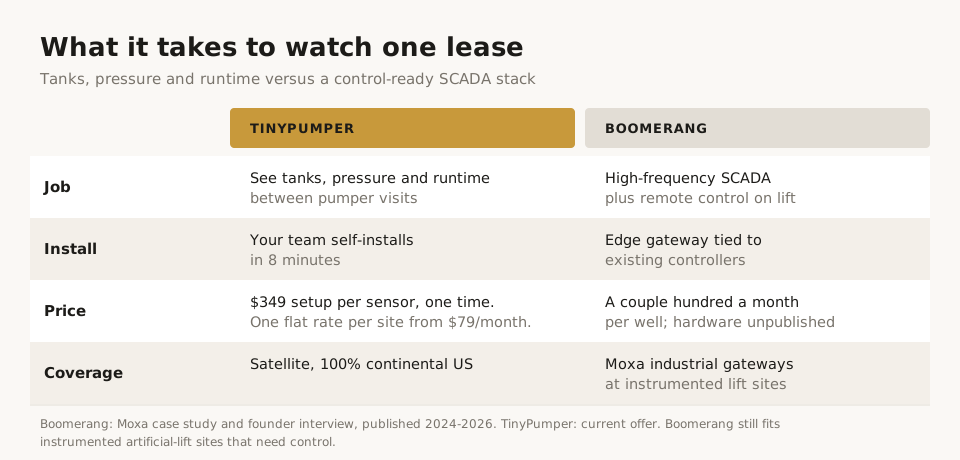
| Boomerang | TinyPumper | |
|---|---|---|
| Built for | SCADA and control on artificial lift | Tanks, pressures and runtime on conventional sites |
| Field gear | Moxa gateway plus Boombox tied into existing controllers | Solar gateway plus radar and pressure sensors, up to 8 sensors |
| Install | Commissioning on instrumented sites; not a strap-on sensor | Your team self-installs in 8 minutes |
| Price | Interview: a couple hundred a month per well; hardware unpublished | $349 setup per sensor, one time, then one flat rate per site |
| Coverage | Wireless backhaul on industrial gateways | Satellite, 100% continental US |
| Control | Yes: start, stop, speed, valves | No. It watches. It does not shut in a well |
When Is TinyPumper the Better Fit?
- SCADA never penciled on these wells. TinyPumper gives you roughly 99% of SCADA’s upside without the panel, the integrator and the per-point bill.
- Your old SCADA is aging and the upkeep is eating you. Swap sites to TinyPumper one at a time.
- You want to know the minute something goes wrong. Sensors report every hour and check your thresholds every 5 minutes.
- You don’t want a bill per point. One flat monthly rate per site covers every sensor at that location.
- You have no power and no signal. The gateway runs on solar, and satellite covers 100% of the continental US.
Producers running TinyPumper report cutting lease runs by 30 to 50 percent and catching failures days sooner. It works the same at 50 wells or 5,000. The dividing line is the cost of SCADA per site, not the size of the company. See the full picture in our oilfield monitoring alternatives guide.
Tanks, pressures and runtime on one gateway. $349 a sensor, one-time setup, then one flat rate a month per site. 60-day money-back.
See TinyPumperThe Amateur vs. the Pro
| The Amateur | The Pro |
|---|---|
| Buys Boomerang SCADA because the demo showed a live ESP speed change, then parks it on a stripper battery with no VSD | Asks whether this lease needs control or sight, then picks Boomerang for instrumented lift and TinyPumper for tanks, pressure and runtime |
| Treats “boomerang monitoring oil and gas” and the email plugin as the same search | Names Oilfield Monitor in Houston, boomscada, and the Boomerang monitoring app as one oilfield product |
| Pays per well for control loops he never uses | Counts points on the battery, then prices TinyPumper at $349 setup per sensor and one flat site rate from $79/month |
What to Avoid
- Buying control you will not use. If nobody will change a setpoint from town, Boomerang’s closed-loop story is extra stack.
- Skipping the backhaul question. Ask Oilfield Monitor how a Boombox talks when the existing modem is dead.
- Ignoring the 60-day TinyPumper trial. If sight is the job, you can prove it on one lease before you roll a basin.
TinyPumper at a Glance
TinyPumper is 24/7 remote well monitoring for oil and gas producers. It has 100% continental US coverage, because we use satellite. It connects up to 8 sensors per gateway. It comes with a 60-day money-back guarantee. It carries lifetime replacement on all equipment, every sensor included. It is rated Class I Div 1 and IP67, and works from -40 to 158°F. TinyPumper is Greasebook’s sister product, and every well with a TinyPumper sensor gets free Greasebook.
Who This Page Is Not For
This page is not for producers who need remote control of instrumented artificial lift, and it is not for automation teams already happy with a Boomerang stack. If you are shopping the whole field, see oilfield monitoring alternatives and oil and gas SCADA.
Frequently Asked Questions
What is Boomerang oilfield monitoring?
Boomerang is oil and gas SCADA from Oilfield Monitor in Houston. It uses industrial edge gateways and a Boombox to read artificial-lift sites at high frequency and, where you allow it, to change equipment from town. Searchers also type boomerang scada, boomscada, boomerang oilfield monitor, and boomerang monitoring app. Those names point at this product, not the email plugin or the cartoon channel.
What is the best Boomerang alternative for oil and gas?
If you need remote control of instrumented lift, another full SCADA platform is the alternative. If you need to see tank levels, pressures and runtime on conventional wells, TinyPumper is the better fit. It watches all three on one gateway, your team self-installs it in 8 minutes, and it costs $349 a sensor, one-time setup, then one flat monthly rate per site.
Does TinyPumper control wells like Boomerang SCADA?
No. TinyPumper watches; it does not control. It will not shut in a well or change a setpoint. It reports tank levels, pressures and engine or compressor runtime every hour, checks your thresholds every 5 minutes, and sends an alert the moment something crosses a line. For most conventional leases, that covers what producers actually need from SCADA.
How is TinyPumper priced compared with Boomerang?
Boomerang does not publish a rate card. The founder interview described a couple hundred dollars a month, charged per well per month, with hardware sold as a Boombox and modem package. TinyPumper is $349 a sensor, one-time setup, then one flat rate a month per site, unlimited sensors at that site. Every order comes with a 60-day money-back guarantee.
Is Boomerang the same as the email plugin or the cartoon channel?
No. Boomerang oilfield monitoring is a Houston SCADA product from Oilfield Monitor. The Gmail plugin, the cartoon channel, the movie and the toys share the name and nothing else. If you searched boomerang oil and gas, boomerang oilfield, or boomscada, you are in the right place.
Can I use the Boomerang monitoring app without SCADA experience?
Boomerang’s materials talk about low-code setup, but the real install still maps tags, serial connections and control limits. That work usually lands on a SCADA tech or a production engineer with controls support. TinyPumper is the other end of that spectrum: if you can change a lightbulb, you can install it in 8 minutes.