Published November 11, 2026 · Updated November 11, 2026
Short answer: ABB Wellhead Manager (sold as ABB Ability Wellhead Manager, and often called ABB Totalflow Wellhead Manager) is a cloud SCADA host for oil and gas wells. It pulls data from flow computers, RTUs and PLCs you already have in the field. If your wells don’t have that gear, Wellhead Manager has nothing to read. TinyPumper is the alternative for those wells: radar tank sensors, pressure sensors and runtime monitoring that your team self-installs in 8 minutes, for one flat rate per site.
It’s 1 a.m. and the compressor on your best lease just quit. Nobody has wired that site for SCADA because the numbers never worked. You find out when the pumper rolls up at eight. That is the gap this page is about.
Is ABB Wellhead Manager or TinyPumper the Better Fit for My Wells?
It depends on what is already on the lease. If your wells already run flow computers, RTUs or PLCs and someone on staff keeps them talking, ABB Wellhead Manager puts that SCADA and meter data in the cloud. If the wells never got automation because the numbers never worked, TinyPumper watches tanks, pressures and runtime with nothing to wire. As of November 2026, it is $349 a sensor, one-time setup, then one flat monthly rate per site. If you need to shut in or adjust wells remotely, TinyPumper only watches, so SCADA stays the pick.
What Is ABB Wellhead Manager?
ABB Wellhead Manager is a subscription cloud SCADA and analytics platform for onshore oil and gas wells, built by ABB, the industrial automation company. ABB’s 2021 brochure calls it a “cloud-based vendor agnostic SCADA Host” running on Microsoft Azure. Its polling engine collects data from PLCs, electronic flow computers and artificial lift controllers, then gives you alarms, dashboards, trends and remote commands.
It is not a sensor and it is not a box you bolt to a tank. It is the software layer that sits on top of field automation. That is the most important thing to understand before you compare it to anything.
What Does ABB Wellhead Manager Do Well?
We are not going to knock a product for doing what it says. Wellhead Manager is strong at real SCADA work:
- Monitoring and control together. It sends remote commands to field devices, which a watch-only system can’t do (ABB Wellhead Manager brochure, 2021).
- Metering depth. ABB says its measurement app collects daily and hourly flow records, meter configuration, gas analysis and meter alarms, tracks calibration schedules, and exports CFX files (ABB Wellhead Manager brochure, 2021).
- Works with many brands. The polling engine is built to read most major hardware makers, not just ABB’s (ABB Wellhead Manager brochure, 2021).
- A big hardware base behind it. ABB says it has over 300,000 flow computers and RTUs installed in oil and gas worldwide (ABB upstream onshore measurement brochure, accessed November 2026).
If your measurement team lives in EFM data and your wells already report through RTUs, that is a real advantage.
Where Does It Stop for a Conventional Producer?
Wellhead Manager needs something in the field to read. On most conventional wells, that something was never bought. To use it there, you first put in:
- Flow computers, RTUs or PLCs at each site.
- Power for them: battery and solar, or a line.
- Radios or another way to get the data off the lease.
- Somebody to map tags, set polling schedules and build alarms.
ABB’s own Totalflow manual is written for an “experienced flow meter technician,” and setup runs from a laptop with ABB’s PCCU32 software. If you’ve ever said, “Nobody on our payroll knows how to program an RTU,” that line tells you who this stack is built for.
ABB doesn’t publish what any of it costs. Wellhead Manager is “a subscription service,” with no number given (ABB press release, March 2019; no price found as of November 2026). For a sense of setup time on ABB’s packaged SCADA host, its SCADAvantage datasheet says install, configuration and basic training “normally” take 3 to 5 days (ABB SCADAvantage datasheet, accessed November 2026). That is a different ABB product, but it shows SCADA work is measured in days, not minutes.
That is the honest reason a lot of producers say, “The SCADA quote never penciled on these wells.” On a well making a few barrels a day, the field gear and the integrator cost more than the well returns.
Public complaints we found were about the Totalflow hardware side, not Wellhead Manager itself. One newcomer on Reddit’s r/PLC said replacement PCCU cables run “$250 or more” (Reddit r/PLC, October 2024). Another wrote, “ABB support is horrible” (Reddit r/PLC, June 2025). Weigh those as single voices, not a verdict.
How Does TinyPumper Compare?
| ABB Wellhead Manager | TinyPumper | |
|---|---|---|
| What it is | Cloud SCADA host and analytics software | Sensors, a solar gateway and the app, shipped ready to go |
| What it watches | Whatever your PLCs, flow computers and lift controllers report | Tank levels, pressures (wellhead, flowline, injection) and engine or compressor runtime |
| Field gear needed | Flow computers, RTUs or PLCs, power and comms you buy separately | None beyond TinyPumper; the radar sensor sits on top of the tank |
| Who sets it up | Measurement and SCADA techs, per ABB’s manuals | Your own team self-installs in 8 minutes, no electrician |
| Control | Yes, remote commands to field devices | No. It watches and alerts; it does not shut in or adjust wells |
| Coverage | Depends on the comms you install | 100% continental US coverage, because we use satellite |
| Pricing | Subscription, price not published (ABB, checked November 2026) | $349 a sensor, one-time setup, then one flat rate a month per site, unlimited sensors |
| If it breaks | Ask the vendor | Lifetime replacement on all equipment |
| Trial | Ask the vendor | 60-day money-back, we pay return shipping |
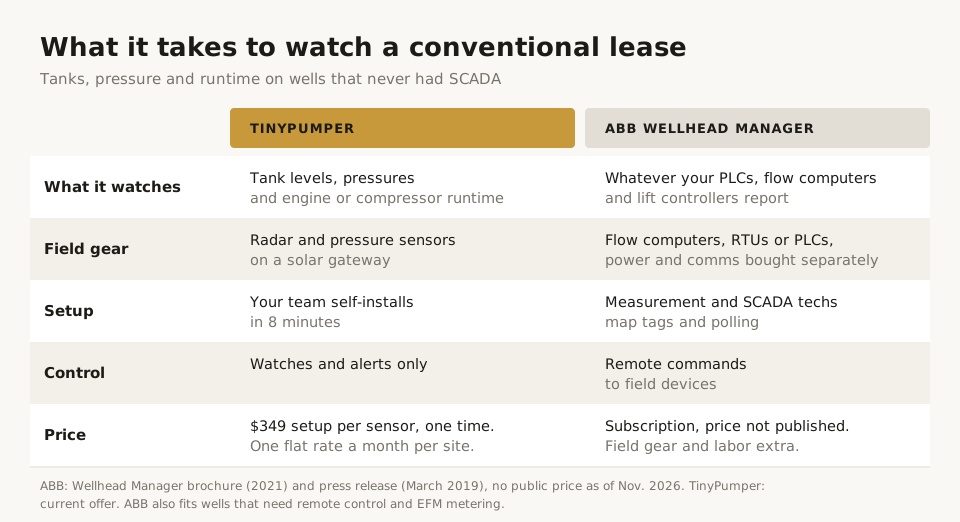
Where a cell in the ABB column says “ask the vendor” or “not published,” that is because ABB’s public pages don’t say. Ask them directly before you sign.
When Is TinyPumper the Better Fit?
- The wells were never automated. You get roughly 99% of SCADA’s upside at about 95% less cost, with no RTUs, trenching or radio survey.
- You want answers, not a project. A producer who says, “I just need to know if the compressor’s running before the pumper drives out there,” wants a phone alert, not a tag map. The gateway’s built-in shake counter tells you an engine or compressor stopped, and sensors check thresholds every 5 minutes so the alarm goes out right away.
- You have dead zones. Satellite covers 100% of the continental US.
- You want one price per site. Add another tank or a pressure sensor at the same site and the monthly rate doesn’t change.
Producers running TinyPumper report cutting lease runs by 30 to 50 percent and catching failures days sooner. For the whole-lease picture, see our oil well monitoring systems guide and oilfield tank monitoring.
TinyPumper is GreaseBook’s sister product. It has 100% continental US coverage, because we use satellite. Each gateway connects up to 8 sensors. Hardware is Class I Div 1 certified and IP67-rated, and pressure sensors read up to 10,000 PSI. Every order carries a 60-day money-back guarantee, and all equipment has lifetime replacement. Every well with a TinyPumper sensor gets free Greasebook.
Tanks, pressures and runtime on one gateway. $349 a sensor, one-time setup, then one flat rate a month per site. 60-day money-back.
See TinyPumperWhen Is ABB Wellhead Manager the Better Fit?
If you need to control wells from the office, Wellhead Manager does that and TinyPumper does not. If your measurement team already runs ABB Totalflow flow computers and needs EFM records, calibration tracking and CFX exports in one place, Wellhead Manager is built for that job.
Plenty of producers run both kinds of wells. Keep SCADA on the big, instrumented wells and put TinyPumper on the rest. GreaseBook integrates with SCADA, so field data, sensor data and SCADA data can land on one screen. For more on where SCADA fits, see oil and gas SCADA.
Who This Page Is Not For
This page is not for producers who need to shut in or adjust wells remotely, and it is not for teams already running Totalflow flow computers across their wells with staff to maintain them. For the full field of options, see oilfield monitoring alternatives.
Frequently Asked Questions
What is ABB Wellhead Manager?
ABB Wellhead Manager is a cloud SCADA and analytics subscription from ABB for onshore oil and gas wells. It runs on Microsoft Azure and reads data from PLCs, flow computers and artificial lift controllers already in the field, then gives you alarms, dashboards, trends, metering reports and remote commands. It is software only, so the field automation underneath it has to be bought and installed separately.
Is ABB Totalflow Wellhead Manager the same as ABB Ability Wellhead Manager?
Yes, people mean the same product. ABB markets it as ABB Ability Wellhead Manager. Many producers call it ABB Totalflow Wellhead Manager because it is often paired with ABB’s Totalflow flow computers and RTUs. The software itself is built to read many hardware brands, not only Totalflow, so you don’t need Totalflow gear to use it.
How much does ABB Wellhead Manager cost?
ABB doesn’t publish a price. Its March 2019 press release calls Wellhead Manager a subscription service, and we found no public per-well or per-site rate as of November 2026. Budget for the field gear too: flow computers or RTUs, power, comms and the labor to set them up. Ask ABB for a written quote that covers all of it.
What is the best ABB Wellhead Manager alternative for oil and gas?
It depends on your wells. If they already run SCADA and you need control, stay with SCADA. If they were never automated because the cost never paid back, TinyPumper is the alternative. It watches tanks, pressures and runtime on one gateway, your team self-installs it in 8 minutes, and it costs $349 a sensor, one-time setup, then one flat rate a month per site.
Does TinyPumper need power or wiring at the wellsite?
No. The gateway is solar powered and the radar tank sensor talks to it over Bluetooth, so nothing gets wired to the tank. There is no trench to dig and no electrician to schedule. Readings reach your phone over satellite, which covers 100% of the continental US. If any device ever fails, lifetime replacement covers it.