Published November 10, 2026 · Updated November 10, 2026
Short answer: Sentry Technologies sells simple alarm hardware for oil and gas equipment. Its Watchdog ST watches a few alarm points, like a Murphy switch gauge, and sends an alert over satellite when one trips. If an alarm is all you need, it does that job. If you also need tank levels, pressures and compressor runtime hour by hour, plus a production record of what the lease made, you need a whole-site monitor. TinyPumper watches all of it on one solar gateway, and your team installs it in 8 minutes.
An alarm tells you something broke. It doesn’t tell you what you lost, or what was creeping toward trouble all week. That gap is what this page is about.
Is Sentry Technologies or TinyPumper the Better Fit for My Lease?
It depends on what you need from the lease. If you only need a satellite call when a Murphy switch trips, and you already keep production records somewhere else, Sentry’s Watchdog ST can be the simpler buy. If you also want tank levels, pressures and runtime reported every hour, with the readings landing in your production records, TinyPumper fits better. As of November 2026, TinyPumper is $349 a sensor, one-time setup, then one flat rate a month per site, unlimited sensors. If you need full SCADA control of instrumented facilities, neither one is the right pick.
What Is Sentry Technologies?
Sentry Technologies is a remote monitoring and alarm company for oil and gas field equipment, at sentryti.com. It markets itself to producers who need alarms on compressors, tanks, separators and pipelines 24 hours a day. Its best-known product is the Watchdog ST, a battery-powered unit that watches 4 alarm setpoints and sends alerts by satellite (Sentry Watchdog ST page, September 2024). Its tagline is “Keep it simple. Keep it Sentry.”
What Sentry Technologies Is Not
The name is crowded, so here is who this page is not about.
If you typed “what is Sentry” or searched Sentry io, you probably found Sentry.io. That is a software error tracker that app developers use, with its own Sentry log tools and a Sentry/React package. It has nothing to do with oil wells.
The same goes for searches about a self-hosted Sentry, Sentry pricing for developer teams, or an open source Sentry alternative. Those comparisons, including GlitchTip vs Sentry, are about software, not leases.
Search Sentry Technologies Inc. and you will also find a drone-detection company and an assisted-living technology company. Searches for Sentry technology solutions turn up IT and security firms too. None of them sell oilfield monitors.
This page compares the oilfield company with TinyPumper. For every monitoring option in one place, see our oilfield monitoring alternatives guide.
What Does Sentry Do Well?
Credit where it’s due. Sentry built a focused alarm, and that focus has real value.
- It stays simple. A few alarm points and an alert to your phone. No platform to learn.
- It reaches remote leases. Alerts go out over one-way satellite, in any weather (Sentry Watchdog ST page, September 2024).
- No solar to mount on the alarm unit. The Watchdog ST runs on batteries.
- It works with what’s already there. Sentry calls a Murphy switch gauge a perfect fit. If you’ve heard a pumper say “I already have a Murphy switch on it,” that is the buyer Sentry built for.
- It has a step up. Its SOLARPack 410 can add traditional SCADA communication later (SOLARPack 410 manual).
Where Does an Alarm Stop?
The Watchdog ST answers one question: did a switch trip? On most leases the costly surprises sit between “fine” and “tripped”:
- Trends. Casing pressure climbing all week. A tank filling faster than it should. An alarm stays silent until the line is crossed.
- Point count. 4 setpoints per unit (Sentry Watchdog ST page, September 2024) covers a compressor and a tank. A tank battery with several tanks and pressures needs more units or a bigger system.
- Install scope on the bigger system. The SOLARPack 410 manual lists a mounting pole, antenna, solar panel and wiring, batteries, and software setup. That is a field integration job, not a quick swap.
- Production records. Sentry’s site describes alerts, not gauges, run tickets or a record of what each well made. “The alarm told me it broke, not what I lost” is the problem that leaves behind.
That leaves you running two systems: alarms in one place, production numbers in a spreadsheet. Somebody has to tie them together.
How Does TinyPumper Compare?
| Sentry Watchdog ST | TinyPumper | |
|---|---|---|
| What it watches | 4 alarm setpoints on dry-contact switches like a Murphy gauge (Sentry Watchdog ST page, September 2024) | Tank levels, pressures (wellhead, flowline, injection) and engine or compressor runtime, up to 8 sensors per gateway |
| What you see | An alert when a setpoint trips | Hourly readings, with thresholds checked every 5 minutes and an alert right away |
| Power | Batteries, no solar (Sentry Watchdog ST page, September 2024) | Solar-powered gateway, no wiring |
| Coverage | One-way satellite alerts (Sentry Watchdog ST page, September 2024) | 100% continental US coverage, because we use satellite |
| Install | “Install in minutes,” per Sentry; the SOLARPack 410 adds a pole, antenna, solar panel, batteries and software setup (SOLARPack 410 manual) | Your team self-installs in 8 minutes |
| Production records | Not described on its site | Readings flow into GreaseBook. Every well with a TinyPumper sensor gets free Greasebook. |
| Pricing | Not published on its site (November 2026) | $349 a sensor, one-time setup, then one flat rate a month per site, unlimited sensors |
| If it breaks | Ask the vendor | Lifetime hardware replacement |
| Trial | Ask the vendor | 60-day money-back, we pay return shipping |
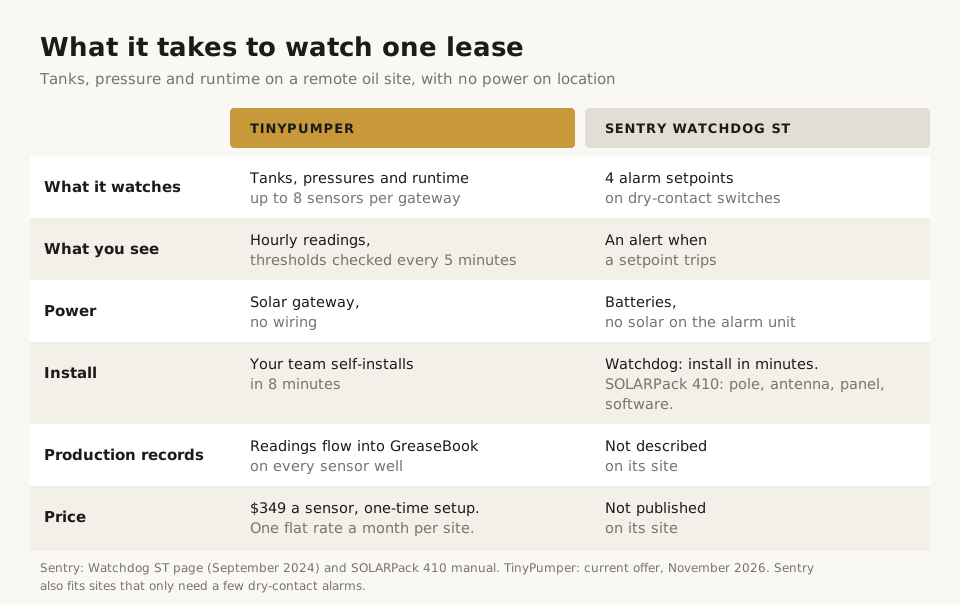
Where the Sentry column says “not published” or “ask the vendor,” its public site doesn’t say. Get the answer from Sentry in writing before you buy.
When Is TinyPumper the Better Fit?
- You want the whole site, not one switch. Tanks, pressures and runtime on the same gateway.
- You want to see trouble coming. Hourly readings show the pressure creeping, not just the moment it trips. The radar tank sensor mounts on top and never touches the fluid.
- You’re tired of hearing “the compressor went down Saturday and nobody knew till Monday.” The gateway’s shake counter tracks runtime, and the alert reaches your phone right away.
- You want one price per site. Add a tank or a pressure sensor to the same site and the monthly rate doesn’t change.
- You want readings in your production records. Sensor data flows into the GreaseBook dashboard next to your pumpers’ gauges.
Producers running TinyPumper report cutting lease runs by 30 to 50 percent and catching failures days sooner.
TinyPumper watches tanks, pressures and runtime on one gateway. $349 a sensor, one-time setup, then one flat rate a month per site. 60-day money-back.
See TinyPumperWhen Is Sentry the Better Fit?
If you have a few legacy dry-contact switches, you already keep production records somewhere else, and all you want is a phone alert when one trips, Sentry’s Watchdog ST is a fair, simple buy. If you need full control of instrumented facilities, neither product is the answer; you’re shopping for SCADA.
TinyPumper at a Glance
TinyPumper is a remote monitoring system for oil and gas producers. It has 100% continental US coverage, because we use satellite. It connects up to 8 sensors per gateway. Every order carries a 60-day money-back guarantee. There is lifetime replacement on all equipment. TinyPumper is GreaseBook’s sister product.
Who This Page Is Not For
This page is not for producers who only need a few dry-contact alarms and already have their production records handled. It is not for producers who need full SCADA control. It is not for software teams comparing Sentry.io. If you’re weighing tank-only gauges, see our Tank Sentinel alternative and TankScan alternative pages, or start at the oilfield monitoring alternatives guide.
Frequently Asked Questions
What is Sentry Technologies?
Sentry Technologies, at sentryti.com, is a remote monitoring and alarm company for oil and gas field equipment. Its best-known product, the Watchdog ST, watches a small number of alarm points such as a Murphy switch gauge and sends an alert over satellite when something trips. It is not Sentry.io, the developer error tracker, and not the drone-detection or assisted-living companies that share the name.
What are some good alternatives to Sentry?
For oilfield alarms and monitoring, the main alternatives are tank-only gauges like Tank Sentinel and TankScan, full SCADA systems, and whole-site monitors like TinyPumper. TinyPumper watches tanks, pressures and engine or compressor runtime on one solar gateway, reports every hour, and checks thresholds every 5 minutes. If you meant Sentry.io, the alternatives are developer tools that fall outside oil and gas.
Who are Sentry’s competitors?
In oilfield monitoring, Sentry Technologies competes with tank-gauge makers, SCADA vendors and right-sized site monitors such as TinyPumper. Which one fits depends on how much of the lease you need to see. A single dry-contact alarm is Sentry’s home turf. Tanks, pressures and runtime on one screen, tied to your production records, is where TinyPumper fits.
Is there a free version of Sentry?
Sentry Technologies does not publish a free plan or any pricing on its site as of November 2026, so you need a quote. Questions about a free Sentry tier usually mean Sentry.io, the software error tracker, which is a different company; check its own pricing page. TinyPumper has no free tier, but every order carries a 60-day money-back guarantee and we pay the return shipping.
Is Sentry a monitoring tool?
Yes. Sentry Technologies sells monitoring and alarm hardware for oil and gas equipment like compressors, tanks, separators and pipelines. Its Watchdog ST is built to tell you something is wrong, not to keep a record of what the well made. Sentry.io is also a monitoring tool, but it watches software code for errors, not oilfield equipment.
What are the key differences between Sentry and New Relic?
Sentry.io and New Relic are both software monitoring tools that developers use to track errors and app performance. Neither one watches a tank, a casing pressure or a compressor. If you are a producer comparing oilfield monitors, the comparison that matters is Sentry Technologies against tank gauges, SCADA and whole-site monitors like TinyPumper, which this page covers.
Is Sentry an AI company?
Sentry Technologies, the oilfield company, describes its products as alarms and monitoring hardware, and its public pages make no artificial intelligence claims as of November 2026. Its Watchdog ST is deliberately simple: a few alarm points and a satellite alert. If you meant Sentry.io, the software company, check its own site, since it works in a different field entirely.
Is Sentry.io a tracker?
Sentry.io is an error tracker for software. Developers add it to their apps, including through packages like Sentry/React, to log crashes and slowdowns. Some teams run a self-hosted Sentry or an open source alternative like GlitchTip. None of that applies to oil wells. For tracking tanks, pressures and runtime on a lease, look at oilfield monitors like Sentry Technologies or TinyPumper.
How many employees does Sentry.io have?
We don’t track headcount for Sentry.io, a software company outside oil and gas, so check its own site or a business directory. If you are sizing up Sentry Technologies, the oilfield alarm company, the questions that matter more are who answers the phone when an alarm misfires, how fast a failed unit gets replaced, and whether the price is in writing.
What products does Sentry Technologies sell?
Sentry Technologies lists the Watchdog ST alarm, the SOLARPack 410, Accutech Wireless Sensors and Digital Tank Level systems as its core products (Sentry products page, 2025). The Watchdog ST is the simple satellite alarm. The SOLARPack 410 is a solar-powered field unit with a path up to host-based SCADA, and it takes a pole, antenna, panel and software setup to install.
Are there reviews or Reddit threads on Sentry Technologies alternatives?
We found no public reviews or Reddit threads from producers about Sentry Technologies’ oilfield products as of November 2026. Most Sentry reviews online are about Sentry.io, the developer tool. Before you buy any oilfield monitor, ask the vendor for two producers running it on leases like yours, and call them. TinyPumper’s 60-day money-back guarantee lets you judge it on your own lease.