Published November 10, 2026 · Updated November 10, 2026
Short answer: PetroPower is a Wichita, Kansas company whose Well IQ system bundles field hardware, hosted software and ongoing support to monitor and control upstream production sites. If you need H2S detection, remote shutdown or a vendor crew to install and maintain it all, PetroPower fits that job. If you need to see tank levels, pressures and compressor runtime on leases with no power, without a controls project, TinyPumper is the better PetroPower alternative. Your team self-installs it in 8 minutes, and one flat rate covers each site.
Here is how it usually starts. You’ve got SCADA on two good wells, and the rest of the field runs blind between pumper visits. Somebody quotes you a monitoring system, and the first question back is “who’s going to babysit the panel?” That is the gap this page is about.
Is PetroPower or TinyPumper the Better Fit for My Lease?
It depends on what the site needs. If you need H2S detection, remote shutdown or a vendor crew to install and maintain everything, PetroPower’s Well IQ fits. If you need tanks, pressures and runtime watched on leases with no power, and your own pumper can install it, TinyPumper fits. As of November 2026, TinyPumper costs $349 a sensor, one-time setup, then one flat rate per site from $79 a month. Need full control of instrumented facilities? Look at oil and gas SCADA.
What Is PetroPower?
PetroPower (also written Petro Power) is a remote monitoring and control company based in Wichita, Kansas. It sells two main products: Well IQ, its full-service monitoring and control system, and T-Rex, a pump optimization product. PetroPower says it was founded in 2009 and serves 14 states (PetroPower “Why PetroPower” page, 2026).
Its own pitch is “remote monitoring and control for better operational awareness.” Well IQ brings hardware, software, hosting and ongoing technical support together. The field hardware comes from OleumTech, a maker of industrial wireless I/O, and PetroPower writes its own software on top (PetroPower website, 2026).
Whether you search PetroPower or petro-power, it is the same company and the same product line.
What Does PetroPower Do Well?
- It is built for upstream. Well IQ watches tank levels, pressure, flow, temperature, H2S, injection pressure and alarms, and can handle shutdown and control (PetroPower Well IQ page, 2026).
- Real service behind it. You can pick a self-install, turnkey or hybrid path, and on turnkey, PetroPower handles installation and maintenance (PetroPower Well IQ page, 2026).
- Industrial hardware. The OleumTech wireless modules carry a Class I, Division 2 hazardous location rating and speak Modbus (OleumTech Wireless I/O Modules User Guide).
- Room to grow on one site. An OleumTech gateway supports up to 63 end transmitters (OleumTech Wireless I/O Modules User Guide).
- Staying power. PetroPower reports thousands of systems deployed (PetroPower “Why PetroPower” page, 2026).
For a facility that needs control, safety gas detection and a vendor who stays involved, that is a strong package.
Where Does PetroPower Stop for an Independent Producer?
It is a controls-style install. The OleumTech guide calls for NEMA 4X enclosures, grounding, antenna work and Modbus mapping in configuration software, and says the gear must be installed by a factory rep or trained technician (OleumTech Wireless I/O Modules User Guide). That is fine on a big facility. On a five-barrel stripper, it is a project.
It needs power on site. The OleumTech modules run on 9 to 30 volts DC (OleumTech Wireless I/O Modules User Guide). On a lease with no electricity, somebody has to supply that power.
You can’t see the price up front. PetroPower says pricing depends on the site and service model, and quotes each site after scoping sensors, communications, install path and support (PetroPower Well IQ page, 2026).
It is not production software. Its public pages show monitoring, alarms, reporting and control. They do not show pumper gauge entry, run tickets, allocation or state production reports (PetroPower website, 2026). You would still need a separate system for those.
How Does TinyPumper Compare?
| PetroPower (Well IQ) | TinyPumper | |
|---|---|---|
| What it watches | Tanks, pressure, flow, temperature, H2S, injection, plus shutdown and control (PetroPower Well IQ page, 2026) | Tank levels, pressures (wellhead, flowline, injection) and engine or compressor runtime; flow through turbine meters |
| Control | Yes, shutdown and control | No. It watches, it doesn’t control |
| How the tank is measured | Not stated on its site | Radar on top of the tank, no fluid contact |
| Power | OleumTech modules run on 9 to 30 VDC (OleumTech user guide) | Solar gateway, wireless sensors |
| Install | Self, turnkey or hybrid paths (PetroPower Well IQ page, 2026); trained-tech install per OleumTech guide | Your team self-installs in 8 minutes |
| Hazard rating | Class I, Division 2 modules (OleumTech user guide) | Class I Div 1, IP67 |
| Sensors per gateway | Up to 63 transmitters (OleumTech user guide) | Up to 8 sensors per gateway |
| Coverage | Not stated on its site | 100% continental US coverage, because we use satellite |
| Pricing | Not published; quoted per site (PetroPower Well IQ page, 2026) | $349 a sensor, one-time setup, then one flat rate a month per site, unlimited sensors |
| If it breaks | Ask the vendor | Lifetime hardware replacement |
| Trial | Ask the vendor | 60-day money-back, we pay return shipping |
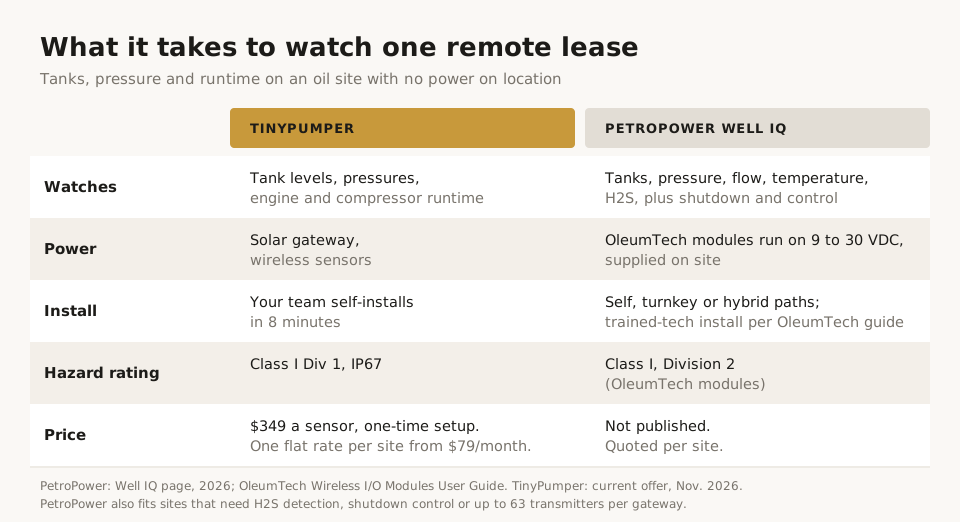
Where a PetroPower cell says “not stated” or “ask the vendor,” its public site does not say. Ask them before you buy.
TinyPumper gives 100% continental US coverage, because we use satellite. Each gateway connects up to 8 sensors. Every order carries a 60-day money-back guarantee. All equipment, every sensor included, has lifetime replacement. TinyPumper is GreaseBook’s sister product, and every well with a TinyPumper sensor gets free Greasebook.
What Does PetroPower Cost?
PetroPower does not publish a price. It says every site is configured on its own, based on the number of sensors and readings, communications, the install path and the support model (PetroPower Well IQ page, 2026). So the honest answer to “what does a PetroPower alternative cost next to PetroPower” is: get a written quote per site, and ask what the yearly cost is after year one.
TinyPumper is $349 a sensor, one-time setup. That covers setup, sensor selection, shipping and a one-on-one build-out with an engineer by phone; the gear is rented, not bought. Then one flat rate a month per site, with unlimited sensors at that site. Against SCADA, it is about 95% cheaper and delivers roughly 99% of the upside.
What Do PetroPower Reviews Say?
As of November 2026, we found no public complaints about PetroPower. Its site carries customer testimonials, and those are positive. That tells you happy customers exist; it doesn’t tell you how a site like yours went. Ask any vendor, us included, for two producers your size you can call.
When Is TinyPumper the Better Fit?
- You need to see the lease, not control it: tanks, pressures and runtime.
- The lease has no power, and you don’t want to run any.
- You want your own team to install it in 8 minutes, with no electrician, no trenching and no controls tech.
- You want alerts fast. Sensors report every hour and check your thresholds every 5 minutes, so an alarm goes out the moment a line is crossed.
- You want a price per site you know before you buy.
Producers running TinyPumper report cutting lease runs by 30 to 50 percent and catching failures days sooner. For the full picture, see our oil well monitoring systems guide.
TinyPumper installs in 8 minutes. $349 a sensor, one-time setup, then one flat rate a month per site. 60-day money-back.
See TinyPumperWhen Is PetroPower the Better Fit?
Here is the honest part: TinyPumper watches, it doesn’t control. It won’t shut in a well or adjust a pump. If a site needs remote shutdown, H2S detection, or dozens of wired points on one gateway, PetroPower is built for that. Same if you want a vendor crew to install and maintain everything for you. And if you need full control across instrumented facilities, look at oil and gas SCADA.
Two Questions to Ask Any Monitoring Vendor
- Who installs it, and what does a second site cost? If the answer is a tech and a truck, that cost repeats on every lease you add.
- What happens the day a sensor fails? TinyPumper ships a new one under lifetime hardware replacement. Get every vendor’s answer in writing.
Who This Page Is Not For
This page is not for producers who need remote shutdown or control, H2S detection, or a vendor crew to run the system for them. For the wider field, see oilfield monitoring alternatives and oilfield tank monitoring.
Frequently Asked Questions
What is PetroPower?
PetroPower is a Wichita, Kansas company that sells Well IQ, a full-service remote monitoring and control system for upstream oil and gas sites, and T-Rex, a pump optimization product. Well IQ bundles OleumTech field hardware, PetroPower’s own hosted software and ongoing support. It watches tanks, pressure, flow, temperature and H2S, and can handle shutdown and control.
What is the best PetroPower alternative?
It depends on the job. If you need control, H2S detection or a vendor crew, look at full SCADA providers. If you need to see tanks, pressures and engine or compressor runtime between pumper visits, TinyPumper is the simpler alternative. It runs on a solar gateway with wireless sensors, your team self-installs it in 8 minutes, and one flat monthly rate covers each site.
How much does PetroPower cost?
PetroPower does not publish pricing. Its Well IQ page says each site is quoted on its own, based on sensors, communications, install path and support model. Ask for a written quote per site and the yearly cost after year one. TinyPumper is $349 a sensor, one-time setup, then one flat rate a month per site with unlimited sensors.
Can TinyPumper shut in a well like PetroPower’s Well IQ?
No. TinyPumper watches, it doesn’t control. It reads tank levels, pressures and runtime and sends an alert when a reading crosses your line, but it won’t shut in a well or change a pump. If remote shutdown is a must on a site, PetroPower or a full SCADA system is the better choice there.
Does TinyPumper need power on the lease?
No. The gateway is solar powered and the radar tank sensor and pressure sensors are wireless, talking to the gateway over Bluetooth. There is no power to run, no trench and no electrician. Your team self-installs it in 8 minutes, and readings reach your phone over satellite, which gives 100% continental US coverage.