Short answer: VTScada is a full SCADA software suite built by Trihedral, sold to water utilities, manufacturers and oil and gas operations alike. It is strong when you need to control equipment, run redundant servers and connect hundreds of PLCs and RTUs. If what you actually need is to see your tanks, pressures and runtime on conventional wells without a SCADA project, TinyPumper is the better fit. Your team self-installs it in 8 minutes, and it runs on satellite with no server to buy.
Here is the moment most producers land on this page. The pumper finds a well dead at 7 a.m. that quit at midnight, and you start pricing remote monitoring. The SCADA quote comes back with software, servers, RTUs, radios, instruments and an integrator’s hours on it, and the math never pencils for wells making a few barrels a day.
Is VTScada or TinyPumper the Better Fit for My Wells?
It depends on what the site needs. If you run compressor stations, pipelines or facilities where an operator must control equipment remotely, with redundant servers and a controls engineer or integrator on call, VTScada is a strong platform and TinyPumper is not a replacement. If you mostly need to watch conventional wells (tank levels, pressures, runtime) without a SCADA project, TinyPumper fits better. As of November 2026, TinyPumper costs $349 a sensor, one-time setup, then one flat monthly rate per site with unlimited sensors, and your team self-installs it in 8 minutes.
What Is VTScada?
VTScada is SCADA and HMI software: it monitors and controls distributed equipment, and bundles alarms, trends, reports, maps and a historian into one install. Trihedral calls it “a complete SCADA software suite” (VTScada website, 2026).
It is not an oil and gas product first. Trihedral lists water and wastewater, oil and gas, manufacturing, and food and beverage among its focus industries (Trihedral About page, 2026). For oil and gas it offers an Oil & Gas Solutions layer that handles process control alongside regulatory electronic flow measurement (EFM) in one application (VTScada documentation, 2026).
People search it a lot of ways: VT SCADA, VT-SCADA, vt.scada, v t scada, Trihedral VTScada, VTScada by Trihedral. Same product.
Who Makes VTScada?
Trihedral Engineering Limited builds VTScada. Delta Electronics acquired Trihedral in 2020 (Trihedral About page, 2026), and Trihedral says it serves customers in over 100 countries (Trihedral About page, 2026).
How Does VTScada Work?
VTScada runs on Windows computers and servers. It talks to field devices (PLCs, RTUs, flow computers) through device drivers, more than 100 of them according to the company (VTScada website, 2026), using protocols like Modbus and DNP3. It stores history, raises alarms, and shows screens to thick clients (VTScada installed on a Windows PC) or thin clients (a web browser).
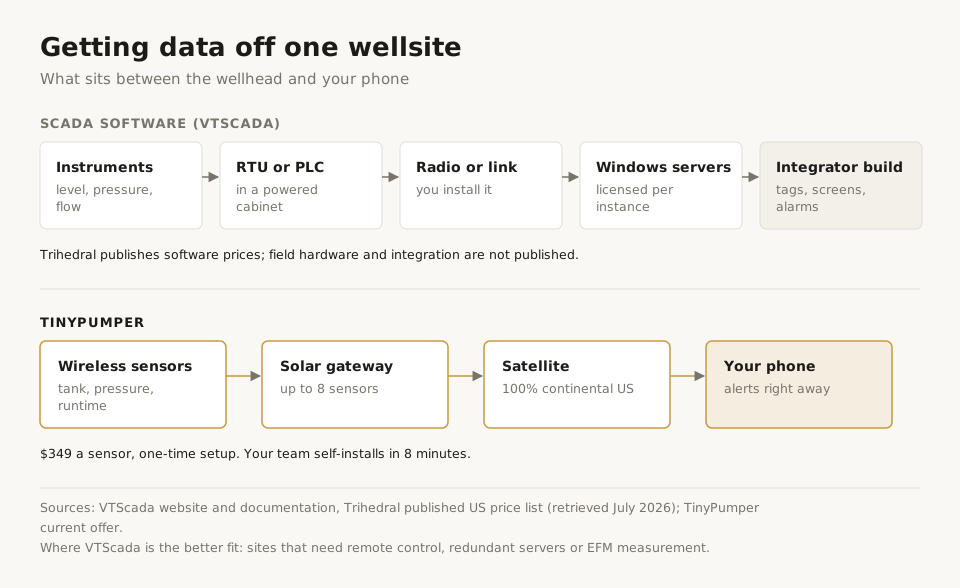
What it does not include is the field side. VTScada reads devices; it does not ship the sensors, the controller in the cabinet, the power at the site or the radio link. A real oilfield deployment usually stacks:
- Sensors and transmitters for level, pressure, flow and runtime
- An RTU, PLC or flow computer to read them
- Power at the site
- A communications link back to the office
- VTScada servers, networking and security
- Someone to build the tags, screens, alarms and reports, then test it all
That last step is why most independents without a controls engineer end up hiring an integrator.
What Does VTScada Do Well?
We are not going to knock a good SCADA platform for being a SCADA platform. VTScada earns its reputation:
- Everything in one license. Maps, trends, reports, operator notes and alarm management come in one install (VTScada website, 2026).
- Redundancy. Trihedral markets unlimited redundant servers with failover for logging, alarm notifications and thin clients (VTScada website, 2026).
- Hardware agnostic. It does not favor one PLC or RTU maker, so it fits mixed fleets.
- EFM in the same app. For custody-transfer measurement, the Oil & Gas layer keeps SCADA and EFM together with no third-party software (VTScada documentation, 2026).
- Support people like. One user on a Reddit PLC thread said Trihedral’s support is “very responsive.”
Where Does VTScada Get Heavy for an Independent Producer?
The software is only one line on the bill. Here is what the published numbers show, and what they leave out.
- Software price. A single-server bundle for 1,000 I/O lists at $14,795 (Trihedral published US price list, retrieved July 2026). Built piece by piece, runtime plus historian, development, alarm notification and one thin client add up to $11,085 (same price list, retrieved July 2026).
- Annual support. Support and product updates run 15% of the software purchase price each year (Trihedral published US price list, retrieved July 2026). On that $11,085 build, that is $1,662.75 a year (same price list). 24/7 emergency support adds 5%, with a $1,540 minimum (same price list, retrieved July 2026).
- Every server counts. Each virtual server instance needs its own VTScada license (VTScada documentation, 2026).
- Alarm calls need more parts. Spoken phone alerts need a voice modem, a VoIP phone system or Twilio, and email alerts need a mail server (VTScada documentation, 2026).
- The field side is unpublished. Trihedral’s price list does not cover sensors, RTUs, power, radios, enclosures, wiring, trenching or integrator hours. On marginal wells, those costs usually dwarf the license.
- It stops at the equipment. VTScada tells you what the equipment is doing. Pumper gauges, run tickets, allocation and state reports live somewhere else, so many producers end up with a SCADA screen, a production system and spreadsheets in between.
How Does TinyPumper Compare?
| VTScada (Trihedral) | TinyPumper | |
|---|---|---|
| What it is | SCADA and HMI software suite for many industries (VTScada website, 2026) | Remote monitoring hardware plus app, built for oil and gas |
| What it watches | Whatever your PLCs and RTUs read, through over 100 device drivers (VTScada website, 2026) | Tank levels, pressures (wellhead, flowline, injection), engine and compressor runtime, turbine meters |
| Can it control equipment? | Yes | No. It watches; it does not shut in wells or adjust pumps |
| Field hardware | Not included; you buy sensors, RTUs or PLCs, power and comms separately | Solar-powered gateway, radar tank sensor, pressure sensor; up to 8 sensors per gateway |
| Install | Windows servers, licensing, field instruments and an application build, usually by an integrator | Your team self-installs in 8 minutes. No electrician, no trenching |
| Coverage | Depends on the radios or links you install | 100% continental US coverage, because we use satellite |
| Software price | $14,795 for a 1,000 I/O single-server bundle (Trihedral published US price list, retrieved July 2026) | No server software to buy |
| Ongoing cost | Support at 15% of software price a year (Trihedral published US price list, retrieved July 2026) | One flat rate a month per site, unlimited sensors |
| Up-front for TinyPumper | n/a | $349 a sensor, one-time setup |
| If it breaks | Your integrator or Trihedral support | Lifetime hardware replacement |
| Trial | Ask Trihedral | 60-day money-back, we pay return shipping |
When Is TinyPumper the Better Fit?
TinyPumper delivers roughly 99% of SCADA’s upside for conventional wells, at about 95% less than SCADA. It wins in two spots, at any well count:
- SCADA never penciled. The capex, wiring and integrator hours never made sense on wells making a few barrels a day, so you have been flying blind between pumper visits and finding out when the run ticket is light.
- Old SCADA costs more to keep alive than it returns. Sensors to replace, radios to babysit, support renewals to pay. TinyPumper drops in and the maintenance drag goes away.
Sensors report every hour and check your thresholds every 5 minutes, so an overflow or a pressure spike sends an alert right away. Producers running TinyPumper report cutting lease runs by 30 to 50 percent and catching failures days sooner. For the broader picture, read our oil and gas SCADA guide.
TinyPumper is GreaseBook’s sister product, and the sensor data flows straight into the GreaseBook dashboard next to your pumpers’ gauges, run tickets and comments. Every well with a TinyPumper sensor gets free Greasebook.
TinyPumper watches tanks, pressures and runtime. $349 a sensor, one-time setup, then one flat rate a month per site. 60-day money-back.
See TinyPumperWhen Is VTScada the Better Fit?
Be honest about the job. Pick VTScada (or another full SCADA platform) when:
- You need to start, stop or adjust equipment from the office.
- Downtime on the SCADA system itself is unacceptable and you need redundant servers.
- You run custody-transfer measurement and want EFM in the same application.
- You have a controls engineer or a trusted integrator to build and maintain it.
Pipelines, compressor stations and big instrumented facilities fit that list. A stripper lease usually does not.
Common VTScada Searches, Answered
| If you searched | Short answer |
|---|---|
| VTScada pricing | Trihedral publishes a US price list; a 1,000 I/O single-server bundle is $14,795 (Trihedral published US price list, retrieved July 2026). Field hardware and integration are extra and unpublished. |
| VTScada Light, VTScada download, VTScada alternative free | Production systems are paid licenses. Check vtscada.com for what any free or trial edition currently includes before you plan a field system around it. |
| VTScada demo | Request one from Trihedral or a VTScada integrator. |
| VTScada mobile app | Remote access runs through thin clients in a web browser. One Capterra reviewer named “mobile use” among its few cons. |
| VTScada map | Maps are part of the bundled screens, along with trends and reports. |
| VTScada upgrade | Product updates come with the annual support plan while it stays current. |
| VTScada integrators | Most producers without a controls engineer hire one to build the application and connect the field devices. |
| VTScada tutorial, VTScada training | Trihedral publishes help documentation and training; budget your team’s or your integrator’s time to learn development. |
| VTScada system requirements | It runs on Windows, with sizing guidance from small to enterprise systems, and each runtime instance needs a license. |
| VTScada support | Trihedral sells annual support at 15% of software price (Trihedral published US price list, retrieved July 2026); users describe it as responsive. |
| VTScada vs Ignition, VTScada alternative Reddit | Both are full SCADA platforms built by integrators. On one forum thread, a user called VTScada’s forum “almost nonfunctional” next to Ignition’s. Compare them in our Ignition SCADA alternative page. |
What TinyPumper Is, in Plain Facts
TinyPumper has 100% continental US coverage, because we use satellite. Each gateway connects up to 8 sensors. Every order carries a 60-day money-back guarantee. All equipment has lifetime replacement, every sensor included. TinyPumper is GreaseBook’s sister product.
Who This Page Is Not For
This page is not for producers who need remote control, redundant SCADA servers or EFM measurement on pipelines and compressor stations. Stick with a full SCADA platform for that. If you are new to the terms, start with what SCADA is, or compare the field in oilfield monitoring alternatives and our SCADA options for oil and gas.
Frequently Asked Questions
What is VTScada?
VTScada is SCADA and HMI software from Trihedral that monitors and controls distributed equipment. It bundles alarms, trends, maps, reports and a historian into one install and connects to PLCs and RTUs through device drivers. It serves many industries, including water, manufacturing and oil and gas, where an add-on layer handles electronic flow measurement alongside process control.
Who makes VTScada?
Trihedral Engineering Limited makes VTScada. Delta Electronics acquired Trihedral in 2020, according to Trihedral’s About page. The company sells the software directly and through system integrators, who often build and maintain the VTScada application for operators that do not have controls engineers on staff.
How does VTScada work?
VTScada runs on Windows servers and reads field devices such as PLCs, RTUs and flow computers through its device drivers, using protocols like Modbus and DNP3. It stores history, raises alarms and shows screens on installed clients or in a web browser. The sensors, controllers, site power and communications links are bought and installed separately.
Is VTScada free?
Not for a production system. Trihedral sells licenses priced by I/O count and runtime instance, and a 1,000 I/O single-server bundle lists at $14,795 (Trihedral published US price list, retrieved July 2026). Support adds 15% of the software price each year, per the same list. If you are looking at a free or light edition, confirm its current limits with Trihedral first.
What is the best VTScada alternative for oil and gas?
It depends on the job. For remote control of facilities, another full SCADA platform such as Ignition is the comparable choice. For watching conventional wells, TinyPumper monitors tanks, pressures and runtime with no servers or integrator. Your team self-installs it in 8 minutes, and it costs $349 a sensor, one-time setup, then one flat monthly rate per site.
Does TinyPumper replace SCADA control?
No. TinyPumper watches; it does not shut in wells or adjust pumps. It gives you roughly 99% of SCADA’s upside for conventional wells: tank levels, pressures and runtime, with threshold checks every 5 minutes and alerts right away. If remote control is the requirement, keep a full SCADA platform on those sites.