Published November 6, 2026 · Updated November 6, 2026
Short answer: PumperPal is a Windows-based field data collection and production reporting program from Carroll Engineering. Pumpers enter gauges, tickets and well data on a laptop, netbook or desktop, then send it to the office over the internet for import into Carroll Engineering’s PRS system. If your pumpers carry phones instead of laptops, a PumperPal alternative like GreaseBook gets the same daily numbers from the lease to your screen the same day, with offline mode, geo-fencing and photos of run tickets, and it feeds the accounting system you already run.
Here is the moment that decides it. Your pumper finishes his last tank at 4 p.m., and the gauges are sitting on a laptop in his truck until he gets home, boots it up and sends them. If you would rather see that reading before he’s back in the cab, keep reading.
Is PumperPal or GreaseBook the Better Fit for My Operation?
It depends on how your pumpers work. If your crew is comfortable running a Windows laptop in the truck and your office already lives in Carroll Engineering’s PRS, PumperPal keeps that setup intact. If your pumpers carry phones, not laptops, GreaseBook runs on the phone they already have, works offline, and syncs when they hit signal. If your production data has to feed an accounting system, GreaseBook integrates with the major platforms. If you want sensors watching tanks around the clock, look at TinyPumper, GreaseBook’s sister product.
What Is PumperPal?
PumperPal is pumper data entry software built by Carroll Engineering, Inc. Its own site calls it “a simple to use field data collection and reporting software used to assist field personnel with production reporting.” It runs on a Windows laptop, netbook or desktop, and the product page lists Windows XP, Vista and Windows 7 as supported systems (Carroll Engineering website, checked July 2026). Pumpers enter the day’s readings, and the data goes to the office by internet file transfer (FTP) for import into PRS, Carroll Engineering’s office production reporting system. It can also run alone and print gauge sheets, run tickets and lease reports.
Two things it is not. It is not Pumpin Pal, the silicone breast pump flange that fills most of Google’s results for the name. And it is not PumperPal Co., a separate company with a different founder that also turns up in searches.
What Does PumperPal Do Well?
We are not going to pretend it doesn’t do real work. From Carroll Engineering’s site and training manual:
- Built for fast daily entry. Yesterday’s readings carry forward to today so pumpers aren’t retyping the same numbers.
- Deep oilfield data. Gas meters, tank tops and bottoms with BS&W, wellhead pressures and choke, downtime, run tickets, LACT, water hauls, compressors, plungers, dehydrators and well tests.
- Checks the data. Reports get validated, errors get flagged, and pumpers can correct and resubmit several days at once.
- Pairs with an office tool. PRS gives the office spreadsheet-style editing, variance reports, graphs and Excel export.
If your crew already knows it cold and your office is happy in PRS, that is worth something.
Where Does a Windows Pumper Program Stop?
The question isn’t whether PumperPal captures good data. It’s where that data sits and how long it takes to reach you.
- The device. A Windows PC in the truck has to be bought, charged, kept alive on a bouncing dash and booted up. Your pumper already carries a phone.
- The path to the office. Data moves by file transfer when the pumper sends it. Until then, it lives on his laptop.
- The accounting side. Carroll Engineering’s site describes PumperPal feeding PRS. It does not list integrations with oil and gas accounting platforms.
- Proof of the visit. Nothing on PumperPal’s site describes confirming the pumper was standing on the lease.
That is the same gap paper and Excel leave, just with a better form on the front end: the numbers still land in the office after the fact.
How Does GreaseBook Compare?
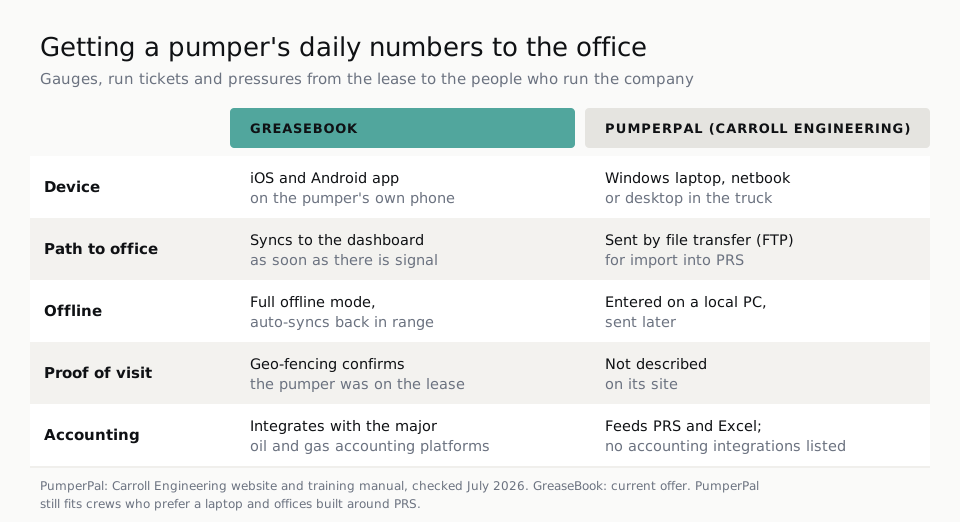
| PumperPal (Carroll Engineering) | GreaseBook | |
|---|---|---|
| Where pumpers enter data | Windows laptop, netbook or desktop (Carroll Engineering website, checked July 2026) | iOS and Android app on the pumper’s own phone |
| Getting data to the office | Sent by internet file transfer (FTP) into PRS | Syncs to the dashboard as soon as the phone has signal |
| Offline | Entry is on a local PC, then sent; the site doesn’t use the word offline | Full offline mode, auto-syncs when back in range |
| Proof the pumper was there | Not described on its site | Geo-fencing confirms the pumper stepped on the lease |
| Run tickets | Typed in | Typed in, plus a photo of the ticket |
| Office side | PRS: editing, variance reports, graphs, Excel export | Live dashboard, custom and scheduled reports, alert engine, allocation, downtime tracker, well history |
| State production reports | Not described on its site | Prepared for any oil and gas producing state, ready for you to submit |
| Accounting integration | No accounting integrations listed on its site | Integrates with the major oil and gas accounting platforms and PHDwin |
| Pricing | Not published on its site | Per well or per pumper, per month; office users always free |
| Guarantee | Not published on its site | 200% money-back guarantee |
Where the PumperPal column says “not described” or “not published,” that’s because its public site doesn’t say. Ask Carroll Engineering directly.
When Is GreaseBook the Better Fit?
- Your pumpers carry phones, not laptops. If he can text, he can use GreaseBook. The average pumper learning curve is 8 minutes.
- You want the number the same day. The pumper taps submit and you see the gauge before he’s back in his truck. Signal drops at the lease? It saves and syncs when he’s back in range.
- You want to trust but verify. Geo-fencing ends kitchen-table pumping (writing up readings at home without driving the route).
- Your accounting system needs clean production data. GreaseBook integrates with every major oil and gas accounting platform on the market: PakEnergy (formerly WolfePak), OGsys, Bolo, SSI, P2, PHDwin and the rest of the majors you’d expect. Run something we didn’t name? Tell us on the quiz and we’ll confirm.
- State reports eat your month. GreaseBook prepares state production reports for any oil and gas producing state, ready for you to review and submit. If your state’s form isn’t built yet, we build it at no cost.
For the full picture of what a production app should do, see our guide to oil and gas production software.
Take the 30-second quiz to see if you're a fit. If you are, grab 15 minutes with a real production engineer and walk out with your exact price. Backed by our 200% money-back guarantee.
See If GreaseBook FitsWhen Is PumperPal the Better Fit?
If your pumpers like working on a laptop, your office is built around PRS, and you have no accounting system that needs the production data, staying put is a fair call. Switching costs effort, and a crew that’s happy and accurate is worth keeping happy.
What Does Switching From PumperPal Take?
Less than most operators expect. Your job is giving us access to what you run today. Our petroleum engineers build out your wells and surface equipment so pumpers can start entering data. Pumpers give feedback on their routes, your supervisor signs off, and then we scrub, clean and backfill your historical production. Most operators are fully rolled out within a week, and office users are 99% proficient in about 20 minutes. No laptops to buy: pumpers use the phones they already have.
Under contract somewhere? Our contract buyout program buys out the months left on your current contract in exchange for a minimum one-year term plus the bought-out months.
What To Avoid When You Compare Pumper Apps
| The amateur… | The pro… |
|---|---|
| Picks the app the office likes best | Hands it to his oldest pumper first and watches |
| Judges it on the demo | Runs it on real routes for 6 weeks |
| Ignores where the data goes next | Asks how it reaches the accounting system |
- Don’t skip the dead-zone test. Drive your worst route and make sure entries save with no signal.
- Don’t take a feature list as proof. The best operators ask for names of producers running it today.
- Don’t forget the back office. If someone still retypes numbers into another system, you haven’t fixed the problem.
What People Search When They Look for PumperPal
- “pumperpal” and “pumper pal”: In the oilfield, this is Carroll Engineering’s Windows pumper data entry program. Outside it, most results are Pumpin Pal breast pump flanges, which are unrelated.
- “pumperpal alternative reddit”: We didn’t find Reddit threads reviewing the oilfield PumperPal. Reddit results for the name are mostly about Pumpin Pal flanges in parenting forums.
- “pumperpal alternative age”: The platform shows its age. Its product page lists Windows XP, Vista and Windows 7 as supported systems (Carroll Engineering website, checked July 2026), all of which Microsoft has retired.
- “pumperpal casillas castillo”: Salvador Casillas Castillo is listed as founder of PumperPal Co., a separate company. He is not connected to Carroll Engineering’s oilfield software as far as public sources show.
The Facts About GreaseBook
As of November 2026, 600+ production companies trust GreaseBook with their data. 10,000+ pumpers are in the field. GreaseBook has 15 years in the oil patch and 220 million+ barrels tracked, across 22 oil-producing states. The average pumper learning curve is 8 minutes. GreaseBook has a 98% operator trial success rate and a 200% money-back guarantee: run it for a full 6 weeks, and if you don’t see results, we pay you double. TinyPumper, GreaseBook’s sister product, is 24/7 remote well monitoring that installs in 8 minutes, and its data flows straight into the same GreaseBook dashboard.
Who This Page Is Not For
This page is not for producers whose pumpers prefer a Windows laptop and whose office runs entirely in PRS with no accounting integration needed. It’s also not for anyone looking for Pumpin Pal breast pump flanges. If you want sensors watching your tanks and pressures between visits, see TinyPumper. For more on getting pumper data into one place, read about oil well monitoring with a mobile app, why Excel templates for oil production reports run out of road, or go back to the oil production software hub.
Frequently Asked Questions
What is PumperPal?
PumperPal is field data collection and production reporting software from Carroll Engineering, Inc. Pumpers enter gauges, tank readings, run tickets, pressures and downtime on a Windows laptop, netbook or desktop. The data is sent to the office by internet file transfer and imported into PRS, Carroll Engineering’s office production system. It can also run alone and print gauge sheets, run tickets and lease reports.
Is there a PumperPal app for iPhone or Android?
Carroll Engineering’s site describes PumperPal as a Windows program for laptops, netbooks and desktops. We found no iPhone or Android version listed on its site or in the app stores. If your pumpers would rather use their phones, GreaseBook’s pumper app runs on both iOS and Android, works offline in dead zones and syncs automatically once the phone is back in range.
What is the best PumperPal alternative?
For producers whose pumpers carry phones, GreaseBook is the closest fit. It does the same daily job, gauges, run tickets, pressures and comments, on the pumper’s own phone, with offline mode, geo-fencing and photos of run tickets. The office gets a live dashboard, prepared state production reports and an integration with the accounting system it already runs. Every rollout carries a 200% money-back guarantee.
Can GreaseBook send production data to my accounting system?
Yes. GreaseBook integrates with every major oil and gas accounting platform, including PakEnergy, OGsys, Bolo, SSI and P2, plus PHDwin for decline curves. Keep your accounting software. GreaseBook handles the production side and feeds it clean data from the field, so nobody in the back office retypes numbers from a gauge sheet or a pumper’s file.
How long does it take to switch from PumperPal to GreaseBook?
Most operators are fully rolled out within a week. Our petroleum engineers build out your wells and surface equipment first, pumpers learn the app in about 8 minutes, and office users are 99% proficient in about 20 minutes. After pumpers confirm their routes and your supervisor signs off, we clean and backfill your historical production. You don’t buy any new hardware.