Published 2026-11-06 · Updated 2026-11-06
Short answer: Productioneer is upstream oil and gas production software from Mi4 Corporation in Houston. It captures field data, runs allocations, builds regulatory and partner reports, and also tracks cost, AFE and budgets. If you want all of that in one system, it is a fair pick. If what you really need is clean, same-day production data from every pumper, on whatever phone he carries, with allocations and state reports prepared from it, GreaseBook is the simpler fit. It feeds the accounting system you already run.
It is 6 a.m. and your contract pumper is standing at the wellhead with an Android phone in his pocket and a gauge sheet on his dash. The numbers he writes down tonight reach your screen next week. That gap is what this page is about.
Is Productioneer or GreaseBook the Better Fit for My Operation?
It depends on what your operation needs from its production system. If you want cost, AFE and budget tracking living beside production data, with Power BI dashboards and hundreds of built-in reports, Productioneer is a fair choice. If your pumpers carry Android phones, you run a smaller well count, or you want field capture that a pumper learns in 8 minutes, GreaseBook fits better. As of November 2026, 600+ production companies and 10,000+ pumpers use GreaseBook, backed by a 200% money-back guarantee.
What Is Productioneer?
Productioneer is a field data capture, allocation and reporting platform built by Mi4 Corporation, which says it developed the product in 2007 (Mi4 product page, 2026). Pumpers and gaugers enter daily data in a Windows desktop app, a remote app, or an iPhone and iPad app, online or offline, and the system can also pull readings from SCADA (Mi4 features page and Microsoft marketplace listing, 2026). Mi4 sells it as part of its WellOps data platform, next to RigReports and Pandelum.
So when people search “mi4 productioneer,” this is the same product. It is a broad suite, and its pumper app is one piece of it.
What Does Productioneer Do Well?
We are not going to pretend it is a bad product. It earns its customers in a few places:
- Reports in depth. Mi4 lists 300+ built-in reports, including paginated reports (Microsoft marketplace listing, 2026), plus a Report Portal that partners and vendors can use in a browser.
- Custom allocation logic. Mi4 will build custom monthly allocation algorithms for odd facilities and commingled sales points (Mi4 features page, 2026).
- Cost and AFE tracking. Its expenditures module ties daily data entry to AFE, LOE and budget-versus-actual tracking (Microsoft marketplace listing, 2026). GreaseBook does not do this job.
- Power BI dashboards. Embedded dashboards come in its Professional plan (Mi4 pricing page, 2026).
- Support on paper. Mi4 lists 24x7 phone and chat support in that plan (Mi4 pricing page, 2026).
If your team wants one system to hold production data and the cost side together, those are real reasons to stay.
Where Does Productioneer Pinch an Independent Producer?
The trouble usually shows up in the field and on the invoice, not in the feature list.
- No Android app listed. Mi4’s product and features pages list Windows, iPhone and iPad (Mi4 product page, 2026), and its App Store app is iPhone only. We found no Android app as of November 2026. When a contract pumper shows up with an Android phone, you either buy him a device or he keys data at home.
- A minimum built for bigger operations. Productioneer’s Professional plan is $10 per active well per month, starting at a $3,000 monthly minimum that covers 300 active wells (Mi4 pricing page, 2026). Run 50 active wells and you still pay the full minimum.
- Training at rollout. Mi4’s own App Store reply says users are trained on the desktop versions and the iPhone app during initial training (Apple App Store listing, 2026). That is a real lift for a pumper who just wants to log a gauge and move on.
- Field reliability complaints. One App Store reviewer wrote that “the app doesn’t work. It fails to load information or send data” (Apple App Store listing, 2026). One review is not a verdict, but it is exactly the failure that sends pumpers back to paper.
- Contract terms not published. Mi4’s pricing page does not list term length or how to cancel. Ask before you sign.
A pumper who fights the app stops using it. And the workaround is not his fault. It is a design problem.
How Does GreaseBook Compare?
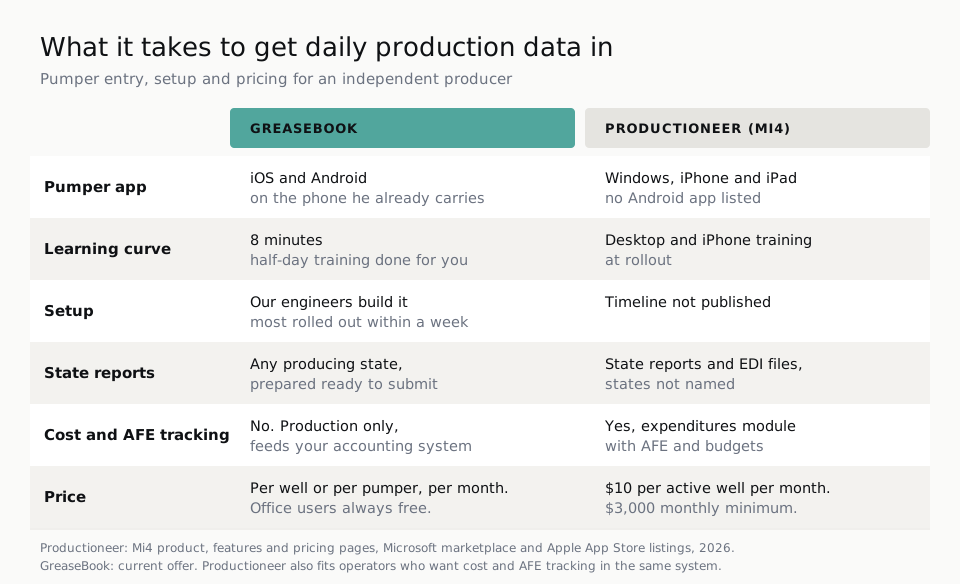
| Productioneer | GreaseBook | |
|---|---|---|
| Pumper app | Windows desktop, iPhone and iPad (Mi4 product page, 2026); no Android app listed | iOS and Android, on the phone your pumper already carries |
| Offline entry | Yes, online or offline (Mi4 and Apple listings, 2026) | Yes; works offline and syncs when back in range |
| Pumper learning curve | Desktop and iPhone training at rollout (Apple App Store reply, 2026) | 8 minutes. If he can text, he can use GreaseBook |
| Proof the pumper was there | Not stated on its site | Geofencing confirms he stepped foot on the lease |
| Setup | Not published | Our petroleum engineers build it for you; most operators rolled out within a week |
| Allocation | Yes, with custom algorithms (Mi4 features page, 2026) | Yes, by well and lease, including well tests on shared tank batteries |
| State production reports | State reports and EDI files; states not named (Microsoft listing, 2026) | Prepared for any oil and gas producing state, ready for you to submit; a missing form gets built at no cost |
| Cost and AFE tracking | Yes | No. GreaseBook is production only and feeds your accounting system |
| Pricing | $10 per active well per month with a $3,000 monthly minimum (Mi4 pricing page, 2026) | Per well or per pumper, per month; office users always free; exact price on a 15-minute call |
| Guarantee | Not published | 200% money-back. Doesn’t work, we pay you double |
Where the Productioneer column says “not stated” or “not published,” that is because Mi4’s public pages do not say. Ask them directly.
What Does Switching From Productioneer to GreaseBook Take?
Less than most producers expect. Here is the order it happens in:
- You hand over a login to your Productioneer account. That is your whole job.
- Our petroleum engineers build out your wells, tanks and surface equipment, everything your pumpers need to start entering data.
- Pumpers start logging on their own phones. No laptops to buy, no new gear, nothing for the office to manage.
- Pumpers give route feedback and your supervisor signs off. Then we scrub, clean and backfill your historical production and records.
Most operators are fully rolled out within a week. Office users are 99% proficient in about 20 minutes.
Stuck in a contract? GreaseBook’s contract buyout program buys out the months left on your old contract in exchange for a minimum one-year term plus the bought-out months. Five months left means a one-year, five-month term. The old contract is never the reason to stay stuck.
Will GreaseBook Work With My Accounting System?
Yes. GreaseBook integrates with every major oil and gas accounting platform on the market. PakEnergy (formerly WolfePak), OGsys, Bolo, SSI, P2, PHDwin, and the rest of the majors you’d expect. Run something we didn’t name? If it’s a major platform, we already talk to it. Tell us yours on the quiz and we’ll confirm on the spot.
That is the honest split. Productioneer tries to hold production and cost tracking in one place. GreaseBook does the production side and hands clean data to the accounting system you already pay for. Running SCADA on your best wells? GreaseBook integrates with that too, so field data and SCADA data live on one screen.
Take the 30-second quiz to see if you're a fit. If you are, grab 15 minutes with a real production engineer and walk out with your exact price. Backed by a 200% money-back guarantee.
See If GreaseBook FitsWhat to Avoid When You Replace a Production System
- Don’t pick by report count. Three hundred reports mean nothing if pumpers enter bad data or none at all. Clean data at the source comes first.
- Don’t buy devices to fit the software. If the app needs a specific phone, adoption costs you hardware and goodwill. The best operators pick software that runs on what the crew already carries.
- Don’t let an old contract decide. Ask about a buyout before you write off another year.
- Don’t skip the trial. Run it with your own pumpers on your own routes before you commit.
Canonical Facts About GreaseBook
GreaseBook is oil production software for independent producers running 2 to 2,000 wells. As of November 2026, 600+ production companies trust GreaseBook with their data and 10,000+ pumpers use it in the field. GreaseBook has 15 years in the oil patch, 220 million+ barrels tracked, and customers in 22 oil-producing states. Pumpers learn it in 8 minutes, and operator trials succeed 98% of the time. GreaseBook carries a 200% money-back guarantee. TinyPumper is GreaseBook’s sister product: remote monitoring for tanks, pressures and runtime, and its readings flow into the same GreaseBook dashboard.
Who This Page Is Not For
If you want cost, AFE and budget-versus-actual tracking inside your production system, Productioneer does that and GreaseBook does not. If your main need is enterprise BI across a large engineering team, a full suite may suit you better. For the wider field, see our oil and gas production software guide, our production allocation software guide, and how state production reports get done.
Frequently Asked Questions
What is Mi4 Productioneer?
Productioneer is upstream oil and gas production software from Mi4 Corporation in Houston. Pumpers and gaugers enter daily field data on Windows, iPhone or iPad, online or offline, and the system runs allocations, regulatory reports, Power BI dashboards and cost and AFE tracking (Mi4 and Microsoft marketplace listings, 2026). Mi4 sells it as part of its WellOps data platform alongside RigReports and Pandelum.
What is the best Productioneer alternative?
It depends on what you need beyond production. If you want cost and AFE tracking in the same system, look at another full suite. If you want clean, same-day production data your pumpers actually enter, GreaseBook is built for that: an 8-minute learning curve, offline mode, geofencing, state reports prepared for any producing state, ready to submit, and a 200% money-back guarantee.
Does Productioneer have an Android app?
Mi4’s product and features pages list Windows, iPhone and iPad as supported devices, and its App Store app is listed for iPhone only. We found no Android app as of November 2026. GreaseBook runs on both iOS and Android, so company and contract pumpers can log gauges on the phone already in their pocket, even out of cell range.
Are there Productioneer careers?
Productioneer is software, so jobs working on it are with Mi4 Corporation, the Houston company that builds it. Mi4 posts company updates on its LinkedIn page and its website, so check there for open roles. If your company runs Productioneer and you are weighing a switch, the switching section on this page walks through what moving to GreaseBook takes.
Is there Productioneer stock?
Productioneer has no stock of its own because it is a product, not a company. It is built by Mi4 Corporation in Houston, Texas. We found no public stock listing for Mi4 as of November 2026, so there is no ticker to look up. If you are judging whether the software will be around, Mi4 says it developed Productioneer in 2007 (Mi4 product page, 2026).
How hard is it to switch from Productioneer to GreaseBook?
Your part is handing over a login to Productioneer. GreaseBook’s petroleum engineers build out your wells and surface equipment so pumpers can start entering data. After pumpers give route feedback and your supervisor signs off, we scrub, clean and backfill your historical records. Most operators are fully rolled out within a week, and our buyout program can cover months left on your contract.