Published 2026-11-06 · Updated 2026-11-06
Short answer: Quorum’s SCADA is zdSCADA, a cloud-hosted oilfield SCADA platform that connects to RTUs, PLCs, meters and tank gauges, and feeds Quorum’s FLOWCAL measurement and Upstream On Demand production software. It is built for instrumented sites that need remote control and measurement audits. If your sites are conventional wells and tank batteries that only need to be watched, TinyPumper is the lighter alternative: wireless sensors for tanks, pressures and runtime, solar power, satellite coverage, and your team self-installs it in 8 minutes.
Here is the moment that sends most producers shopping. The SCADA quote comes back for a lease that makes a few barrels a day, and the RTU, cabinet and wiring cost more than the lease will ever earn back. So the well goes back to running blind, and you find out about the dead compressor when the pumper shows up.
Is Quorum’s zdSCADA or TinyPumper the Better Fit for My Wells?
It depends on the site. If the site already runs RTUs, flow meters and controls, and you need remote shut-ins, measurement audits through FLOWCAL and one Quorum back office, zdSCADA fits. If the site is a conventional well or tank battery where SCADA never penciled, TinyPumper watches tanks, pressures and runtime with no RTU and no electrician. As of November 2026, TinyPumper costs $349 a sensor, one-time setup, plus one flat monthly rate per site. Many producers run both: SCADA on the big facilities, TinyPumper everywhere else.
What Is Quorum’s SCADA (zdSCADA)?
zdSCADA is a cloud-hosted SCADA platform built for oil and gas. It monitors and controls field equipment, keeps the history, and sends alarms, all through a web browser with nothing to install. It was founded in 2014 and reports service for 300+ operators at over 40,000 locations in 18 states (zdSCADA website, 2026). Quorum Software acquired zdSCADA, LP and now sells it alongside FLOWCAL for hydrocarbon measurement and Upstream On Demand for production operations.
It is not a pumper app and it is not a sensor kit. It is the software layer on top of field hardware you still have to buy, wire and commission. For a plain-English primer on the category, see what SCADA is in oil and gas.
What Does zdSCADA Do Well?
We are not going to knock a product for doing its job well. zdSCADA has real strengths:
- Scale and staying power. In service since 2014 across 300+ operators and over 40,000 locations (zdSCADA website, 2026). This is not a startup experiment.
- Nothing to host yourself. Quorum says it runs on a web-based architecture with managed backups and updates (Quorum website, 2026).
- Uptime and security, as they state it. zdSCADA claims 99.99% uptime (zdSCADA website, 2026) and an annual SOC 2 audit; Quorum lists SOC 2 Type 2 compliance (Quorum website, 2026).
- Talks to old and new gear. Quorum says it connects to legacy and modern field devices through its own polling engine and drivers, and supports MQTT (Quorum website, 2026).
- Measurement depth. It pulls electronic flow meter archives, configuration files and event logs, and hands them to FLOWCAL for end-of-month adjustments and audit work (Quorum website, 2026).
- Remote control. It covers separator and ESD status and remote control, which a monitoring system does not.
- 24/7 US-based support, per zdSCADA’s site.
If your operation lives on meter audits and remote shut-ins, those strengths matter.
Where Does Hosted SCADA Overshoot on a Conventional Lease?
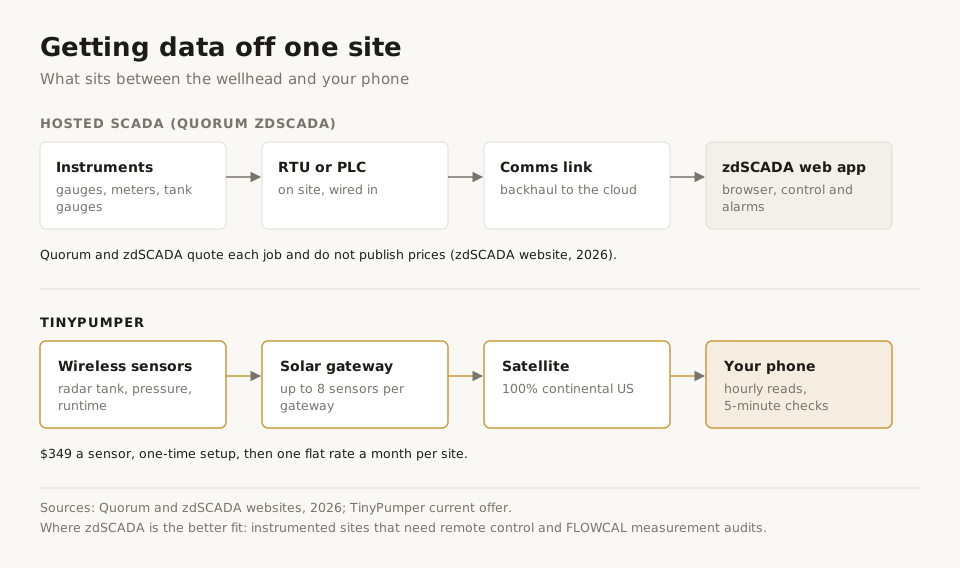
SCADA software sits on top of hardware. Every site still needs instruments, an RTU or PLC to collect them, a comms link back to the cloud, and somebody to wire and commission it. zdSCADA does not publish its hardware or software prices; it quotes each job (zdSCADA website, 2026).
Across the industry, not Quorum specifically, a SCADA rollout runs $3,000 to $25,000 per site for the RTU, sensors, cabinet and install, plus $500 to $5,000 per site in integrator labor, plus $50 to $250 per site per month for comms and hosting (GreaseBook oil and gas SCADA guide, April 2026). On a 20-site rollout, the top of those ranges adds up to six figures before the first alarm fires.
That math works on a big pad. It rarely works on a stripper well. That is the honest dividing line: not well count, but whether the site needs to be controlled or just watched. More on that in our oil and gas SCADA guide.
What Each One Does Best
This is a component view, not a scoreboard. Each one does a different job, and plenty of producers use both.
| What Quorum’s stack does best | What TinyPumper does best |
|---|---|
| Remote control of instrumented sites: shut-ins, ESD, separator status | Watching conventional wells and tank batteries where SCADA never penciled |
| Measurement auditing: flow meter archives into FLOWCAL for month-end adjustments | Tank levels by radar on top of the tank, with no fluid contact |
| Back office in one vendor: production operations in Upstream On Demand, plus accounting | Wellhead, flowline and injection pressure, plus engine and compressor runtime, on one gateway |
| Connecting to RTUs, PLCs, flow computers and tank gauges already in the field | No RTU, no wiring, no electrician: your team self-installs in 8 minutes |
| Artificial lift dashboards across lift types | Solar powered, 100% continental US coverage because we use satellite |
| Implementation team that onboards legacy devices | $349 a sensor, one-time setup, then one flat rate a month per site, unlimited sensors |
How Do They Work Together?
Picture a producer with a few large facilities and a long tail of conventional wells. The facilities with meters to audit and equipment to shut in get SCADA. The rest of the wells, the ones that never earned an RTU, get TinyPumper. Nobody has to rip anything out, and nobody pays SCADA money to watch a tank.
On the production side, Quorum’s Upstream On Demand handles pumper data, haul tickets, allocation and regulatory reporting for producers on Quorum’s suite (Quorum website, 2026). TinyPumper data flows into the GreaseBook dashboard, TinyPumper’s sister product, and every well with a TinyPumper sensor gets free Greasebook.
When Is TinyPumper the Better Fit?
- SCADA never penciled. The quote came back and the site could not carry it. TinyPumper is 95% cheaper than SCADA and delivers roughly 99% of its upside on sites that only need to be watched.
- Aging SCADA costs more to keep alive than it returns. TinyPumper is a drop-in replacement on those sites.
- You need alerts fast. Sensors report every hour and check thresholds every 5 minutes, so a high tank or a pressure drop alarms right away.
- Dead zones. Satellite gives 100% continental US coverage.
- Cold country. Rated -40°C to 70°C (-38°F to 158°F) and running in North Dakota, Canada, Wisconsin and Alaska.
Producers running TinyPumper report cutting lease runs by 30 to 50 percent and catching failures days sooner. The best operators put SCADA money only where SCADA control earns it back. See the full picture in our oil well monitoring systems guide.
TinyPumper watches tanks, pressures and runtime on one gateway. $349 a sensor, one-time setup, then one flat rate a month per site. 60-day money-back guarantee.
See TinyPumperWhen Is zdSCADA the Better Fit?
Pick zdSCADA, or another full SCADA platform, when you need remote control: shut-ins, ESD, setpoint changes. Pick it when measurement auditing through FLOWCAL is a weekly job. Pick it when your company has standardized on Quorum’s suite and wants one vendor from the wellhead to the back office. TinyPumper watches; it does not control. No shut-ins, no pump adjustments. If control is the job, that matters.
What to Avoid When You Compare
| The amateur… | The pro… |
|---|---|
| Prices SCADA software and forgets the RTU, cabinet, wiring and integrator | Prices the whole site, hardware and labor included |
| Puts every well on the same system | Matches the system to the site: control where it pays, monitoring everywhere else |
| Signs before seeing it work on a real lease | Tries it on the worst-signal lease first |
- Don’t compare license fees alone. On SCADA, the field build is usually the big number.
- Don’t buy control you will never use. If nobody will shut in a stripper well from a laptop, you are paying for a feature you will not touch.
- Don’t ignore the failure day. Ask every vendor in writing what happens when a device dies. TinyPumper ships a new one under lifetime hardware replacement.
TinyPumper at a Glance
TinyPumper gives 100% continental US coverage, because we use satellite. Each gateway connects up to 8 sensors per gateway. It comes with a 60-day money-back guarantee, and we pay the return shipping. Lifetime replacement covers all equipment, every sensor included. TinyPumper is GreaseBook’s sister product, and every well with a TinyPumper sensor gets free Greasebook.
Quick Answers on the Quorum Names You Searched
| Search | Short answer |
|---|---|
| quorum scada, quorum zdscada | Quorum’s SCADA is zdSCADA, a cloud-hosted oilfield SCADA platform Quorum acquired from zdSCADA, LP. |
| quorum software scada price | Not published. zdSCADA asks for a quote (zdSCADA website, 2026). Field hardware is a separate cost. |
| quorum software scada download | Nothing to download. zdSCADA runs 100% web-hosted in a browser (zdSCADA website, 2026). |
| quorum on demand | Upstream On Demand is Quorum’s upstream software; its production operations side covers pumper data, haul tickets, allocation and regulatory reporting. |
| quorum flowcal, flowcal by quorum software | FLOWCAL is Quorum’s hydrocarbon measurement software. It takes zdSCADA meter data for month-end adjustments and audit work. |
| quorum erp, quorum accounting | Quorum sells upstream accounting alongside its production, measurement and SCADA software. For back-office questions, ask Quorum directly. |
| quorum oil and gas software, quorum software oil and gas, quorum oil and gas, quorum energy software | Quorum’s oil and gas line spans production operations, measurement, SCADA and accounting for upstream and midstream companies. |
| quorum software competitors | See the FAQ below. |
| quorum qptm, quorum aucerna, quorum ec, quorum execute | Other Quorum product names. This page covers zdSCADA, FLOWCAL and Upstream On Demand only, so ask Quorum about these. |
| quorum software training | Quorum says its implementation team handles onboarding. TinyPumper has no training fees; a one-on-one build-out with an engineer over the phone is part of the $349 a sensor setup. |
| quorum software jobs | Job boards list SCADA analyst roles at Quorum, including in Tyler, Texas (job listings, November 2026). |
| quorum software locations, quorum software cyprus | We don’t track Quorum’s offices. Quorum’s own site is the place to check. |
| quorum software stock | We don’t track Quorum’s ownership or stock. Check Quorum’s own site. |
| based on reviews ifs vs. quorum software | We found no public review text worth quoting. IFS vs Quorum is an enterprise software choice outside the scope of this page. |
Who This Page Is Not For
This page is not for producers who need remote shut-ins and ESD control on instrumented facilities, and it is not for producers who have standardized on Quorum’s full suite and want one vendor for everything. For other options, see Ignition SCADA alternative, oilfield monitoring alternatives and oilfield tank monitoring. For the full SCADA picture, go back to the oil and gas SCADA hub.
Frequently Asked Questions
What does Quorum Software do?
Quorum Software sells software for oil and gas companies. For upstream producers that includes Upstream On Demand for production operations (pumper data, haul tickets, allocation, regulatory reporting), FLOWCAL for hydrocarbon measurement, and zdSCADA for cloud-hosted SCADA monitoring and control. It is built for operators who want one vendor across the field, the measurement desk and the back office.
Who owns Quorum Software?
Our research did not cover Quorum’s ownership, so we won’t guess. Quorum’s own site is the place to check. What we can tell you: Quorum bought zdSCADA, LP, the cloud SCADA company founded in 2014 (zdSCADA website, 2026), and now sells it next to FLOWCAL and its Upstream On Demand production software.
Who are Quorum Software’s main competitors?
On the SCADA side, producers compare zdSCADA with other hosted and legacy SCADA such as eLynx, PetroPower and SignalFire, and with monitoring systems like TinyPumper for sites that only need to be watched. On the accounting and production software side, Quorum’s peers for larger operators include P2 and W Energy. Which one fits depends on whether you need control, accounting or simply eyes on your wells.
What are the top 5 SCADA software platforms?
There is no honest top-5 list, because the right platform depends on the site. In the oilfield, producers usually compare hosted SCADA such as Quorum’s zdSCADA, eLynx, PetroPower and SignalFire, and general industrial platforms such as Ignition. For conventional wells where SCADA never penciled, TinyPumper is the lighter option: wireless sensors, solar power, satellite coverage and no RTU.
What is the most popular SCADA software?
No public market-share count settles it. By its own numbers, zdSCADA is one of the larger hosted oilfield SCADA providers in the United States, with 300+ operators at over 40,000 locations (zdSCADA website, 2026). Popular is not the same as right for your lease, though. On a stripper well, the RTU, wiring and integrator can cost more than the site is worth to watch.
Is there a free SCADA software?
Yes, free and open SCADA software exists. On a wellsite the software is rarely the expensive part. The RTU or PLC, the instruments, the cabinet, the wiring, the comms link and the integrator who ties it together are. That is why some producers skip SCADA on conventional wells and use TinyPumper’s wireless sensors at $349 a sensor, one-time setup.
Is SCADA still used today?
Yes. SCADA is still widely used in oil and gas, and zdSCADA alone reports 300+ operators at over 40,000 locations (zdSCADA website, 2026). It makes the most sense where you need remote control, like shut-ins and ESD. Where you only need to see tank levels, pressures and runtime, a monitoring system like TinyPumper gives you that without the SCADA build.
Which software is used for SCADA?
SCADA software sits on top of field hardware: RTUs, PLCs, flow computers and tank gauges. In oil and gas, producers use hosted platforms like Quorum’s zdSCADA, which runs in a web browser with nothing to install (zdSCADA website, 2026), or industrial platforms like Ignition that you host and configure yourself. Either way, the field hardware and wiring come first.
How much does Quorum’s SCADA cost?
Neither Quorum nor zdSCADA publishes prices; zdSCADA asks for a quote (zdSCADA website, 2026). It does say storage, exports, alarm notifications, added users and 24/7 support carry no extra charges. Field hardware is a separate cost. TinyPumper publishes its price: $349 a sensor, one-time setup, then one flat rate a month per site with unlimited sensors.
What is the best Quorum SCADA alternative?
It depends on what you need. If you need remote control and measurement audits, another full SCADA platform is the alternative. If you need to see tanks, pressures and engine or compressor runtime on conventional wells, TinyPumper is the lighter alternative: your team self-installs it in 8 minutes, it runs on solar, and satellite gives 100% continental US coverage.