Published November 6, 2026 · Updated November 6, 2026
Short answer: CriticalControl is the shorthand for Critical Control Technologies and Critical Control Energy Services Inc., a company that sells oil and gas measurement software and services: ProChart for paper gas charts, ProTrend for measurement data checks, and ProMonitor Live, a web SCADA that reads the EFMs, PLCs and tank devices already on your site. If your lease has those instruments, it reads them. If it has nothing to read, you need sensors first. TinyPumper ships them, runs on solar, and watches tanks, pressure and runtime for one flat rate per site.
Picture a stripper lease with three tanks, a pumping unit and no power pole within a mile. Nobody on payroll knows what a PLC register is. A web SCADA screen is useless there until somebody buys, wires and commissions the instruments it needs. That gap is what this page is about.
Is Critical Control or TinyPumper the Better Fit for My Leases?
It depends on what your leases already have. If you run a lot of paper gas charts, or your sites already carry EFMs and PLCs and you want measurement checked and volume statements built, Critical Control fits that work. If your wells have no power, no instruments and no controls engineer, TinyPumper watches tanks, pressure and runtime and your team self-installs it in 8 minutes. As of November 2026, it is $349 a sensor, one-time setup, then one flat rate a month per site from $79.
What Is Critical Control?
Critical Control (written CriticalControl, and also sold as Critical Control Technologies and Critical Control Energy Services Inc.) is an oil and gas measurement company. Its pitch is measurement data “from wellhead to financial statement” (Critical Control website, 2025). It has three main products:
- ProChart reads paper gas chart recorders and turns them into volumes.
- ProTrend pulls measurement data into one place and checks it for errors.
- ProMonitor Live is a hosted web SCADA that connects to “EFM’s, PLC’s, tanks and artificial lift systems” already in the field (Critical Control ProMonitor Live page, 2025).
It also offers outsourced volume statements, allocation reporting and production accounting as a service.
One note for searchers: “critical control” also means a workplace safety practice, critical control management. That is a different topic. This page is about the oil and gas measurement company.
What Does Critical Control Do Well?
- Gas charts at scale. Critical Control says it processes over 140,000 charts a month for over 900 customers (Critical Control ProChart page, 2025). If you still run circle charts, that matters.
- Checking the measurement. ProChart describes four levels of quality review, and ProMonitor Live checks gas composition, orifice plate size and calibration at over 70 meter checkpoints (Critical Control website, 2025).
- Working with what you own. On a site that is already instrumented, ProMonitor Live reads the devices you have and lets you change set points and stop or restart equipment.
- Doing the work for you. Its services team can take on composition, calibration and volume statement work, which can save a measurement-heavy company a hire.
That is real, specialized work. We are not going to pretend TinyPumper does it.
Where Does Critical Control Stop on a Marginal Lease?
The web SCADA reads devices. It does not ship a ready-to-go sensor kit for an empty site. On a lease with no instruments:
- You buy the instruments first. Tank levels, pressure transmitters or a PLC have to go in before ProMonitor Live has anything to show.
- You bring power and communications. Critical Control says you add communications to the site, and its published SCADA price excludes “data and equipment costs” (Critical Control measurement page, June 2025).
- The bill grows per meter. That price is $35 per meter per month (Critical Control measurement page, June 2025). At that rate, 15 meters run $525 a month before any equipment or data.
- Paper charts are not live. ProChart’s remote scanning turns charts around in 24 to 48 hours (Critical Control ProChart page, 2025). That beats the mail, but it tells you about yesterday.
None of that is a knock on the product. It was built for measurement shops with instruments in the ground. Most marginal leases are not that.
How Does TinyPumper Compare?
| Critical Control (ProMonitor Live, ProChart, ProTrend) | TinyPumper | |
|---|---|---|
| What it is | Measurement software, web SCADA and outsourced measurement services | Self-installed lease monitor: gateway plus wireless sensors |
| What it watches | Whatever EFMs, PLCs and tank devices are already on site; paper gas charts through ProChart | Tank levels, pressure (wellhead, flowline, injection) and engine or compressor runtime |
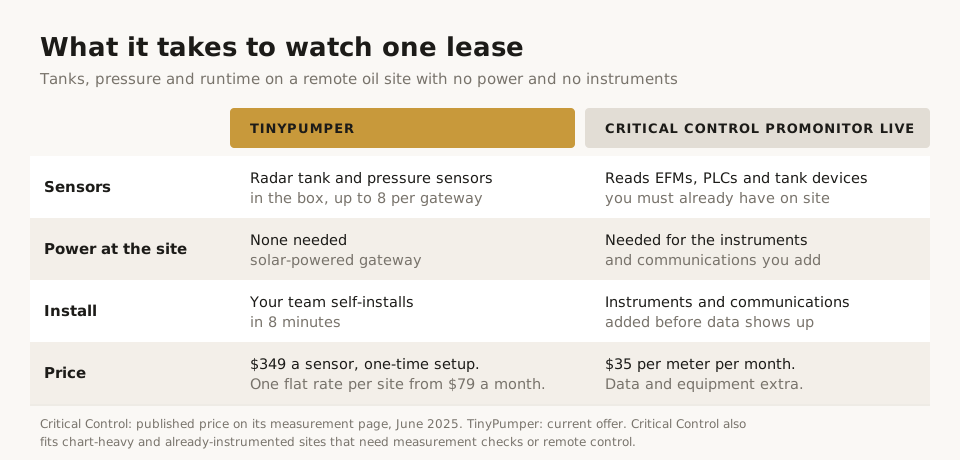
| Sensors | Not included; “data and equipment costs excluded” (Critical Control, June 2025) | Included in the setup; up to 8 sensors per gateway |
| Power at the site | Needed for the instruments and communications you add | None; the gateway is solar powered |
| Install | Instruments and communications added to the site; its services team helps load your data | Your team self-installs in 8 minutes, no electrician |
| Control | Yes; change set points, stop and restart equipment | No; it watches, it does not control |
| Pricing | $35 per meter per month, data and equipment extra (Critical Control, June 2025); ProChart priced per chart, number not published | $349 a sensor, one-time setup, then one flat rate a month per site, unlimited sensors |
| Coverage | Depends on the communications you add | 100% continental US coverage over satellite |
| If it breaks | Ask the vendor | Lifetime hardware replacement |
When Is TinyPumper the Better Fit?
- Your leases have no power and no instruments, and nobody on staff wires PLCs.
- You need tanks, pressure and runtime on one screen, not a measurement audit.
- You want one flat rate per site, so a busy tank battery does not multiply the bill.
- You want an alert right away. TinyPumper’s sensors check thresholds every 5 minutes and push an alarm the moment a line is crossed.
Producers running TinyPumper report cutting lease runs by 30 to 50 percent and catching failures days sooner. For the full field of choices, see oilfield monitoring alternatives, and for how it fits a whole lease, the oil well monitoring guide.
TinyPumper is GreaseBook’s sister product. It gives 100% continental US coverage because we use satellite. Each gateway carries up to 8 sensors. Every order comes with a 60-day money-back guarantee, and all equipment has lifetime replacement. Every well with a TinyPumper sensor gets free Greasebook, so the sensor readings sit next to your pumpers’ daily gauges and run tickets.
TinyPumper watches tanks, pressure and runtime on one solar gateway. $349 a sensor, one-time setup, then one flat rate a month per site. 60-day money-back.
See TinyPumperWhen Is Critical Control the Better Fit?
Be honest with yourself about the job. Critical Control is the better pick when:
- You still run a lot of paper gas charts and need them turned into checked volumes.
- Your sites already carry EFMs and PLCs, and you want one web screen over them.
- You need to stop, restart or adjust equipment from the office. TinyPumper does not do that.
- You want to hand gas composition, meter calibration and volume statements to an outside team.
If full control of instrumented facilities is the real need, also read our oil and gas SCADA guide.
Two Questions to Ask Before You Buy
- What has to be on the site before I see data? Get a list of every instrument, power source and communications device, with prices. TinyPumper’s answer: the gateway and sensors in the box.
- What does the monthly bill look like at my real meter or tank count? Per-meter pricing is fine on five meters and painful on fifty. Run your own numbers.
Who This Page Is Not For
This page is not for producers who need gas chart integration, measurement accounting or remote control of equipment. Critical Control fits that work better. For other ways to watch a lease, see oilfield monitoring alternatives and oilfield tank monitoring.
Frequently Asked Questions
What is Critical Control Technologies?
Critical Control Technologies is an oil and gas measurement company. It sells ProChart for turning paper gas charts into volumes, ProTrend for gathering and checking measurement data, and ProMonitor Live, a hosted web SCADA that reads the EFMs, PLCs and tank devices already on a site. It also offers outsourced volume statements and production accounting. Its focus is measurement accuracy from the wellhead through to the financial statement.
Is Critical Control Energy Services Inc. the same company?
Yes. Critical Control Energy Services Inc. is the services side of the same business, and you will see the name written as Critical Control, CriticalControl or Critical Control Technologies. The services team handles work like gas composition, meter calibration scheduling and volume statements, while the software side sells ProChart, ProTrend and ProMonitor Live. Either name points to the same oil and gas measurement company.
What is the best CriticalControl alternative?
It depends on the job. If you need gas chart integration or measurement accounting, look at other measurement service firms. If you need to watch tanks, pressure and runtime on leases with no power and no instruments, TinyPumper is the better alternative. It ships its own sensors, runs on solar, and your team self-installs it in 8 minutes for one flat rate per site.
How much does Critical Control cost?
Critical Control publishes $35 per meter per month for its web SCADA, and says data and equipment costs are excluded (Critical Control website, June 2025). ProChart is priced per chart, but the number is not published. Hardware, communications and install fees are not published either, so ask for a full quote at your real meter count before you compare.
Does TinyPumper control wells?
No. TinyPumper watches; it does not control. It will not shut in a well or change a set point. It does send an alarm when a tank, pressure or runtime reading crosses your line, because the sensors check thresholds every 5 minutes. For most marginal leases that covers what you would pay SCADA for. If you need remote control, a SCADA system is the better fit.