Published November 6, 2026 · Updated November 6, 2026
Short answer: TotalRod is well management and production gauging software from Production Systems in Midland, Texas. It covers the whole life of the well, and its site says gauging data goes in through a desktop application or a web interface. If you want one database for drilling, completions, schematics and gauging, with lots of office users on one license, it does that job. If your real problem is getting gauges, pressures and run tickets off the lease every day, you need something your pumpers will use on the phone in their pocket. That is GreaseBook: an 8-minute pumper learning curve, offline mode, and our petroleum engineers build the account for you.
The gap is usually not in the database. It is in the truck. The pumper writes the gauge on a sheet, texts a picture of the run ticket, and somebody keys it in Friday. Any system that waits for a laptop gets the numbers late.
Is TotalRod or GreaseBook the Better Fit for My Operation?
It depends on who enters the data and what you need to track. If you want one system for the whole life of the well, drilling and completions through gauging, with lots of office users on one license, TotalRod fits. If your pumpers, company or contract, need to log gauges, pressures and run ticket photos on their own phones, offline, with the back office seeing it the same day, GreaseBook fits. If you run SCADA on your best wells, GreaseBook works alongside it.
What Is TotalRod?
TotalRod is a well operations database and production gauging system built and licensed by Production Systems, a Midland, Texas company. It has two parts: Well Management (drilling, completions, well servicing, schematics, pumping unit inspections, fluid levels, well tests, downtime, failures) and Production Gauging (battery production, tank gauges, meter readings, run tickets, injection, compressor readings, well tests and well allocation).
Production Systems says it was founded in 1989 (TotalRod About Us page, 2026), and that TotalRod has been in use for over twenty years (TotalRod FAQ, 2026).
TotalRod is not Total Rod Concepts. Total Rod Concepts, Inc. is a Midland oil field equipment company that sells sucker rods. If you searched “Total Rod” looking for rods, that is them. If you searched “TotalRod software” or “Total Rod software,” you want Production Systems. The two names show up side by side in Google, which trips a lot of people up.
What Does TotalRod Do Well?
- It covers the life of the well. Drilling, completions, servicing and inspections live in the same place as daily gauging. Few production tools go that wide.
- No per-seat licensing. TotalRod says it is licensed on a corporate basis by number of wells and batteries, with no limit on users (TotalRod Features and Benefits page, 2026). That helps a company with many occasional office users.
- It works offline. Its site says users can work without an internet connection, and its training covers syncing for users not connected to the main server.
- It has been around. Twenty-plus years in the field counts for something with a conservative operator.
- It scales. Its FAQ cites a client with 8,000+ wells, 2,500+ batteries and 150 pumpers (TotalRod FAQ, 2026).
If you have a staffed engineering and operations group that wants drilling history next to gauge sheets, that breadth is real value.
Where Does TotalRod Stop for an Independent Operator?
Most independents running a handful of wells to a couple thousand need one thing first: clean daily production from the field, fast. That is where TotalRod’s design shows its age.
- No pumper phone app on its site. TotalRod says gauging is entered “through the desktop application or the web-based interface.” We did not find a TotalRod app in the App Store or Google Play. A pumper who has to get to a laptop enters data from home, or not at all.
- Training is a project. Its training page says “proper training is critical” and offers sessions at your office, theirs, or online. Fine for a big team. Heavy for a two-person back office.
- Breadth you may not need. Drilling, schematics and inspection modules are more to set up and keep clean if you mostly want gauges and run tickets.
- No published accounting connections. Its training mentions exporting reports to Excel and PDF. We found no named accounting integrations on its site.
- No published price. You know the license is by wells and batteries. You do not know the number until you talk to them.
Paper and Excel fail because the numbers never land in one spot. Older desktop production software fails because the pumper has to carry the data back to a computer. Both leave the office two to three weeks behind.
How Does GreaseBook Compare?
| TotalRod | GreaseBook | |
|---|---|---|
| Built by | Production Systems, Midland, Texas | GreaseBook, 15 years in the oil patch |
| How pumpers enter data | Desktop application or web interface (TotalRod site, 2026) | Pumper app on iOS and Android, on the phone they already carry |
| Offline | Yes, with sync for users not on the main server | Yes, syncs automatically when back in range |
| Proof the pumper was there | Not stated on its site | Geofencing confirms the visit |
| Scope | Life of the well plus production gauging | Production: gauges, pressures, run tickets, well tests, allocation, downtime |
| Allocation | Well allocation listed in its gauging module | Well testing and allocation engine |
| State production reports | Not stated on its site | Prepared for any oil and gas producing state, ready for you to submit |
| Accounting connection | Excel and PDF export; no named integrations on its site | Integrates with every major accounting platform |
| Setup | Training at your office, theirs or online | Turnkey. Our petroleum engineers build the account |
| Pricing model | Corporate license by wells and batteries, unlimited users; price not published | Per well or per pumper, per month; office users always free |
| Guarantee | Not stated on its site | 200% money-back guarantee |
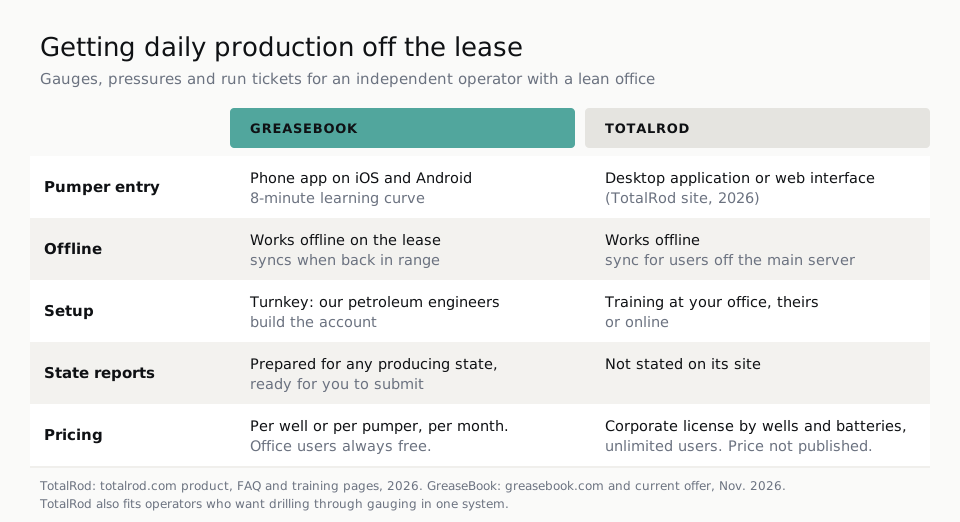
Where the TotalRod column says “not stated,” its public site does not say. Ask them directly before you decide.
What Is GreaseBook?
GreaseBook is a production app for independent oil and gas producers running 2 to 2,000 wells. As of November 2026, 600+ production companies trust it with their data, 10,000+ pumpers use it in the field, and it has tracked 220 million+ barrels across 22 oil-producing states. Pumpers learn it in about 8 minutes. If he can text, he can use GreaseBook. Office users are 99% proficient in about 20 minutes. GreaseBook comes with a 200% money-back guarantee: run it for a full 6 weeks, and if it doesn’t work, we pay you double. TinyPumper, GreaseBook’s sister product, adds 24/7 sensor monitoring of tanks, pressures and runtime, and its data flows into the same GreaseBook dashboard.
Pumper data lands on your screen the same day: gauges, pressures, comments, run ticket photos, well tests. Fat-finger checks catch bad entries at the source. The alert engine flags a well that slipped. The well history file keeps it all in one place.
GreaseBook integrates with every major oil and gas accounting platform on the market. PakEnergy (formerly WolfePak), OGsys, Bolo, SSI, P2, PHDwin, and the rest of the majors you’d expect. Keep your accounting system. GreaseBook feeds it clean production data from the field.
We’re not the cheapest option out there. But a pumper app nobody uses costs more than one everybody does.
What Does Switching From TotalRod Look Like?
The heavy lifting is ours, not yours.
- You hand over a login to the system you run today.
- Our petroleum engineers build the account: wells, tank batteries, surface equipment, everything your pumpers need to start entering data.
- Pumpers learn the app in about 8 minutes on their own smartphones. No laptops to buy, no new gear.
- Pumpers give feedback on their routes and your supervisor signs off.
- Then we scrub, clean and backfill your historical production and records.
Most operators are fully rolled out within a week. Still under contract? Our contract buyout program covers the months left on your old provider’s contract, in exchange for a minimum one-year term plus the bought-out months.
The first week, your pumpers might grumble. By week three, most won’t want to go back.
Take the 30-second quiz to see if you're a fit. If you are, grab 15 minutes with a production engineer and get your exact price. 200% money-back guarantee.
See GreaseBookWhen Is TotalRod the Better Fit?
If you want drilling, completions, schematics and pumping unit inspections in the same database as daily gauging, TotalRod covers more ground than GreaseBook does. If you have a large staff of occasional office users and your field team already enters data well on desktop or web, its unlimited-user license may suit you. And if TotalRod is working for you today, there is no reason to rip it out.
Is There a Free TotalRod Alternative on GitHub?
People search “TotalRod alternative GitHub” hoping for a free, open-source version. We don’t know of a maintained open-source package that does oil and gas production gauging, allocation and state reports. A home-built tool also means your office maintains it, backs it up and trains every new pumper on it. If cost is the worry, compare against what paper and Excel already cost you: clerk hours keying numbers twice and wells that slip while the truth sits in an inbox.
Who This Page Is Not For
This page is not for operators who want one life-of-well system covering drilling through gauging, and it is not for operators whose field team is happy entering data on desktop or web. For a wider look, see oil and gas production data management software and oil and gas production software.
Frequently Asked Questions
What is TotalRod software?
TotalRod is well management and production gauging software built and licensed by Production Systems in Midland, Texas. It tracks drilling, completions, servicing, schematics, inspections and failures, plus daily battery production, tank gauges, meter readings, run tickets and well allocation. Its site says gauging is entered through a desktop application or a web interface, and it is licensed by wells and batteries with unlimited users.
Is TotalRod the same company as Total Rod Concepts?
No. TotalRod is software from Production Systems, a Midland, Texas company. Total Rod Concepts, Inc. is a separate Midland oil field equipment company that sells sucker rods. The names look alike and both come up when you search “Total Rod,” so check which one you need. For production gauging software, you want Production Systems. For rods, you want Total Rod Concepts.
What is the best TotalRod alternative?
It depends on your problem. If you want daily production from the field fast, the best alternative is a pumper app that works offline on the phone your pumpers already carry. GreaseBook does that, with an 8-minute pumper learning curve, geofencing, an allocation engine and state reports prepared for any producing state. Our petroleum engineers build the account, and the 200% money-back guarantee backs it.
Is there a free TotalRod alternative?
We don’t know of a maintained free or open-source tool that handles oil and gas production gauging, allocation and state reports. Excel is free on paper, but it never sends an invoice for the real cost: clerk hours keying the same numbers twice, files that don’t match, and wells that slip unnoticed. A home-built tool on GitHub also needs someone in your office to maintain it.
Can I switch from TotalRod without losing my well history?
Yes. You hand over a login, and our petroleum engineers build your wells and surface equipment so pumpers can start entering data. After your pumpers give route feedback and your supervisor signs off, we scrub, clean and backfill your historical production. Most operators are fully rolled out within a week, and a contract buyout program covers months left on an old contract.