Published November 11, 2026 · Updated November 11, 2026
Short answer: CygNet is a full SCADA platform for oil and gas, built and sold by Weatherford. It is strong when you need to watch and control pipelines, plants and big compressor stations, and you have people to run servers and field gear. If you run conventional wells and the real problem is “we’re flying blind between pumper visits,” you likely need a monitor, not a control room. TinyPumper watches tanks, pressures and runtime, and your team installs it in 8 minutes.
Here is the night that sends most producers looking. The compressor trips at 2 a.m. Nobody knows until the pumper rolls up at seven. The SCADA quote you got last year never penciled, so those wells run blind.
Is CygNet or TinyPumper the Better Fit for My Wells?
It depends on the job. If you run pipelines, plants or compressor stations and need remote control, and you have staff to run servers and field gear, CygNet fits. If you run conventional wells where SCADA never penciled, and you just need to see tanks, pressures and runtime, TinyPumper fits. As of November 2026, it is $349 a sensor, one-time setup, then one flat rate a month per site. If you want a full SCADA platform but not Weatherford, Ignition is a common platform-to-platform alternative.
What Is CygNet SCADA?
CygNet SCADA is oil and gas SCADA software from Weatherford. You will see it written as CygNet (SCADA), the CygNet SCADA platform, or just CygNet software. They are all the same product.
The CygNet Weatherford brochure says the platform pulls data in real time from downhole sensors, flow meters, wellheads, plants and pipelines. Weatherford says it is “designed specifically for the oil and gas industry.” Some people call it CygNet oil field automation software, and that fits: it can watch and control.
CygNet SCADA software runs on Windows servers, and Weatherford recommends server-class hardware for it (CygNet 9.8 system requirements, as read July 2026). Some CygNet SCADA systems also need a Microsoft SQL Server license that you get on your own (same document). There is also a hosted version called CygNet on Demand.
The CygNet oil and gas interface is built for a control room. It has screens, alarms and trends that someone designs and keeps up to date. The CygNet blog at Weatherford says the product is moving to a cloud, software-as-a-service setup (Weatherford blog, “Announcing CygNet v9.9,” April 2025).
If you searched for CygNet Vision SCADA, the Weatherford material we reviewed does not show a separate product by that name. It calls the product the CygNet SCADA platform.
What Does CygNet Do Well?
- It is built for oil and gas. Wells, tanks, compressors, plants and pipelines are its home turf.
- It handles a big footprint. Weatherford says it scales to millions of data points and tens of thousands of devices (Weatherford CygNet brochure, as read July 2026).
- It talks to a lot of field gear. Weatherford lists Emerson, ABB, Lufkin and Allen-Bradley devices (CygNet on Demand brochure, as read July 2026).
- It can control, not just watch. If you need to change a setpoint from the office, SCADA does that.
If you run a large field with a SCADA team, that is a real strength. We are not going to knock it for doing what it says.
What Does a CygNet Build Actually Take?
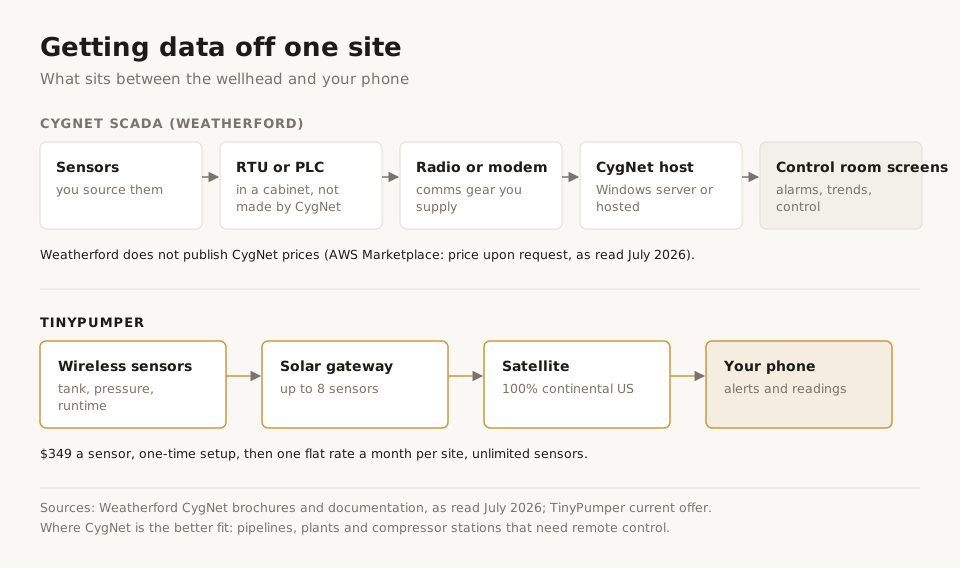
A SCADA CygNet system has four layers, and CygNet is only one of them. CygNet’s own docs say it “does not produce” RTUs, PLCs or field radios (CygNet documentation, as read July 2026). So you supply:
- Sensors on tanks, lines and equipment.
- An RTU or PLC in a cabinet at the site, wired to those sensors.
- A radio or modem link to get the data off the lease.
- The CygNet host, on your servers or hosted by Weatherford.
Weatherford says a cloud CygNet SCADA host can be up “in a matter of hours” (Weatherford CygNet brochure, as read July 2026). That is the software. The field work in steps 1 to 3 is still yours. Weatherford’s own rollout steps list “remote field device, communications installed and configured” as a separate step (CygNet on Demand brochure, as read July 2026).
Weatherford does not publish CygNet prices. Its AWS Marketplace listing says “price upon request based on scope of work” (AWS Marketplace, as read July 2026).
Where Does CygNet Overshoot for a Small Producer?
A full CygNet SCADA build is a lot of system for a well that makes a few barrels a day. The server, the license and the upkeep do not shrink when you only have 10 or 20 sites. Each site still needs its own cabinet, wiring and radio, and often a truck and a contractor to put it in.
Here is the plain version. CygNet tells you what the field devices sensed and what the control system did. For most conventional wells, you just need to know what the tanks, the pressure and the compressor are doing right now.
What Do People Say About CygNet?
There are not many public reviews. Its AWS Marketplace listing shows “no customer reviews yet” (AWS Marketplace, as read July 2026).
A CygNet SCADA alternative Reddit search is where most of the plain talk lives. On r/PLC, one person said of CygNet and similar tools: “Used mostly in Oil and Gas and power generation, but they are lots of maintenance” (Reddit). On r/oilandgasworkers, another said “the idea of SCADA sounds nice until you see your bill for it” (Reddit). Those are single opinions, not facts.
A CygNet SCADA alternative GitHub search turns up code. Code does not mount a sensor on a tank or keep a radio link alive on a lease 40 miles from town.
How Does TinyPumper Compare?
| CygNet SCADA (Weatherford) | TinyPumper | |
|---|---|---|
| What it is | Full SCADA platform: data, screens, alarms, history and control | Wireless site monitor: tanks, pressures and runtime |
| Field hardware | Not included. CygNet does not make RTUs, PLCs or radios (CygNet docs, as read July 2026) | Radar tank sensor, pressure sensor and solar gateway, with lifetime replacement |
| What runs it | Windows servers, or hosted CygNet on Demand | No server to keep. Readings go to your phone |
| Install | Host “in a matter of hours” (Weatherford brochure, as read July 2026), plus field devices and comms | Your team self-installs it in 8 minutes |
| Control | Yes, it can watch and control | No. It watches only |
| Coverage | Depends on the radios and modems you choose | 100% continental US coverage over satellite |
| Pricing | Not published. “Price upon request” (AWS Marketplace, as read July 2026) | $349 a sensor, one-time setup, then one flat rate a month per site, unlimited sensors |
| Trial | Ask Weatherford | 60-day money-back, we pay return shipping |
Here is our honest admission. TinyPumper watches; it does not control. It will not shut in a well or change a pump. But on most conventional wells, it gives you about 99% of what you’d pay SCADA for, and it is 95% cheaper than SCADA.
TinyPumper gives 100% continental US coverage because we use satellite. Each gateway takes up to 8 sensors. Every order comes with a 60-day money-back guarantee. All equipment has lifetime replacement. TinyPumper is GreaseBook’s sister product, and every well with a TinyPumper sensor gets free Greasebook.
When Is TinyPumper the Better Fit?
- SCADA never penciled. Your wells are conventional, and the math on a full SCADA build never worked.
- Old SCADA costs more than it returns. You inherited cabinets nobody can log into, and keeping them alive is a drain.
- You’re flying blind between pumper visits. You want to know the compressor quit at 2 a.m. at 2 a.m., not at seven.
- You want alerts fast. Sensors report every hour and check your limits every 5 minutes, so an alarm goes out right away.
- You have dead zones. Satellite covers 100% of the continental US.
Producers running TinyPumper report cutting lease runs by 30 to 50 percent and catching failures days sooner. For the bigger picture, see our oil and gas SCADA guide and the full list of oilfield monitoring alternatives.
TinyPumper watches tanks, pressures and runtime on one gateway. $349 a sensor, one-time setup, then one flat rate a month per site. 60-day money-back.
See TinyPumperWhen Is CygNet the Better Fit?
If you need to control pipelines, plants or compressor stations from an office, CygNet is built for that and TinyPumper is not. The same goes for a large field that already has RTUs in place and a team that knows them. If you want to stay on a full SCADA platform but leave Weatherford, Ignition is a common platform-to-platform alternative; see our Ignition SCADA alternative page.
Who This Page Is Not For
This page is not for producers who need remote control of pipelines, plants or compressor stations. It is also not for teams that run a SCADA staff and want to stay on a full platform. For simpler tank-only options, see the Tank Sentinel alternative and TankScan alternative pages.
Frequently Asked Questions
What is CygNet software?
CygNet software is Weatherford’s SCADA platform for oil and gas. It pulls data from flow meters, wellheads, tanks, compressors, plants and pipelines into one system with screens, alarms and history. It runs on Windows servers or as a hosted service called CygNet on Demand. CygNet does not make the sensors, RTUs or radios in the field. Those come from other vendors.
Is SCADA obsolete?
No. SCADA still runs pipelines, plants and big compressor stations, where remote control pays for itself. What has changed is the small, conventional well. For a lease making a few barrels a day, a full SCADA build often costs more than it returns. That is where a simple wireless monitor like TinyPumper fits: you see tanks, pressures and runtime without the build.
Is SCADA outdated?
The idea is not outdated, but a lot of old installs are. Many leases still carry aging RTUs, dead solar panels and custom setups nobody remembers how to fix. Weatherford is moving CygNet toward hosted and cloud setups. For a small producer, the real question is not age. It is whether the upkeep is worth what the system tells you.
Is there a free SCADA software?
Some SCADA software is free or open source, and you will find projects on GitHub. But the software is the cheap part. You still need sensors, an RTU or PLC, a radio or modem, a server, and someone who can set it all up and keep it running. For conventional wells, free software rarely makes a full SCADA build pencil.
Who sells SCADA software?
In oil and gas, SCADA software comes from big service and automation companies and from smaller hosted providers. Weatherford sells CygNet. Inductive Automation sells Ignition. Hosted providers like eLynx and ZDScada run SCADA as a service. Most of them still need field hardware and a contractor to install it. TinyPumper is not SCADA. It is a wireless monitor that watches the site.
What are the top 5 SCADA software platforms?
There is no single top five. It depends on your industry and your size. In oil and gas, names that come up include Weatherford CygNet, Ignition, eLynx and ZDScada. Large plants and pipelines lean on the full platforms. Small conventional producers often find all of them more than they need, and look at simpler wireless monitors like TinyPumper instead.
What are the four types of SCADA systems?
Most guides split SCADA into four kinds. Monolithic systems ran on one central computer. Distributed systems split the work across several computers on one network. Networked systems linked sites over wide-area networks. IoT systems send data to the cloud from wireless devices. CygNet runs on servers and is adding cloud options. TinyPumper works more like the fourth kind.
What is the best CygNet SCADA alternative?
It depends on what you need. If you want another full SCADA platform with control, Ignition is a common platform-to-platform alternative. If you run conventional wells and just need to see tanks, pressures and runtime, TinyPumper is the simpler fit. Your team installs it in 8 minutes, the gateway runs on solar, and there is no server to keep.
Does TinyPumper control wells like CygNet does?
No. TinyPumper watches; it does not control. It will not shut in a well or change a pump. It reports tank levels, pressures and engine or compressor runtime, and sends an alert when something crosses your limit. For most conventional wells, that covers about 99% of what you would pay SCADA for, without the cost or the upkeep.