Short answer: Zedi is a cloud SCADA platform for oil and gas, owned by Emerson and now sold as DeltaV SaaS SCADA. It polls the RTUs, PLCs and flow computers on a site, raises alarms and lets an operator control equipment from a screen. That is the right tool when a facility is already instrumented and needs control. On conventional wells where SCADA never penciled, or where aging SCADA costs more to keep alive than it returns, most producers just need to see tanks, pressures and runtime. TinyPumper gives you that view on one gateway, for one flat rate per site, and your team installs it in 8 minutes.
It is 2 a.m. on a lease 40 miles from the yard. The compressor quit at midnight and the water tank is climbing. Full SCADA would tell you, and so would a monitor that cost a fraction as much. The question is how much system the lease actually needs.
Is Zedi or TinyPumper the Better Fit for My Leases?
It depends on what the lease needs. If you already run RTUs, PLCs and flow computers and need to start, stop and adjust equipment from the office, Zedi’s cloud SCADA (now Emerson’s DeltaV SaaS SCADA) is built for that job. If you need to see tank levels, pressures and runtime on conventional wells where SCADA never penciled, TinyPumper watches all three on one gateway. As of November 2026, it costs $349 a sensor, one-time setup, then one flat monthly rate per site. TinyPumper watches; it does not control.
What Is Zedi SCADA?
Zedi SCADA is a cloud-hosted SCADA and remote data platform with a web screen and a mobile app called Zedi Go. It collects data from field controllers and gateways, raises alarms and, where permitted, sends commands back to equipment. Emerson bought Zedi Inc.’s software and automation businesses in 2019 (Emerson announcement, 2019), and the platform is now marketed as DeltaV SaaS SCADA.
Zedi is built for oil and gas producers, and Emerson also sells it into water and wastewater operations (Zedi SCADA brochure, accessed July 2026). So it is a general industrial SCADA platform with deep oilfield roots, not a lease-only tool.
Which Zedi Are You Looking For?
The name gets mixed up, so here is a quick sort.
If you searched for Zedi SCADA or Zedi Inc., you are in the right place: that is the oilfield cloud SCADA company Emerson bought. Some people type it as zed i, and Google sends them to the same place.
If you searched for an Allen and Heath ZEDi, that is a different product entirely: a small audio mixing desk. If you want the ZEDi-10 or the ZEDi-6 mixer, an Allen Heath ZEDi alternative, or the ZEDi-10FX manual, head to Allen & Heath. This page will not help you mix a band.
Looking for the Zedi phone number? Emerson now supports Zedi customers, so use the contact page on Emerson’s site. We don’t publish another company’s support lines, because they change and a wrong number wastes your morning.
What Does Zedi Do Well?
- It is real SCADA. Zedi polls field devices and can control them. Emerson says it supports over 200 device and protocol types (Emerson video, accessed July 2026).
- It has a long track record. At the time of the Emerson purchase, Zedi technology was watching more than 2 million sensors (Emerson announcement, 2019).
- It takes security seriously. Data travels over private, encrypted networks, and Zedi reports at least 99.9% observed availability, which it notes is a history, not a guarantee (Zedi security brochure, accessed July 2026).
- It is built for hazardous locations. Zedi Connect field hardware carries a Class I, Division 2 hazardous-location rating (CSA certification report, accessed July 2026).
- Users are not metered. Zedi says there are no seat or site licenses for users (Zedi security brochure, accessed July 2026).
If you have instrumented facilities and a team that runs SCADA, that is a serious product.
Where Does Cloud SCADA Overshoot a Conventional Lease?
Cloud SCADA moves the screen and the server off your desk. It does not move the field work. Zedi still sits on top of a normal SCADA build at the wellsite:
- A panel. Controller, modem and terminals in an enclosure, built and landed by trained hands.
- Wiring. Transducers wired back to the controller, plus the protocol mapping so the tags read right.
- A project. Emerson’s own pitch is up and running in weeks, not months. That is fast for SCADA, and still a project, not a morning.
- Price you have to ask for. Emerson does not publish Zedi pricing (Emerson and Zedi websites, checked November 2026). One SCADA engineer on Reddit said their Zedi implementation cost about the same as a CygNet install, with monthly hosting on top (r/SCADA thread, accessed July 2026).
On a well making a few barrels a day, that math rarely works. That is why so many conventional wells run blind between pumper visits.
How Does TinyPumper Compare?
| Zedi (DeltaV SaaS SCADA) | TinyPumper | |
|---|---|---|
| What it is | Cloud SCADA: monitoring, alarms and remote control | Remote monitoring: tanks, pressures and runtime |
| What it watches | Whatever the site’s controllers and instruments report | Tank levels, wellhead, flowline and injection pressure, engine or compressor runtime |
| Field hardware | Controller, modem and panel at the site, wired to your instruments | Solar gateway plus wireless sensors; radar on top of the tank, no fluid contact |
| Install | A project; Emerson says weeks (Emerson website, accessed July 2026) | Your team self-installs in 8 minutes |
| Control | Yes, where the site allows it | No. It watches, it does not control |
| Coverage | Private carrier networks and satellite through Zedi (Zedi security brochure, accessed July 2026) | 100% continental US coverage, because we use satellite |
| Pricing | Not published (Emerson website, checked November 2026) | $349 a sensor, one-time setup, then one flat rate a month per site, unlimited sensors |
| If it breaks | Ask the vendor | Lifetime hardware replacement |
| Trial | Ask the vendor | 60-day money-back, we pay return shipping |
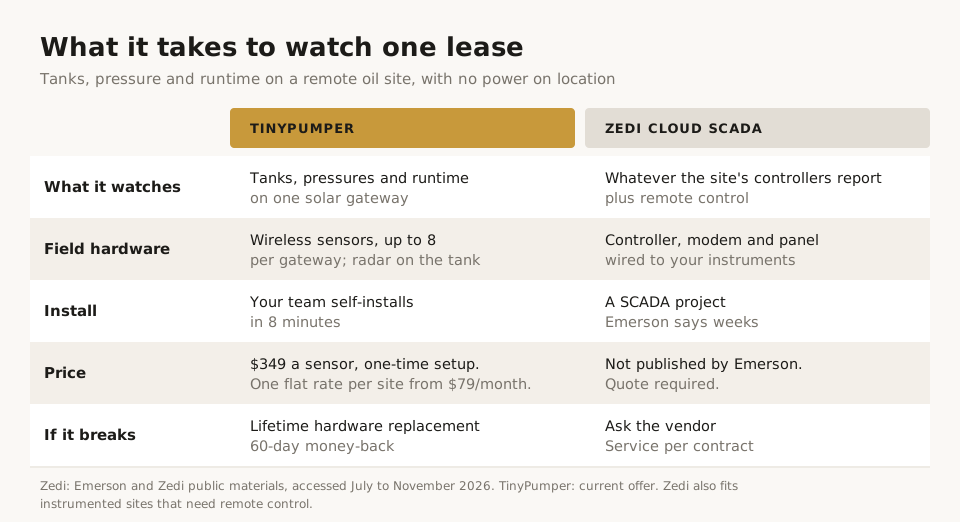
Where the Zedi column says “not published” or “ask the vendor,” its public materials don’t say. Get it in writing before you sign.
When Is TinyPumper the Better Fit?
- SCADA never penciled on these wells. TinyPumper gives you roughly 99% of SCADA’s upside for about 95% less than SCADA.
- Your SCADA is aging and the upkeep is eating you. Swap sites to TinyPumper one at a time, no panel rebuild.
- You want to know the minute something goes wrong. Sensors report every hour and check your thresholds every 5 minutes, so an alarm goes out right away.
- You don’t want a bill per point. One flat monthly rate per site covers every sensor at that location.
- You have no power and no cell signal. The gateway runs on solar, and satellite covers 100% of the continental US.
Producers running TinyPumper report cutting lease runs by 30 to 50 percent and catching failures days sooner. It works the same at 50 wells or 5,000; the dividing line is the cost of SCADA per site, not the size of the company. See the full picture in our oil well monitoring systems guide.
Tanks, pressures and runtime on one gateway. $349 a sensor, one-time setup, then one flat rate a month per site. 60-day money-back.
See TinyPumperWhen Is Zedi the Better Fit?
If you need to start, stop or change setpoints on equipment from the office, Zedi does that and TinyPumper does not. If your facilities already have controllers and flow computers wired up, a SCADA team to run them, and a security office that wants private networks and formal audit trails, Zedi fits that world well. For the broader picture of when full SCADA earns its keep, read our oil and gas SCADA guide.
Two Questions to Ask Before You Buy Either One
- Do I need to control this site, or just see it? If seeing is enough, you are about to pay for control you won’t use.
- Who fixes it when it breaks at 2 a.m.? With a SCADA panel, it is often a technician on a service call. TinyPumper sensors screw in like a lightbulb, and a broken one gets replaced for life.
TinyPumper at a Glance
TinyPumper is 24/7 remote well monitoring for oil and gas producers. It has 100% continental US coverage, because we use satellite. It connects up to 8 sensors per gateway. It comes with a 60-day money-back guarantee. It carries lifetime replacement on all equipment, every sensor included. It is rated Class I Div 1 and IP67, and works from -40 to 158°F. TinyPumper is Greasebook’s sister product, and every well with a TinyPumper sensor gets free Greasebook.
Who This Page Is Not For
This page is not for producers who need remote control of instrumented facilities, and it is not for SCADA teams already happy with a Zedi stack. If you are shopping the whole field of options, see oilfield monitoring alternatives and oilfield tank monitoring.
Frequently Asked Questions
What is Zedi SCADA?
Zedi SCADA is a cloud-hosted SCADA platform for oil and gas, with a web screen and the Zedi Go mobile app. It collects data from field controllers and gateways, sends alarms, and can control equipment where the site allows it. Emerson bought Zedi Inc.’s software business in 2019 and now sells the platform as DeltaV SaaS SCADA.
What is the best Zedi alternative for oil and gas?
If you need remote control of instrumented facilities, another full SCADA platform is the alternative. If you need to see tank levels, pressures and runtime on conventional wells, TinyPumper is the better fit. It watches all three on one gateway, your team self-installs it in 8 minutes, and it costs $349 a sensor, one-time setup, then one flat monthly rate per site.
Can TinyPumper control my wells like SCADA?
No. TinyPumper watches; it does not control. It will not shut in a well or change a setpoint. It reports tank levels, pressures and engine or compressor runtime every hour, checks your thresholds every 5 minutes, and sends an alert the moment something crosses a line. For most conventional leases, that covers what producers actually need from SCADA.
How is TinyPumper priced compared with Zedi?
Emerson does not publish Zedi pricing, so you have to ask for a quote. TinyPumper is $349 a sensor, one-time setup. Then one flat rate a month per site, with unlimited sensors at that site. Adding a tank or a pressure sensor to the same site does not add a monthly charge. Every order comes with a 60-day money-back guarantee.
What is the meaning of zedi?
Zedi has two common meanings. In oil and gas, Zedi is the cloud SCADA platform for monitoring and controlling field equipment, built by Zedi Inc. and owned by Emerson since 2019, now sold as DeltaV SaaS SCADA. In audio, ZEDi is a line of small Allen & Heath mixers, such as the ZEDi-10 and ZEDi-6. This page covers the oilfield one.
Is zedi a scrabble word?
Zedi is a company and brand name, not a dictionary word, and standard Scrabble rules don’t allow proper nouns or brand names. In the oil patch it means the cloud SCADA platform Emerson now sells as DeltaV SaaS SCADA. On a music store shelf it means an Allen & Heath mixer. Neither one will score you points.