Published November 12, 2026 · Updated November 12, 2026
Short answer: Quorum Software On Demand Production (formerly Field Insights) is a cloud production operations system inside Quorum’s upstream suite. It pulls in SCADA and meter data, runs allocation and regulatory reporting workflows, and hands volumes to Quorum’s accounting and land products. If you want one vendor for the back office, that is its strength. If you’re an independent producer whose real problem is getting clean numbers off the lease every day, the better Quorum Software On Demand Production alternative for that job is a field-first app. GreaseBook puts gauges, run tickets and pumper comments on the phone your pumper already carries, and he learns it in about 8 minutes.
It’s the tenth of the month. A partner wants last month’s volumes. The gauge sheet doesn’t match the run ticket on Lease 14. Nobody wrote down whether the well was shut in for three days or just skipped. The only man who knows is on the road with no signal, and you’re stuck chasing the pumper down. The allocation engine in the office is only as good as what comes off that lease.
Is Quorum On Demand Production or GreaseBook the Better Fit for My Operation?
It depends on where it hurts. If you already run Quorum’s accounting and land and need governed allocation tied straight to revenue distribution across many assets, Quorum On Demand Production keeps that in one suite, and it may be your better pick. If the problem is getting clean numbers from your pumpers every day, GreaseBook does that job: an 8-minute pumper learning curve, offline entry and geofenced visits, with 600+ production companies on it as of November 2026. Many producers split the work: field capture in GreaseBook, the books where they already live.
What Is Quorum On Demand Production?
Quorum On Demand Production Operations is a cloud (SaaS) production management system for upstream oil and gas. It brings SCADA, field and measurement data into one place, checks it, allocates volumes, and supports regulatory reporting. It is one module of Quorum’s Upstream On Demand suite, which also covers accounting, land and well operations.
It used to be called Field Insights. Quorum partner PetroLedger says the product was renamed On Demand Production (PetroLedger partner page, read July 2026). The iPhone app still carries the name Field Insights Mobile. The Android app is listed as ODP Mobile, and it needs an existing On Demand Production account to log in (Google Play listing, May 2026).
So when you search “Quorum on demand,” you’re looking at a family of products, not one app. Production is the piece this page is about.
What Does Quorum On Demand Production Do Well?
Credit where it’s due. For the right buyer, it’s a strong system.
- One system of record for production. Quorum’s page says it pulls data from SCADA, field capture tools and measurement platforms, with built-in validation rules (Quorum website, 2026).
- Allocation with an audit trail. Real-time allocation, visible logic and facility diagrams, with raw and allocated volumes side by side.
- Tight ties to its own back office. Validated volumes flow to On Demand Accounting for revenue distribution and joint interest billing, and ownership syncs from On Demand Land.
- Forecast against plan. You can load targets in bulk and watch variance on dashboards.
- Scale. Quorum says 500+ companies use its On Demand products (Quorum website, 2026), and it’s built for multi-basin, multi-asset portfolios.
- Upgrades you don’t install. As a cloud product, regulatory updates arrive on their own.
If you run many assets, already live in Quorum’s accounting, and your pumpers enter data without a fight, that’s a real case for staying put.
What Does Quorum Do Best, and What Does GreaseBook Do Best?
We are not trying to win the back office. We’d rather you keep what works there. Here is the honest split.
| What Quorum On Demand does best | What GreaseBook does best |
|---|---|
| Governed allocation inside one vendor’s suite, tied to its own accounting and land products | Getting the pumper to enter clean gauges, run tickets, well tests and comments at the well, on his own phone |
| Revenue distribution, joint interest billing and ownership through On Demand Accounting and Land | Proof of the visit: geofencing confirms the pumper stood on the lease |
| Pulling SCADA and gas measurement data into one record across many assets | Working offline in dead zones and syncing when back in range |
| Forecasting and variance-to-plan dashboards for large portfolios | Catching bad entries at the source (“fat finger” checks) before they reach any report |
| Enterprise rollouts with IT and admins on staff | Turnkey setup by our petroleum engineers, pumpers trained in half a day |
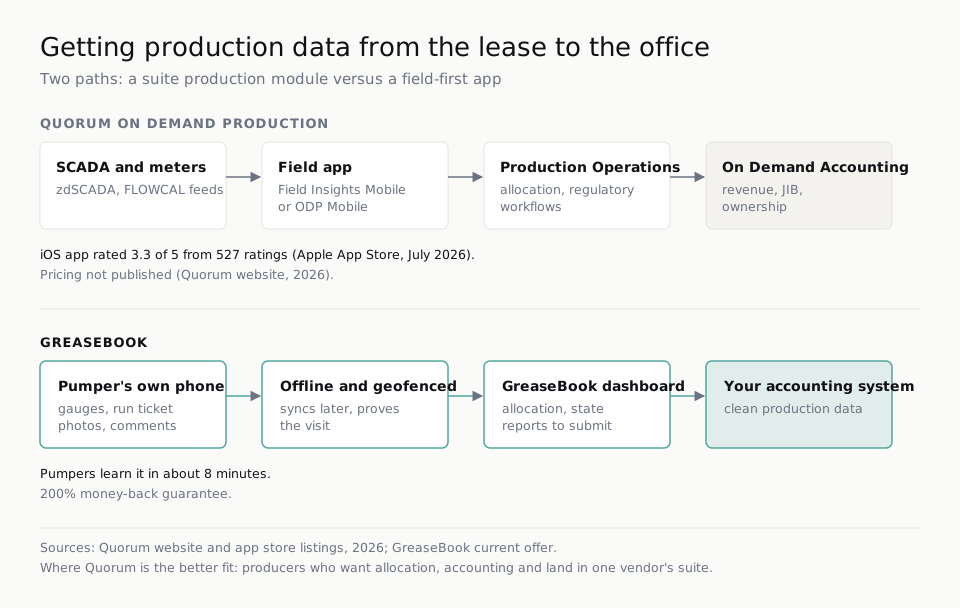
The point of the two columns: these are different jobs. A producer can need both.
Where Does a Suite Production Module Get Hard in the Field?
None of this means Quorum is a bad product. It means a module built to serve a whole suite has to please the office first. The friction tends to show up on the lease.
The app ratings are mixed. Field Insights Mobile sits at 3.3 out of 5 from 527 ratings (Apple App Store listing, July 2026). Several reviewers there mention sync trouble, crashes, and needing an admin to fix an old entry.
Fixing a past day can be work. Some reviewers describe a correction on one day forcing them to rework the days after it. When fixing data costs that much, pumpers stop fixing it. That’s how kitchen table pumping starts: numbers keyed in at home, from memory, at night.
The Android app looks new. The ODP Mobile listing shows “Initial release” with an update in May 2026 (Google Play listing, May 2026). If most of your contract pumpers carry Android phones, ask how long that app has been in the field.
Prices and timelines aren’t public. Quorum says the suite uses a subscription model but publishes no prices, and it markets “75% faster onboarding” without a go-live timeline (Quorum website, 2026). Ask for both in writing.
Breadth means setup. A suite that spans accounting, land, well operations, SCADA and a data hub has a lot to configure. That’s fine with an IT team. It’s heavy for a lean office.
How Does GreaseBook Handle the Field Side?
GreaseBook is built around one job: getting production data from the pumper’s phone to your screen the same day.
- The phone he already has. iOS and Android. If he can text, he can use it. Average learning curve is about 8 minutes.
- Offline first. Cell signal drops on the lease. GreaseBook keeps working and syncs when he’s back in range.
- Proof he was there. Geofencing confirms the visit. You stop wondering whether the route got run.
- Feedback at the well. Pumpers see past readings and comments while standing in front of the well, so they catch a well that’s slipping before it’s a trend nobody noticed.
- Run tickets by photo. The image travels with the entry, so the office isn’t retyping paper.
- Allocation inputs that are actually complete. Well tests, downtime and shut-in state get recorded on the well. Allocation isn’t garbage-in when the source is right. See our guide to production allocation software.
- State production reports. GreaseBook prepares them for any oil and gas producing state, ready for you to review and submit. If your state’s form isn’t built yet, we build it at no cost.
- Every department sees well status without calling the pumper.
For the bigger picture on managing production data from the field, our pillar guide walks through the whole flow.
On the field side specifically, a tool built only for pumpers tends to beat a module built to serve a whole suite. That’s the only claim we’ll make here.
What Is GreaseBook?
GreaseBook is an oil and gas production app. 600+ production companies and 10,000+ pumpers use it. It has been in the oil patch for 15 years, has tracked 220 million+ barrels, and serves operators in 22 oil-producing states. Pumpers learn it in about 8 minutes, and office users are 99% proficient in about 20 minutes. It carries a 200% money-back guarantee: run it 6 weeks, and if you don’t see results, we pay you double what you paid us. TinyPumper, GreaseBook’s sister product, handles remote tank, pressure and runtime monitoring.
Our petroleum engineers build it for you. Pumpers learn it in about 8 minutes. 200% money-back guarantee.
See if GreaseBook fitsDoes GreaseBook Replace Quorum Accounting?
No. GreaseBook does not do the general accounting job: no ledger, no partner billing, no distributions. Quorum On Demand Accounting (and Quorum accounting more broadly) does that job, and that’s a real job a producer with partners needs done.
What GreaseBook does is the production side, start to finish: run ticket and purchaser reconciliation, allocation by well and lease, downtime tracking, state production reports, and alerts on production. Plenty of producers need nothing more than that. The ones who do need full accounting keep their accounting system and feed it clean production data.
GreaseBook integrates with every major oil and gas accounting platform on the market. PakEnergy (formerly WolfePak), OGsys, Bolo, SSI, P2, PHDwin, and the rest of the majors you’d expect. Run something we didn’t name? If it’s a major platform, we already talk to it. Tell us yours on the quiz and we’ll confirm on the spot.
What Do Quorum’s Other Product Names Mean?
Quorum sells a lot more than production software, and the names get mixed up in search.
Quorum On Demand Accounting is the upstream accounting product: revenue distribution, joint interest billing and volume-based expense allocations. Quorum bought OGsys in 2018 (PetroLedger partner page, read July 2026).
Is Quorum an ERP? People search “Quorum ERP” because the Upstream On Demand suite plays that role for many oil and gas producers. It isn’t a cross-industry ERP like SAP or IFS.
Quorum EC is Energy Components, Quorum’s hydrocarbon accounting product aimed at large operators. It is not the On Demand Production app.
Quorum QPTM is a midstream product for pipeline transactions. If you produce oil and gas at the wellhead, it isn’t what you’re shopping for.
Quorum Aucerna refers to the planning and economics business that joined Quorum in February 2021 (PetroLedger partner page, read July 2026). Quorum Execute comes from that side: well planning and delivery, not daily pumper data.
FLOWCAL by Quorum Software is gas measurement software. Quorum’s production page says On Demand Production integrates with it (Quorum website, 2026).
Quorum SCADA questions usually land on zdSCADA, which Quorum’s production page names as an integration (Quorum website, 2026). More on SCADA below.
Put together, Quorum oil and gas software covers upstream, midstream and planning. Quorum energy software is a broad catalog; Quorum Software oil and gas customers usually buy a few pieces, not all of it.
Looking for a Quorum Software On Demand Production tutorial? Quorum trains its own customers and markets unlimited training (Quorum website, 2026). The apps need an existing account, so there’s no public sandbox to learn on. GreaseBook training is done for you: about half a day for pumpers.
Who Are Quorum Software’s Competitors?
It depends on which Quorum product you’re comparing.
For Quorum oil and gas accounting at larger operators, buyers compare P2 and W Energy. For mid-size producers, PakEnergy, Bolo and SSI come up. For field data capture, producers compare IHS FieldDirect, Scout FDC and GreaseBook.
If you’re reading reviews of IFS vs. Quorum Software, know the difference going in. IFS is a broad ERP built for many industries. Quorum builds for energy. Neither one is a pumper app first.
The best Quorum Software On Demand Production fit is a producer already running Quorum’s accounting and land, with an IT team and pumpers who take to the app. The best Quorum Software On Demand Production alternative for field capture is the tool your pumpers will actually use every day.
What Does Switching the Field Side Look Like?
Switching sounds like a project. With GreaseBook it’s mostly a login.
- You hand over a login to your current system. That’s your whole job.
- Our petroleum engineers build it out: wells, surface equipment and everything needed to start entering data.
- Pumpers start on their own phones. No laptops, no new gear. They learn it in about 8 minutes.
- Pumpers give feedback on their routes, your supervisor signs off.
- Then we scrub, clean and backfill your historical production and records.
Most operators are fully rolled out within a week. If you’re in a contract with another provider, our contract buyout program buys out the months left, in exchange for a minimum one-year term plus those bought-out months. And 98% of operator trials succeed, which is why we back it with the 200% guarantee.
How Is GreaseBook Priced?
GreaseBook is priced per well or per pumper, per month. Office and in-house users are always free. Your price comes from three things: how many wells you run, how many pumpers cover your routes, and what you need to track. Every operation is different, so we don’t post a number.
Take the 30-second quiz to see if you’re a fit. If you are, grab 15 minutes with a production engineer and walk out with your exact price.
How Do the Best Operators Evaluate Field Software?
The best operators test the field side in the field, not in a conference room.
| The amateur… | The pro… |
|---|---|
| Picks the field app that comes bundled with the accounting suite | Picks the field tool the pumpers will use, then makes sure it feeds the books |
| Watches a demo on an office monitor | Hands a phone to the oldest pumper on the payroll and watches |
| Asks “does it allocate?” | Asks “where do well tests, downtime and shut-ins get recorded?” |
| Accepts “we’ll quote you later” on price and timeline | Gets both in writing before signing |
| Assumes offline works | Turns on airplane mode at the wellhead and tries it |
What Should You Avoid When Comparing Quorum and GreaseBook?
- Don’t compare the wrong products. Quorum’s accounting and GreaseBook do different jobs. Compare field app to field app.
- Don’t judge by the office screen. The data quality is decided at the well, by the pumper.
- Don’t skip the correction test. Have someone fix a reading from three days ago. Time it.
- Don’t ignore app store ratings. Pumpers live in the app. Their reviews tell you what adoption will look like.
- Don’t sign multi-year before a field trial. Run it on real routes first.
Does SCADA Change the Answer?
Some. If you search “SCADA Quorum,” you’ll find Quorum’s production system pulls in data from SCADA platforms like zdSCADA. GreaseBook pulls in SCADA data too, so horizontal operators with SCADA on their best wells see field-entered and SCADA-sourced data on one screen. GreaseBook lives alongside SCADA; it doesn’t try to replace it.
For conventional wells where SCADA never penciled, look at TinyPumper, GreaseBook’s sister product. It gives you roughly 99% of SCADA’s upside without the cost or the complexity, and your team self-installs it in 8 minutes. More in our oil and gas SCADA guide.
Who This Page Is Not For
This page isn’t for producers already on Quorum’s full suite whose pumpers enter clean data without a fight. Keep what works. It also isn’t for anyone who needs a general ledger, partner billing or distributions from one vendor; GreaseBook doesn’t do accounting. If you’re on paper or Excel, or your field app is the weak link, keep reading our oil and gas production data guide.
Frequently Asked Questions
What does Quorum Software do?
Quorum Software builds software for the energy business. Its Upstream On Demand suite covers accounting, land, well operations and production operations for oil and gas producers, and other lines serve midstream and planning work. On Demand Production is the production piece: it brings in SCADA, meter and field data, runs allocation and regulatory reporting workflows, and passes validated volumes to Quorum’s accounting product.
Is Quorum software an ERP?
Not in the general sense. Quorum does not sell a cross-industry ERP like SAP or IFS. Its Upstream On Demand suite plays a similar role for oil and gas producers, tying accounting, land and production into one set of records, which is why people search for a Quorum ERP. For the field side, many producers still use a separate app built for pumpers.
Who are Quorum Software’s main competitors?
It depends on the product. In upstream accounting, larger operators compare P2 and W Energy, while mid-size producers look at PakEnergy, Bolo and SSI. In field data capture, producers compare IHS FieldDirect, Scout FDC and GreaseBook. A competitor to Quorum’s accounting is a different product from a competitor to its field app, so compare the piece you actually need.
What is the best software for oil and gas production accounting?
It depends on how far past production you need to go. For the production side, meaning run ticket and purchaser reconciliation, allocation by well and lease, downtime and state production reports, GreaseBook covers it without a big suite. If you also bill partners and cut distributions, you need an oil and gas accounting system too, and GreaseBook feeds it clean production data.
What is the best software for a production company?
It depends on your size and where it hurts. An oil and gas production company whose pumpers report on paper or Excel usually gets the most from a field-first production app like GreaseBook. Producers with partners and royalty owners also need oil and gas accounting software. Large portfolios lean on bigger suites like Quorum, and tanks between visits call for monitoring like TinyPumper.
What is the best production software for manufacturing?
GreaseBook is not built for manufacturing, and neither is Quorum. Factories usually look at manufacturing execution systems and general ERP tools that schedule lines, track work orders and manage parts. If your production is oil, gas and water coming off leases, those tools don’t fit. You want software built around gauges, run tickets, well tests and state production reports.
Is Quorum On Demand Production the same as Field Insights?
Yes. Quorum partner PetroLedger says On Demand Production used to be called Field Insights. The iPhone app still carries the Field Insights Mobile name on the App Store, and the Android app is listed as ODP Mobile on Google Play. Both apps need an existing On Demand Production account to log in, so there is no public version to try first.
What is the best Quorum Software On Demand Production alternative?
It depends on which part you want to replace. If you need field capture that pumpers learn in about 8 minutes, that works offline and confirms each visit with geofencing, GreaseBook is built for that job and runs alongside your accounting system. If you need allocation, regulatory workflows and accounting in one vendor’s suite, Quorum may still be the better fit.