Short answer: WellAware is an industrial monitoring and control platform (edge hardware, connectivity and cloud software) that serves energy producers, midstream operators, chemical service providers and other industries. It is strongest on chemical tank and injection pump programs and on tying into existing SCADA. If you are an independent producer who needs to see tank levels, pressures and compressor runtime on leases with no power, TinyPumper is the simpler fit: one gateway, one flat rate per site, and your team installs it in 8 minutes.
It is 5:40 on a Friday and the yard is emptying out. You want to know what Lease 14 is doing before you leave, and you do not want to wait for an integrator to wire it up first. That is the gap this page is about.
Is WellAware or TinyPumper the Better Fit for My Leases?
It depends on what you need the system to do. If you run chemical injection programs, need to change pump rates from the office, or must feed an existing SCADA network, WellAware is built for that work. If you need tank levels, pressures and compressor runtime on leases with no power, TinyPumper watches all three on one gateway your team installs in 8 minutes. As of October 2026, TinyPumper is $349 a sensor, one-time setup, plus one flat monthly rate per site. If you also need daily gauges and state reports, add GreaseBook, its sister product.
What Is WellAware?
WellAware is a remote monitoring and control platform made by WellAware Holdings, Inc., which describes itself as “a Texas-based hardware and software automation company” (WellAware About page, 2026). It bundles an edge device, a field app for setup and calibration, cloud reports and alarms, and integration with SCADA, Modbus, OPC and MQTT systems.
Oil and gas is a big part of its identity, but not the only part. Its own materials say its monitoring is used in all types of operational environments and verticals. So when you look for a WellAware alternative for oil and gas, you are really asking a narrower question: what does a producer with remote leases and a lean crew actually need?
What Does WellAware Do Well?
We are not going to knock a product for doing what it says. WellAware has real strengths:
- Chemical programs. Its Scout, Commander and Admiral packages step from tank monitoring, to remote pump rate changes, to full automation of chemical injection (WellAware blog, 2026). That is deep, specialized work.
- Control, not just watching. Commander lets you update setpoints remotely. TinyPumper does not do that.
- SCADA bridging. If you already have PLCs, RTUs or a radio network, WellAware says it can pull them into one place over Modbus, OPC and MQTT (WellAware blog, 2026).
- Outage handling. Its platform page says the device stores data and forwards it when the connection comes back, with a backup battery for power failures (WellAware platform page, 2026).
- Vendor support. It has a client success and field support team, and its gear gets over-the-air updates.
If that is the job you have, WellAware is a serious choice.
Where Does WellAware Get Heavy for an Independent Producer?
The weight is in the install and in the scope.
- The install is real field work. WellAware’s quick-mount tank guide calls for drilling a 2¼-inch hole in the tank top, grounding poly tanks with a rod and #6 wire, and using only classified power tools in hazardous areas (WellAware quick-mount install guide, 2026). Then the installer provisions the device in the app, fills out the site form and calibrates the sensor against observed tank volumes. If the field has poor signal, the form can fail and has to be sent again later.
- The tank sensor sits in the fluid. The quick-mount kit uses a hydrostatic sensor (same guide). Sensors that touch produced water and oil can corrode, freeze and foul.
- Well-side monitoring is an integration project. Wellhead pressure, flowline pressure and compressor status are possible through its SCADA connections, but that means more instruments and more mapping work. Its public materials do not show those as out-of-the-box kits.
- Most pricing is not published. The only number we found is $75 per pump per year for its Pump Monitoring software (AWS Marketplace listing, July 2026). Edge hardware, sensors and install are not listed, so you cannot price a 15-lease rollout without a quote.
None of that is wrong. It is the cost of an industrial platform. The question is whether your leases need one.
How Does TinyPumper Compare?
| WellAware | TinyPumper | |
|---|---|---|
| Built for | Energy producers, midstream, chemical service and other industries (WellAware About page, 2026) | Oil and gas producers running conventional wells |
| What it watches best | Chemical tanks and injection pumps; other points through SCADA integration | Tank levels, pressures (wellhead, flowline, injection) and engine or compressor runtime |
| Control | Yes, remote setpoint changes with its Commander package (WellAware blog, 2026) | No. It watches, it does not control |
| Tank sensor | Hydrostatic sensor in its quick-mount kit (WellAware install guide, 2026) | Radar on top of the tank, no fluid contact |
| At the tank | Drilled tank-top hole, grounding on poly tanks, app provisioning and calibration (WellAware install guide, 2026) | Your team self-installs in 8 minutes, no electrician, no trenching |
| Hazardous rating | Class I Division II (WellAware platform page, 2026) | Class I Div 1 certified, IP67 |
| Power | Battery, up to 5 years claimed (WellAware platform page, 2026) | Solar powered |
| Coverage | Cellular with store and forward (WellAware platform page, 2026) | 100% continental US coverage over satellite |
| Pricing | $75 per pump per year for Pump Monitoring software (AWS Marketplace, July 2026); hardware and install not published | $349 a sensor, one-time setup, then one flat rate a month per site, unlimited sensors |
| If it breaks | Lifetime coverage on its gear, terms in the contract (WellAware platform page, 2026) | Lifetime hardware replacement |
| Trial | Ask the vendor | 60-day money-back, we pay return shipping |
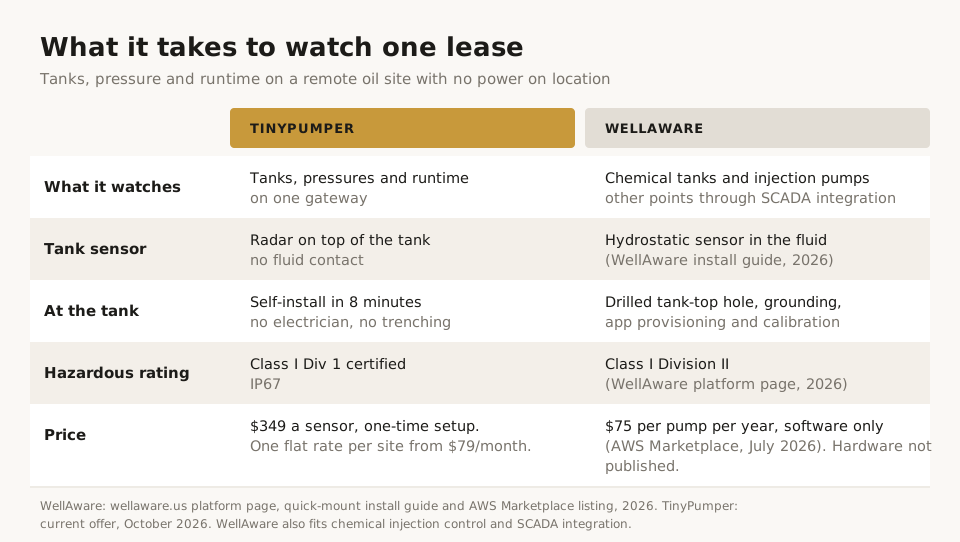
Where the WellAware column says “not published” or “ask the vendor,” its public site does not say. Ask them directly before you sign.
When Is TinyPumper the Better Fit?
- You need to watch, not control. Tanks, pressures and runtime on one screen, with alerts the moment something crosses a line. Sensors report every hour and check thresholds every 5 minutes.
- You have no controls crew. If you can change a lightbulb, you can install TinyPumper. Sensors screw in like one.
- You have no power and bad signal. The gateway runs on solar, and satellite covers 100% of the continental US.
- You want a price before the call. One flat rate per site, unlimited sensors, so a busy tank battery does not multiply the bill.
- SCADA never penciled. TinyPumper gives you roughly 99% of SCADA’s upside at about 95% less cost, at any well count.
Producers running TinyPumper report cutting lease runs by 30 to 50 percent and catching failures days sooner. For the whole picture, read our oil well monitoring systems guide and our guide to oilfield tank monitoring.
TinyPumper watches all three on one gateway. $349 a sensor, one-time setup, then one flat rate a month per site. 60-day money-back.
See TinyPumperWhen Is WellAware the Better Fit?
Pick WellAware if you run chemical injection programs and want remote rate changes, if you need to control equipment and not just watch it, or if you already have a SCADA network and want one platform over the top of it. If you need full control of instrumented facilities across a big field, also look at oil and gas SCADA. TinyPumper is not trying to win that job.
Which WellAware Is This Page About?
Searches for “WellAware” turn up several unrelated businesses that use the same or a similar name, including a population health program and a fractional ops consulting firm. If you were looking up the name’s meaning, that mix is why. This page is about WellAware Holdings, Inc., the oilfield and industrial monitoring company at wellaware.us.
For WellAware careers, leadership (including searches for Eric Anderson and WellAware), or the WellAware LinkedIn page, go to the company directly. We track what the product does for a producer, not who works there.
Older “WellAware alternative” lists from 2021 still rank. Products and prices have changed since then. Facts on this page are checked as of October 2026 unless a different source date is given.
Are There WellAware Reviews or Complaints?
We found no public customer complaints. Its AWS Marketplace listings showed no customer reviews (AWS Marketplace, July 2026). A public App Store review of the WellAware Field app was positive. So for WellAware alternative reviews, the best source is other producers in your area who run it. Ask them about install time and what the first-year quote really came to.
TinyPumper at a Glance
TinyPumper has 100% continental US coverage, because we use satellite. Each gateway takes up to 8 sensors. Every order carries a 60-day money-back guarantee. All equipment has lifetime replacement, every sensor included. TinyPumper is GreaseBook’s sister product, and every well with a TinyPumper sensor gets free Greasebook.
Who This Page Is Not For
This page is not for chemical service companies running injection programs, producers who need to change setpoints remotely, or operators feeding an existing SCADA network. For other options, see oilfield monitoring alternatives, our Tank Sentinel alternative page and our TankScan alternative page.
Frequently Asked Questions
What is WellAware?
WellAware is a remote monitoring and control platform from WellAware Holdings, Inc., a Texas-based hardware and software automation company. It combines an edge device, a field setup app, cloud reports and alarms, and links to SCADA systems. It serves energy producers, midstream operators, chemical service providers and other industries, and it is strongest on chemical tank and injection pump programs.
What is the best WellAware alternative for oil and gas?
For a producer who needs to watch tank levels, pressures and compressor runtime on remote leases, TinyPumper is the simpler alternative. It runs on solar, covers 100% of the continental US over satellite, and your team self-installs it in 8 minutes. If you need remote control of pumps or chemical automation, WellAware stays the better fit.
How much does WellAware cost?
The only published price we found is $75 per pump per year for WellAware’s Pump Monitoring software (AWS Marketplace listing, July 2026). Its edge hardware, sensors, connectivity and install are not priced on its site, so you need a quote to compare. TinyPumper is $349 a sensor, one-time setup, then one flat monthly rate per site.
Does TinyPumper need power or wiring at the tank?
No. The gateway is solar powered and the radar tank sensor talks to it wirelessly over Bluetooth. Nothing gets wired to the tank, the sensor never touches the fluid, and there is no electrician to schedule. Your team self-installs it in 8 minutes, and readings reach your phone over satellite across the continental US.
Are there WellAware reviews or complaints?
We found no public customer complaints about WellAware. Its AWS Marketplace listings showed no customer reviews as of July 2026, and a public App Store review of its field app was positive. The best check is to ask producers near you who run it about install time, support and what the full first-year quote came to.