Short answer: SPOC Automation, now called SPOC Energy, builds variable frequency drives (VFDs) and pump-off controllers for rod pumps, ESPs, disposal pumps and compressors, plus a SCADA system called Well Optix. It controls the equipment. If you need to slow a pump at pump-off and protect the motor, that is SPOC’s job. If you need to see tank levels, pressures and runtime across your leases, including wells with no drive and no power, TinyPumper watches all three on one solar gateway your team installs in 8 minutes.
The drive knows how the pump is running. It does not know the water tank is about to run over, or that the casing pressure has been creeping up all week on the well next door with no drive at all. That gap is what this page is about.
Is SPOC or TinyPumper the Better Fit for My Wells?
It depends on the job. If you need to control the pump, slow it at pump-off, cut cycling and save power on a rod pump, ESP or disposal pump, SPOC’s drives are built for that and TinyPumper is not. If you need to see tank levels, pressures and runtime across leases, including wells with no drive and no power, TinyPumper watches all three on one gateway. As of October 2026, it costs $349 a sensor, one-time setup, then one flat monthly rate per site. You can also run both.
What Is SPOC Automation?
SPOC Automation is a manufacturer of oilfield VFDs, pump-off control and remote monitoring. The CEO has said “SPOC” stands for Sensorless Pump Off Control, the controller inside its first drives. The company now goes by SPOC Energy, and its main site positions it as a power conversion company serving data centers, marine, rental equipment, microgrids and oil and gas.
On the SPOC oil and gas side, the product line includes:
- IronHorse VFD for rod pumps.
- Subduer VFD for ESPs.
- HPS drives for injection and disposal pumps.
- Regulator VFD with the WiseGuy touchscreen.
- Revelation pump-off controller with dynagraph pump cards.
- Well Optix, its SCADA for remote monitoring and control of artificial lift.
What Does SPOC Do Well?
We are not going to knock a company for doing what it says. SPOC drives earn their place:
- Pump control. IronHorse slows the pump at pump-off instead of hard shutdowns, which cuts start-stop wear on the unit.
- Power savings. SPOC says customers regularly see 10% to 40% energy savings, about 20% on average (SPOC IronHorse page, July 2026). That is the vendor’s number, not an independent study.
- Pump cards. Revelation stores surface and pump cards, fillage and rod load trends.
- Built for the field. The Regulator spec lists a NEMA 3R harsh-environment enclosure with a sun shield, and SPOC adds surge suppression on every drive it builds.
- Pumper-friendly screen. SPOC says the WiseGuy screen “speaks in the language of the oilfield.”
- Installed base. The CEO said SPOC has put over 65,000 units in the field (SPOC newsroom interview, fetched July 2026).
Where Does a Drive-First System Stop?
A drive watches the equipment it is wired to. On most leases, the costly surprises live somewhere else:
- Wells with no drive. Plenty of marginal wells will never justify a VFD. A drive-based system cannot see them.
- Tanks. A full water tank or a short oil haul does not show up on a drive screen.
- Power and wiring. SPOC drives run on AC power; the Regulator lists a 380 to 500 VAC input (SPOC Regulator spec page, July 2026). SPOC’s own guidance starts with your electrical contractor, then line reactors and relays.
- Remote data. Well Optix needs a connection out of the lease, and SPOC’s page does not say how that gets built. That becomes your job or your integrator’s.
- Price. SPOC does not publish prices for its drives or Well Optix on the pages we checked (July 2026).
So the question is not “which drive?” It is “what on this lease do I need to see, and which wells are worth wiring?”
How Does TinyPumper Compare?
| SPOC (VFD, Revelation, Well Optix) | TinyPumper | |
|---|---|---|
| Main job | Controls rotating equipment: pump speed, pump-off, motor protection | Watches tank levels, pressures (wellhead, flowline, injection) and engine or compressor runtime |
| Controls the pump | Yes | No. It watches; it does not control |
| Power at the site | AC power to the drive, 380 to 500 VAC on the Regulator (SPOC spec page, July 2026) | Solar-powered gateway, nothing wired to the tank |
| Tank levels | Not covered on the SPOC pages we checked | Radar on top of the tank, no fluid contact |
| Install | Electrical contractor and wiring, per SPOC’s own guidance | Your team self-installs in 8 minutes |
| Getting data off the lease | Not stated on the Well Optix page | 100% continental US coverage over satellite |
| Pricing | Not published (SPOC site, July 2026) | $349 a sensor, one-time setup, then one flat rate a month per site, unlimited sensors |
| If it breaks | DriveShield coverage plans in 3, 6 and 10-year terms (SPOC newsroom, July 2026) | Lifetime hardware replacement |
| Trial | Ask the vendor | 60-day money-back, we pay return shipping |
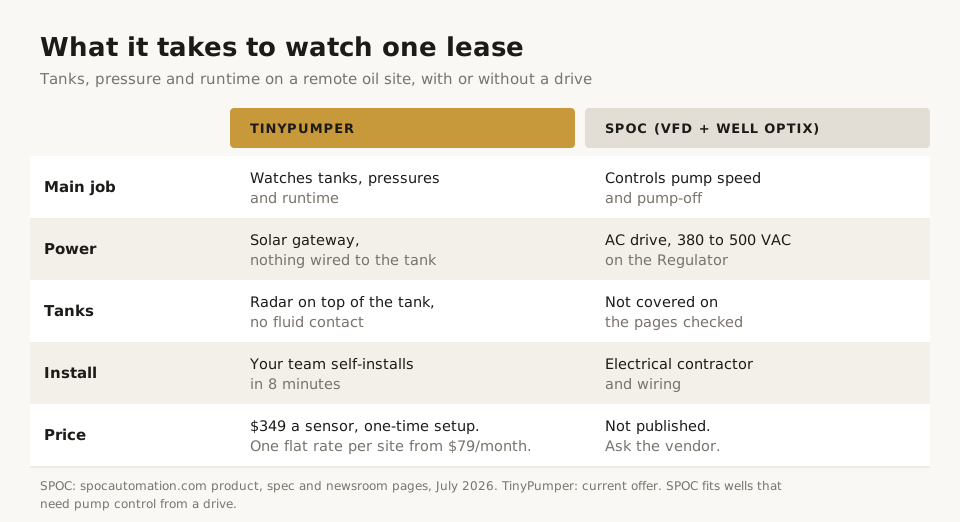
Where a SPOC cell says “not stated” or “not published,” its public site does not say. Ask them directly before you buy.
When Is TinyPumper the Better Fit?
- You need to see the whole lease: tanks, pressures and runtime, on wells with or without a drive.
- The well has no power, or wiring it never penciled.
- You want alerts fast. TinyPumper’s sensors report every hour and check your thresholds every 5 minutes, so an alarm goes out right away.
- You want a flat price per site, not a wiring project per well.
TinyPumper gives you roughly 99% of the upside of SCADA, at about 95% less cost than SCADA. Producers running it report cutting lease runs by 30 to 50 percent and catching failures days sooner. See how it fits across the field in our oil well monitoring systems guide.
TinyPumper watches tanks, pressures and runtime on one solar gateway. $349 a sensor, one-time setup, then one flat rate a month per site. 60-day money-back.
See TinyPumperWhen Is SPOC the Better Fit?
If you need to change how the pump runs, buy a drive. SPOC is a strong choice for pump-off control on rod lift, speed control on ESPs and disposal pumps, and pump cards for rod-lift work. You can still put TinyPumper on the tanks and on the wells that will never get a drive. And if you need full control of instrumented facilities, look at oil and gas SCADA.
Quick Answers on SPOC Searches
SPOC Automation, spocautomation, spoc.automation: SPOC Automation’s old site is spocautomation.com. The company now goes by SPOC Energy at spocenergy.com.
SPOC oil and gas, SPOC application: The SPOC application pages cover artificial lift, ESPs, injection and disposal, and compressors.
SPOC drives, SPOC VFD: SPOC drives are the IronHorse, Subduer, HPS and Regulator VFDs listed above.
SPOC grid: SPOC Energy also sells power conversion for microgrids and other industries outside the oil patch.
SPOC Automation reviews: We found no public customer reviews or complaints in our research (July 2026). Ask for references from producers your size.
SPOC Automation tech support: Contact SPOC directly through spocenergy.com. We do not service SPOC equipment.
SPOC Automation locations, SPOC Energy Trussville: Public listings place SPOC Energy in Trussville, Alabama. Check its site for field offices.
SPOC Automation careers, SPOC Automation jobs, SPOC Energy careers: Job listings are on SPOC Energy’s own site and the usual job boards.
SPOC Automation stock, SPOC Automation stock price: We could not find a public stock listing for SPOC as of October 2026.
The Short Version on TinyPumper
TinyPumper has 100% continental US coverage, because we use satellite. Each gateway connects up to 8 sensors. Every order comes with a 60-day money-back guarantee, and all equipment has lifetime replacement. TinyPumper is GreaseBook’s sister product, and every well with a TinyPumper sensor gets free Greasebook.
Who This Page Is Not For
This page is not for producers who need to change pump speed or run pump-off control from the drive, and it is not for producers who need full SCADA control. For the full field of options, see oilfield monitoring alternatives and oilfield tank monitoring.
Frequently Asked Questions
What does SPOC Automation do?
SPOC Automation, now SPOC Energy, builds variable frequency drives and controls for rotating equipment. In oil and gas that means drives for rod pumps, ESPs, injection and disposal pumps and compressors, the Revelation pump-off controller with pump cards, and Well Optix SCADA for remote monitoring and control of artificial lift. It controls how the equipment runs. It does not cover tank levels on wells without a drive.
What is a SPOC in a company?
In general business talk, a SPOC is a single point of contact: the one person who handles a customer or a project. In the oil patch, SPOC usually means the company SPOC Automation, now SPOC Energy, which builds oilfield drives and pump-off controllers. The two meanings are unrelated, so check which one a search result is talking about.
What does SPOC stand for in business?
For this company, SPOC stands for Sensorless Pump Off Control, according to its CEO. The name came from the pump-off controller built into its first variable frequency drives, which slows a rod pump at pump-off instead of shutting it down hard. In other industries, SPOC often means single point of contact, which has nothing to do with oilfield equipment.
What is SPOC Energy?
SPOC Energy is the current name of SPOC Automation. Its site describes a power conversion company serving data centers, marine, rental equipment, microgrids and oil and gas. On the oilfield side it still sells the drives, pump-off controllers and Well Optix SCADA that SPOC Automation built its name on. Public listings place it in Trussville, Alabama.
What is the best SPOC Automation alternative for oil and gas?
It depends on the job. If you need pump control, another drive maker is the alternative. If you need to watch tanks, pressures and runtime, TinyPumper is the better fit: one solar gateway, up to 8 sensors, 100% continental US coverage over satellite, installed by your team in 8 minutes. It is $349 a sensor, one-time setup, then one flat rate a month per site.
Does TinyPumper control the pump like a SPOC drive?
No. TinyPumper watches; it does not control. It will not change pump speed or shut a well in. What it does is tell you when a tank level, a pressure or a runtime crosses the line you set, checked every 5 minutes, so you know before the pumper rolls up. If you need control, pair it with a drive on the wells that justify one.