Short answer: SignalFire Wireless Telemetry builds wireless nodes and gateways that carry readings from your own instruments into a PLC, a SCADA host or its SignalFire Cloud dashboard. It is a strong telemetry layer if you already run SCADA. If you want a SignalFire alternative for oil and gas that just shows you tanks, pressures and compressor runtime on your phone, with no instrument wiring and no integrator, TinyPumper watches all three on one gateway, and your team self-installs it in 8 minutes.
The compressor quits at 2 a.m. The casing pressure has been climbing since Tuesday. You don’t need a mesh network diagram and a Modbus register map to find that out. You need your phone to tell you before your pumper drives out there. That is the gap this page is about.
Is SignalFire or TinyPumper the Better Fit for My Lease?
It depends on what you already run. If you have a SCADA host or PLCs and want a wireless layer that feeds them almost any instrument, SignalFire is built for that. If you want tanks, pressures and runtime on your phone with no SCADA, no wiring and no integrator, TinyPumper fits. As of October 2026, TinyPumper costs $349 a sensor, one-time setup, then one flat monthly rate per site. If you need full control of instrumented facilities, look at oil and gas SCADA.
What Is SignalFire Wireless Telemetry?
SignalFire Wireless Telemetry (signal-fire.com; buyers also search it as Signal Fire or Signal-Fire) is a Massachusetts company that designs and builds low-power industrial wireless equipment. Its nodes take readings from third-party instruments and send them over a 900 MHz mesh network to a gateway, or over LTE-M cellular from its RANGER nodes. From there the data goes to a PLC or SCADA host over Modbus, EtherNet/IP or MQTT, or to the SignalFire Cloud dashboard.
It is not an oil and gas company first. SignalFire’s own About page lists oil and gas alongside water and wastewater, municipal, environmental, agriculture, marine and manufacturing. That shapes the product: it is a general telemetry layer that an integrator fits to your site, not a lease monitor that arrives ready to run.
What Does SignalFire Do Well?
Credit where it is due:
- Hazardous-area nodes. The Sentinel node is rated Class I Division 1 (SignalFire Sentinel datasheet, March 2025).
- Works with almost any instrument. SignalFire calls its system “sensor-agnostic” and lists HART instruments, guided wave radar, pressure transmitters, flow meters and thermocouples (SignalFire brochure and FAQ, 2017 to 2024).
- Mesh for big clusters. Readings hop node to node to reach the gateway, and one gateway handles up to 240 nodes (SignalFire FAQ).
- Feeds the SCADA you already have. Getting data into a PLC or SCADA host is the core of the design, not an add-on.
- A long track record. SignalFire says it has shipped more than 20,000 nodes with a field-failure rate under 0.15% (SignalFire press release).
If your company has a controls engineer and a SCADA host, those are real reasons to pick it.
What Does It Take to Get SignalFire Data on Your Screen?
This is where a producer without a controls team should slow down. Based on SignalFire’s own manuals, the chain looks like this:
- Pick and buy the instruments. Sensor-agnostic means the sensors are yours to choose, price and source.
- Wire each instrument to a node. 4 to 20 mA, HART, Modbus or digital, depending on the node.
- Power it. Battery, solar or DC, sized per site.
- Configure it in the SignalFire Toolkit. A PC program where network, group and encryption settings must match across nodes.
- Map it to your host. The gateway exposes values in Modbus for your PLC or SCADA to poll, or a RANGER is claimed by serial number in SignalFire Cloud.
That is instrument tech and SCADA tech work. The good operators don’t hand a pumper a Modbus map and hope.
How Does TinyPumper Compare?
| SignalFire Wireless Telemetry | TinyPumper | |
|---|---|---|
| What it is | Wireless nodes and gateways that carry readings from your own instruments to a PLC, SCADA host or SignalFire Cloud | A full site monitor: tank levels, pressures and engine or compressor runtime on one gateway |
| Sensors | Sensor-agnostic: you choose, buy and wire your own instruments (SignalFire brochure) | Radar tank sensor on top of the tank (no fluid contact) and pressure sensor, up to 8 sensors per gateway |
| Setup | Instrument wiring, Toolkit configuration, Modbus mapping when feeding SCADA | Your team self-installs in 8 minutes, no electrician, no trench |
| Where the data lands | Your PLC or SCADA host, or SignalFire Cloud | The TinyPumper dashboard on your phone, and into Greasebook |
| Coverage | 900 MHz mesh to a gateway, or LTE-M nodes | 100% continental US coverage over satellite |
| Hazardous area | Sentinel: Class I Div 1 (SignalFire datasheet, March 2025); RANGER: Class I Div 2 (Instrumart listing, July 2026) | Class I Div 1 certified, IP67 |
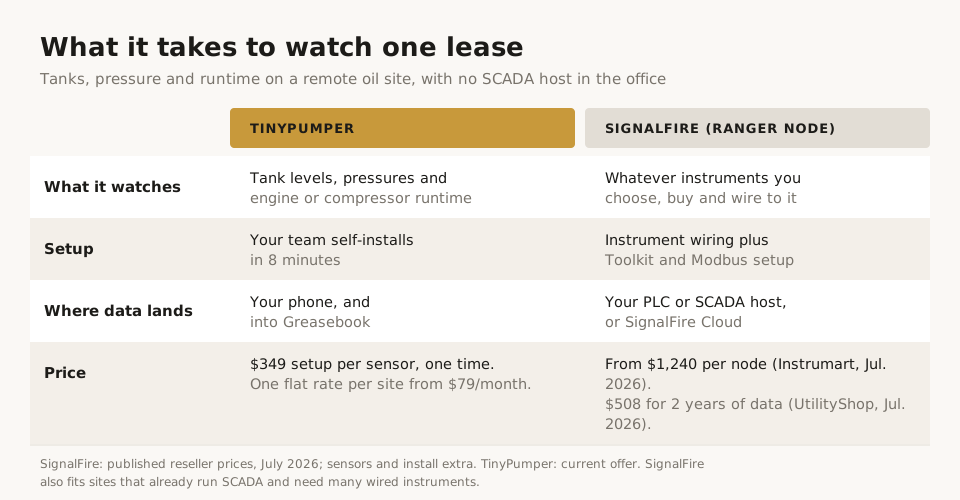
| Price | RANGER from $1,240 (Instrumart reseller listing, July 2026); two-year data plan with Cloud $508 (UtilityShop reseller listing, July 2026); sensors and install extra | $349 a sensor, one-time setup, then one flat rate a month per site, unlimited sensors |
| If it breaks | Ask the vendor | Lifetime replacement on all equipment |
| Trial | Ask the vendor | 60-day money-back, we pay return shipping |
Where a SignalFire cell says “ask the vendor,” its public site does not say. Get the answer in writing before you buy.
TinyPumper is Greasebook’s sister product. It gives 100% continental US coverage, because we use satellite. It connects up to 8 sensors per gateway. It comes with a 60-day money-back guarantee, and we pay the return shipping. Lifetime replacement on all equipment, every sensor included. Every well with a TinyPumper sensor gets free Greasebook.
What Does SignalFire Cost for an Oil and Gas Lease?
SignalFire does not publish list prices on signal-fire.com. Resellers do. The RANGER node starts at $1,240 (Instrumart reseller listing, July 2026), and a two-year data plan with SignalFire Cloud is $508 (UtilityShop reseller listing, July 2026). At that starting price, ten sites with one RANGER each comes to $12,400 in nodes (Instrumart pricing, July 2026), before you buy a single pressure transmitter or radar gauge, and before install or integration labor, which is not published.
TinyPumper is $349 a sensor, one-time setup, then one flat rate a month per site, unlimited sensors at that site. The sensors come with it, and adding a tank or a pressure point to the same site does not add a monthly charge.
When Is TinyPumper the Better Fit?
- You don’t run SCADA, or the SCADA you have costs more to keep alive than it returns.
- Nobody in your office maps Modbus registers, and you don’t want to hire someone who does.
- You want an alert the moment something crosses a line. TinyPumper’s sensors report every hour and check thresholds every 5 minutes, so an alarm goes out right away.
- You have dead zones. Satellite covers 100% of the continental US.
That holds at any scale, from a few dozen wells to a few thousand. Producers running TinyPumper report cutting lease runs by 30 to 50 percent and catching failures days sooner. See the full field of options in our guide to oilfield monitoring alternatives, and how it fits the whole lease in the oil well monitoring systems guide.
TinyPumper watches all three on one gateway. $349 a sensor, one-time setup, then one flat rate a month per site. 60-day money-back.
See TinyPumperWhen Is SignalFire the Better Fit?
If you already run SCADA or PLCs and want more instruments feeding them without trenching wire, SignalFire is built for exactly that, and its Class I Div 1 nodes and mesh networking are real strengths. Same if you need a specific instrument TinyPumper doesn’t carry, like a HART flow meter or a thermocouple. And if you need full control of instrumented facilities, look at oil and gas SCADA.
What to Avoid When Choosing Lease Monitoring
- Don’t price the node and forget the rest. A telemetry node price leaves out sensors, wiring, setup and integration. Ask for the all-in number per site.
- Don’t buy a SCADA feeder with no SCADA. A gateway that speaks Modbus needs something on the other end to listen.
- Don’t let one tech be the only person who can fix it. If the Toolkit settings live on one laptop, so does your monitoring.
Searching SignalFire Product Names?
Buyers search the SignalFire catalog by name: the SignalFire gateway, the RANGER and its wall-mount and DIN versions, the Wireless I/O Module, the Pressure Scout, the Gateway Stick, the Splicer, SignalFire Cloud and the SignalFire Toolkit. Check each one’s own spec sheet for what it reads. The same three questions apply to all of them: who wires the instrument, who configures it in Toolkit, and what host or dashboard receives the data.
- The SignalFire app: SignalFire Cloud is a web and mobile-friendly dashboard for trends and alarms (UtilityShop product listing, July 2026). There is no separate production app in SignalFire’s materials.
- SignalFire wireless telemetry troubleshooting: the setup questions that show up on public forums are about Modbus addressing at the gateway and matching Toolkit settings across nodes. TinyPumper has no Modbus map to troubleshoot, and a sensor that fails gets replaced.
- SignalFire vs Schneider Electric telemetry: both are industrial telemetry built to feed a control system. If you have that control system, compare them on instruments and support. If you don’t, the real comparison is against a monitor that needs no host at all.
Who This Page Is Not For
This page is not for producers who already run SCADA and want a wireless layer to feed it, and it is not for producers who need full control of instrumented facilities. For other tank-focused comparisons, see the Tank Sentinel alternative, the TankScan alternative, our oilfield tank monitoring guide, and the full list of monitoring alternatives.
Frequently Asked Questions
What is SignalFire Wireless Telemetry?
SignalFire Wireless Telemetry is a Massachusetts company that builds wireless nodes and gateways for industrial sensors. Its nodes use a 900 MHz mesh or LTE-M to carry readings from third-party instruments to a gateway, a PLC or SCADA host, or its own SignalFire Cloud dashboard. It serves oil and gas along with water, municipal, agriculture and other industries, so it is built as a telemetry layer rather than a lease monitor.
What is the best SignalFire alternative for oil and gas?
It depends on what you run. If you have SCADA and want more instruments feeding it, another telemetry vendor is the like-for-like swap. If you want to watch tanks, pressures and compressor runtime without a SCADA host, TinyPumper is the better alternative: radar on top of the tank, pressure at the wellhead and runtime on the engine, all on one gateway that your team self-installs in 8 minutes.
Does SignalFire need a SCADA system?
Not always. SignalFire gateways hand data to a PLC or SCADA host over Modbus, and its RANGER nodes can report to the SignalFire Cloud dashboard instead, according to SignalFire’s own documents. Either way, someone wires each instrument to a node and sets it up in SignalFire’s Toolkit software. TinyPumper ships with its own dashboard and needs no PLC, no Modbus map and no integrator.
How much does SignalFire cost?
SignalFire does not publish list prices on its site. Resellers do: the RANGER node starts at $1,240 (Instrumart listing, July 2026), and a two-year data plan with SignalFire Cloud is $508 (UtilityShop listing, July 2026). Sensors and install labor are extra. TinyPumper is $349 a sensor, one-time setup, then one flat rate a month per site, with unlimited sensors at that site.
How is TinyPumper installed?
Your team does it. The gateway is solar powered, the radar tank sensor talks to it over Bluetooth, and the pressure sensor screws in at the wellhead. There is no electrician, no trench and no laptop configuration. Most sites are running in 8 minutes, and readings reach your phone over satellite, which gives 100% continental US coverage.