Short answer: Rugged Telemetry builds industrial tank monitoring and SCADA telemetry for many industries, including oil and gas. Its gear is made for engineered installs: wired sensors, a panel at the site and power to run it. If your leases have no power and nobody to pull wire, TinyPumper watches tanks, pressures and engine or compressor runtime on a solar gateway that your team installs in 8 minutes.
It’s Thursday night. The compressor on the back lease quit at 9 p.m., the water tank is climbing, and nobody knows until the pumper rolls in Friday morning and finds it. That’s the problem any monitor has to solve. The question is how much wiring, power and project work it takes to get there.
Is Rugged Telemetry or TinyPumper the Better Fit for My Oil Lease?
It depends on the job. If you run a powered tank farm or a water system that needs wired analog inputs, relay control and a vendor to wire the panel, Rugged Telemetry’s TiQ.100 is built for that. If you run oil wells with no power on site and want tanks, pressures and runtime without an electrician, TinyPumper fits better. As of October 2026, it costs $349 a sensor, one-time setup, then one flat rate a month per site. If you need to control the well, look at oil and gas SCADA.
What Is Rugged Telemetry?
Rugged Telemetry is an industrial IoT and telemetry company based in Danville, Kentucky (company datasheet, 2026). It makes tank monitoring hardware, runs cloud monitoring platforms and offers integration services. Its website at ruggedtelemetry.com covers oil tanks, water tanks, fuel tanks, chemical tanks, ISO tanks and tanker trucks.
Oil and gas is one industry it serves, not the whole business. Its services page names utility deliveries, wastewater treatment, fleet management, beverage canning and farming. On its oil and gas page, the focus is chemical injection systems and ISO tanks.
Its cloud platform for tanks is called TankiQ. If you searched “Rugged Connect,” you most likely meant this company’s platform. Ask them which product carries that name before you compare.
What Does Rugged Telemetry Do Well?
We are not going to knock it for doing what it was built to do:
- Real industrial hardware. The TiQ.100 sits in a NEMA 4X (IP66) outdoor enclosure and comes in 4, 6 and 8 tank models (TiQ.100 datasheet, 2026).
- Real industrial inputs. It takes wired analog sensor loops plus digital inputs and outputs, so it can run relays and local control.
- Certifications. The datasheet lists UL and cUL 508A and Class I Division 2 (TiQ.100 datasheet, 2026).
- Plays with SCADA. It integrates into existing SCADA systems and offers APIs to pull data into your own software.
- A vendor who will do the project. Rugged Telemetry offers panel design, PLC and SCADA work, and field wiring installations.
If you already run SCADA and want a partner to engineer a panel, that is a real strength.
What Does a Rugged Telemetry Install Take on an Oil Lease?
Rugged Telemetry does not publish an install time. Here is what its own datasheet shows a TiQ.100 install involves:
- Wiring. Level sensors run as wired analog loops on twisted, shielded cable, with runs up to 500 m (1,640 ft) (TiQ.100 datasheet, 2026).
- Power. The controller takes AC 100 to 240 V, with a battery input (TiQ.100 datasheet, 2026). Solar and battery systems are offered, but they have to be designed for the site.
- Enclosure. A panel gets mounted at the site.
- Setup. Sensors, alarms and communications are set on a touchscreen on location.
On a powered facility with a controls tech on call, that’s a normal project. On a stripper lease 40 minutes from the yard with no power pole, it’s a service call, a trench and a wait.
Pricing for the hardware, the TankiQ platform and the data plans is not published on its site. Ask them directly.
How Does TinyPumper Compare?
| Rugged Telemetry (TiQ.100) | TinyPumper | |
|---|---|---|
| What it watches | Tank levels plus industrial inputs and outputs | Tank levels, pressures (wellhead, flowline, injection) and engine or compressor runtime |
| How the tank is measured | Several wired sensor types, including pressure transducers and radar | Radar on top of the tank, no fluid contact |
| Sensor wiring | Wired analog loops (TiQ.100 datasheet, 2026) | Wireless sensors over Bluetooth, up to 8 per gateway |
| Power | AC mains, or an engineered solar and battery build | Solar powered gateway, nothing to wire |
| Install | Panel mount and field wiring; vendor install service offered | Your team self-installs in 8 minutes |
| Hazardous area | Class I Division 2 listed (TiQ.100 datasheet, 2026) | Class I Div 1 certified, IP67 |
| Coverage | LTE modem standard, Inmarsat satellite option (TiQ.100 datasheet, 2026) | 100% continental US coverage over satellite |
| Pricing | Not published on its site | $349 a sensor, one-time setup, then one flat rate a month per site, unlimited sensors |
| If it breaks | Ask the vendor | Lifetime hardware replacement |
| Trial | Ask the vendor | 60-day money-back, we pay return shipping |
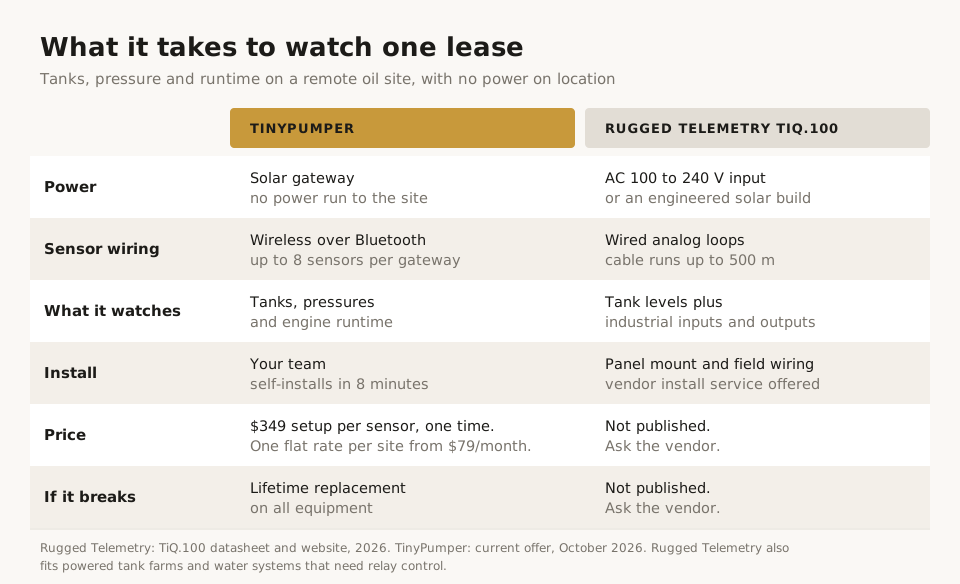
Where a Rugged Telemetry cell says “ask the vendor” or “not published,” that’s because its public site does not say.
TinyPumper in plain facts. TinyPumper has 100% continental US coverage, because we use satellite. Each gateway connects up to 8 sensors. Every order comes with a 60-day money-back guarantee, and we pay the return shipping. All equipment has lifetime replacement, every sensor included. TinyPumper is GreaseBook’s sister product, and every well with a TinyPumper sensor gets free Greasebook.
When Is TinyPumper the Best Rugged Telemetry Alternative?
TinyPumper is the better pick when:
- There’s no power on the lease. The gateway runs on solar. No pole, no panel, no trench.
- You don’t have a controls engineer. If you can change a lightbulb, you can install TinyPumper. No electrician, no third-party service call.
- You need more than the tank. Pressures and engine or compressor runtime ride on the same gateway as the tank levels.
- You want to hear about it right away. Sensors report every hour and check your thresholds every 5 minutes, so an alarm goes out the moment something crosses the line.
- You want one price per site. Adding a tank or a pressure sensor at the same site does not add a monthly charge.
That’s the IoT angle in one line: wireless sensors, a solar gateway and an app, not a wired panel. Producers running TinyPumper report cutting lease runs by 30 to 50 percent and catching failures days sooner. For the full field of options, see our oilfield monitoring alternatives guide.
TinyPumper installs in 8 minutes on solar. $349 a sensor, one-time setup, then one flat rate a month per site. 60-day money-back.
See TinyPumperWhen Is Rugged Telemetry the Better Fit?
Here’s the honest list:
- Telemetry for water systems. Municipal water, wastewater and lift stations are Rugged Telemetry’s ground, through its CiQ water line. TinyPumper is built for oil leases, not city water.
- Water tank telemetry off the oilfield. For produced water and saltwater tanks on a lease, TinyPumper works fine. For a town’s water tower, look at Rugged Telemetry.
- Chemical injection and ISO tanks. Its oil and gas page is built around chemical inventory and daily injection rates.
- Powered tank farms that need relay control. TinyPumper watches. It does not control. No shut-ins, no relay outputs.
What Do Rugged Telemetry Reviews Say?
As of October 2026, we found no customer reviews of Rugged Telemetry’s oilfield monitoring on review sites, forums or Reddit. That doesn’t mean it’s good or bad. It means you should ask for two references running it on an oil lease like yours, and call them.
What Telemetry Tank Level Monitoring Does Not Do
A tank level, from any vendor, tells you how full the tank is right now. It doesn’t tell you what you made, what you sold or what you owe the state. That’s production data, and it lives in a different tool. TinyPumper’s readings flow into GreaseBook, so the tank level, the pumper’s gauge and the run ticket sit on one screen. See how monitoring fits the whole lease in our oil well monitoring systems guide, or compare tank-only gauges in oilfield tank monitoring.
Two Questions to Ask Any Telemetry Vendor
- Who pulls the wire, and who pays for it? Get the full install, power and wiring cost in writing before you compare monthly prices.
- What happens the day it fails? TinyPumper ships a new one under lifetime hardware replacement. Get every vendor’s answer in writing.
For two more tank-focused comparisons, see the Tank Sentinel alternative and the TankScan alternative.
Who This Page Is Not For
This page is not for municipal water systems, chemical injection inventory programs or powered tank farms that need relay control. It’s also not for producers who need full SCADA control of instrumented facilities. For every other monitoring option side by side, start with oilfield monitoring alternatives.
Frequently Asked Questions
What is Rugged Telemetry?
Rugged Telemetry is a Kentucky industrial IoT company that makes tank monitoring hardware, telemetry panels and cloud monitoring platforms. It serves oil and gas, water and wastewater, fuel, chemical and other industries. In oil and gas, it focuses on chemical injection systems, ISO tanks and spill detection. Its gear is built for engineered installs with wired sensors and site power, and it offers field wiring as a service.
What is the best Rugged Telemetry alternative for oil and gas?
For oil leases with no power and no controls engineer, TinyPumper is the better alternative. It watches tank levels, pressures and engine or compressor runtime on one solar gateway, with up to 8 wireless sensors. Your team self-installs it in 8 minutes. It costs $349 a sensor, one-time setup, then one flat rate a month per site, with unlimited sensors at that site.
Does TinyPumper work for water tank telemetry?
TinyPumper monitors produced water and saltwater tanks on an oil lease, using radar on top of the tank so nothing touches the fluid. It can also read flow through turbine meters on disposal lines. It is not built for municipal water systems or lift stations. For city water telemetry, a company like Rugged Telemetry with a dedicated water line is the better fit.
Does TinyPumper need power or wiring at the tank?
No. The gateway is solar powered, and the radar tank sensor and pressure sensors talk to it over Bluetooth. Nothing gets wired to the tank, there’s no trench to dig and no electrician to schedule. Your team self-installs it in 8 minutes, and readings reach your phone over satellite, which covers 100% of the continental US.
What do Rugged Telemetry reviews say?
As of October 2026, we found no public customer reviews of Rugged Telemetry’s oilfield monitoring on review sites, forums or Reddit. That leaves you without outside proof either way. Before you buy any monitoring system, ask the vendor for two references running it on an oil lease like yours, and call both of them about install time, alarms and support.