Published 2026-11-17 · Updated 2026-11-17
Short answer: Texas Computer Works (TCW) sells two oil and gas programs: GRT, an electronic gauge sheet that turns tank gauges and well tests into daily production, and ProdEval, an economics and reserves program. If your problem is getting field data off the lease, GreaseBook is the alternative to GRT: it runs on the pumper’s phone, works offline and confirms he was on the lease. If your problem is reserves, borrowing base or property tax valuation, ProdEval does that job and GreaseBook does not. Plenty of operators should keep ProdEval and change only the field layer.
Here is the morning this page is about. The office wants yesterday’s gauges without calling the pumper. He wrote them on the route, drove home, and keys it in at home on the laptop after supper, if the internet cooperates. Two wells slip a little every week and nobody catches the trend, and when the partner asks, you cannot prove the visit happened at all.
Is GreaseBook or Texas Computer Works the Better Fit for My Operation?
It depends on the job. If your pain is field data (pumpers on paper, or typing gauges into a laptop at night), GreaseBook puts entry on the phone he already carries, works offline and confirms the visit. If your work is reserves, decline forecasts, borrowing base or property tax valuation, Texas Computer Works’ ProdEval fits that job, and GreaseBook does not do it. Many operators should keep ProdEval and replace only the field layer. If you need full control of instrumented facilities, look at SCADA instead of either one.
What Is Texas Computer Works?
Texas Computer Works, usually shortened to TCW, is a Texas petroleum software company. It sells two products that matter to producers:
- GRT, a cloud-based electronic gauge sheet. TCW says it figures each well’s daily production from field measurements, using tank tables and well test data, and its entry screens are laid out like a paper gauge sheet.
- ProdEval, a production monitoring and economic evaluation program. TCW positions it for reserve reporting, prospect analysis and decline forecasting, and lists reservoir engineers, bank engineers, CFOs, property tax professionals and investors among its users.
So TCW is not one thing. GRT is field capture. ProdEval is engineering economics. Treat them as two separate buying decisions.
What Does Texas Computer Works Do Well?
Give TCW its due:
- Measurement-based daily production. GRT works from real tank gauges and well tests, the way a gauger thinks.
- A familiar screen. Building the entry tabs to look like a gauge sheet lowers the learning curve for people used to paper.
- Messy data in, files out. TCW’s site says ProdEval takes Excel worksheets, GRT data, typed entry and commercial sources (it names Lasser, Drilling Info and IHS), and exports to other systems in several file formats.
- Economics is the core, not an add-on. Curve fitting, reserves and prospect analysis are what ProdEval was built for.
- Credibility with banks and tax work. TCW’s homepage carries an endorsement from KeyBank’s oil and gas group, and ProdEval is pitched for property tax valuation across many wells.
- Hands-on setup. TCW says it enters properties with new clients and trains field and office staff online.
If those jobs are your jobs, TCW deserves the look.
Where Does TCW’s GRT Fall Short for Pumpers in the Field?
The gap is the pumper. On the pages we reviewed, TCW describes GRT field entry on a laptop or notebook computer with an internet connection. We found no iOS or Android pumper app and no offline mode on its site. Ask TCW directly before you decide.
That matters on a real route:
- No signal, no entry. Most leases have dead spots. If entry needs an internet connection, the readings wait.
- Entry happens away from the well. When the tool lives on a laptop, the pumper keys it in at home on the laptop instead of standing at the wellhead, where he could see last week’s comments and catch a well before it slips.
- No visit proof described. We did not find geo-fencing or any way to confirm the pumper was on the lease. If you cannot prove the visit, you cannot hold anyone to the route.
- Every department still calls. Anyone who needs well status between laptop sessions picks up the phone.
None of that is a knock on GRT’s math. It is a question of where and how the data gets entered.
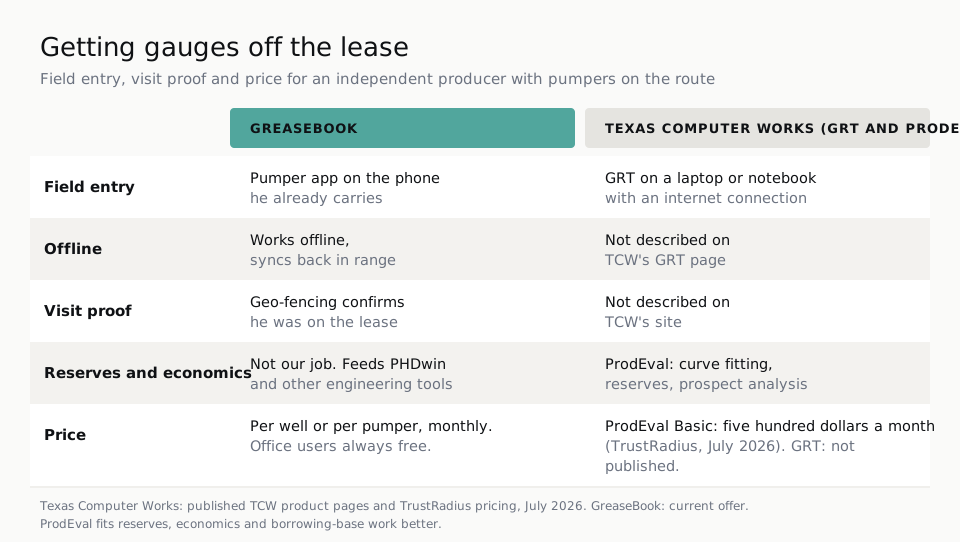
How Does GreaseBook Compare to TCW GRT and ProdEval?
| Texas Computer Works (GRT and ProdEval) | GreaseBook | |
|---|---|---|
| Built for | Gauging companies, operators, engineers, banks, tax appraisers (TCW site) | Independent producers and the pumpers who work their wells |
| Field entry | GRT on a laptop or notebook with an internet connection (TCW GRT page) | Pumper app on his own iPhone or Android phone |
| Offline | Not described on TCW’s site | Works offline, syncs when back in range |
| Proof of the visit | Not described on TCW’s site | Geo-fencing confirms he stepped on the lease |
| Production math | Daily production from tank tables and well tests | Well tests, barrel and bucket tests, allocation engine, downtime tracker |
| Reserves and economics | ProdEval: curve fitting, reserves, prospect analysis | Not our job. Feeds PHDwin and other engineering tools |
| State production reports | Not described on TCW’s site | Prepared for any oil and gas producing state, ready for you to submit |
| Price | ProdEval Basic: five hundred dollars a month, no setup fee (TrustRadius pricing page, July 2026). GRT: not published | Per well or per pumper, per month. Office users always free. Exact price on a call |
| Guarantee | Not published | 200% money-back: doesn’t work, we pay you double |
Where the TCW column says “not described” or “not published,” that is because TCW’s public pages do not say. Ask them.
GreaseBook in plain facts: as of November 2026, 600+ production companies trust GreaseBook with their data. 10,000+ pumpers use it in the field. GreaseBook has 15 years in the oil patch, 220 million+ barrels tracked, and operators in 22 oil-producing states. Pumpers learn it in about 8 minutes. Every rollout carries a 200% money-back guarantee. TinyPumper, GreaseBook’s sister product, handles remote tank, pressure and runtime monitoring.
Can GreaseBook Feed TCW’s ProdEval?
GreaseBook does production, not economics. If your engineers live in ProdEval, keep it. TCW’s site says ProdEval imports Excel worksheets, so GreaseBook production data has a path in. Confirm the file format with both teams before you cut over.
GreaseBook also connects to PHDwin, Spotfire, Microsoft BI and every major oil and gas accounting platform, so clean production data flows to whatever your office already runs. The goal is one source of truth for production, feeding the tools that do the money work.
For the bigger picture on where production data should live, see our guide to oil and gas production data management software.
Is There a Free Texas Computer Works Alternative?
If you searched “Texas Computer Works alternative free,” the honest answer is Excel. It is free, it feels like software, and it never sends an invoice. That is exactly why it is the most expensive free software in the oil patch: somebody keys the same numbers twice, files multiply into FINAL_v3 copies, and wells slip while the truth sits in an inbox.
GreaseBook is not free. Office and in-house users always are, and pricing is per well or per pumper, per month, set by how many wells you run, how many pumpers cover your routes and what you need to track. The 200% guarantee carries the risk.
GreaseBook puts gauges, run tickets and well tests on the pumper's own phone, offline. Turnkey setup by our petroleum engineers. 200% money-back guarantee.
See GreaseBookThe Amateur vs. the Pro
Moving off Texas Computer Works goes well or badly based on a few calls:
| The amateur… | The pro… |
|---|---|
| Rips out GRT and ProdEval together | Moves field capture first and keeps ProdEval if the engineers use it |
| Judges the pumper app from an office demo | Hands it to the oldest pumper on the route and watches him use it |
| Rebuilds tank tables and wells by hand | Hands over a login and lets petroleum engineers build it out |
| Trusts whatever date the laptop entry shows | Checks geo-fenced proof that the pumper was on the lease |
| Signs without asking what happens if it fails | Asks for the guarantee in writing; GreaseBook pays double |
The best operators judge a field tool by whether the pumper uses it at the well, not by the feature list.
What to Avoid
- Don’t assume GRT and ProdEval are one decision. TCW sells field capture and economics separately. Replace the part that hurts.
- Don’t let a laptop be the field tool. If entry waits on a laptop and an internet connection, readings arrive late and away from the well.
- Don’t drop ProdEval to save a line item. If your bank engineer or tax work runs on it, GreaseBook is not a substitute.
- Don’t stay stuck on a contract. GreaseBook buys out the months left on an old provider’s contract in exchange for a minimum one-year term plus the bought-out months.
- Don’t skip the pumper test. 98% of GreaseBook operator trials succeed, and the reason is that the pumper side is simple.
When Is Texas Computer Works the Better Fit?
TCW is the better fit when the job is engineering economics: reserve reports, decline forecasts, prospect analysis, borrowing-base reviews, or ad valorem valuation across many wells. It is also a reasonable fit for a gauging company whose crews already work from laptops and always have a connection. In those cases ProdEval earns its keep, and GreaseBook can sit alongside it on the field side.
Who This Page Is Not For
This page is not for bank engineers, reserve engineers or property tax appraisers whose work lives in ProdEval economics. It is also not for producers who need full SCADA control of instrumented facilities. It is for producers whose Texas Computer Works pain is the field: late gauges, entry away from the well, and no proof the pumper showed up.
Frequently Asked Questions About Texas Computer Works
What is Texas Computer Works?
Texas Computer Works, often called TCW, is a Texas petroleum software company. Its two main products are GRT, an electronic gauge sheet that turns tank gauges and well tests into daily production for each well, and ProdEval, a production monitoring and economic evaluation program used for reserves, prospect analysis, borrowing-base and property tax work. Gauging companies, engineers and bankers are among its users.
Is there a free Texas Computer Works alternative?
Excel is the free alternative most operators start with, and it never sends an invoice. The cost shows up in double entry, version chaos and wells that slip while the numbers sit in someone’s inbox. GreaseBook is not free, but office and in-house users always are, and the 200% money-back guarantee means you get double back if it does not work for you.
Does Texas Computer Works have a pumper phone app?
On the pages we reviewed, TCW describes GRT field entry on a laptop or notebook with an internet connection. We did not find an iOS or Android pumper app or an offline mode on its site, so ask TCW directly. GreaseBook runs on the pumper’s own iPhone or Android phone, works offline, and syncs when he gets back in range.
Can I keep ProdEval and use GreaseBook?
Yes, and for many operators that is the right move. GreaseBook handles field capture, well tests, allocation, downtime and state production reports. ProdEval does reserves and economics, which GreaseBook does not do. TCW’s site says ProdEval imports Excel worksheets, so GreaseBook production data has a path in. Confirm the file format with both teams before you switch.
How long does switching from TCW GRT to GreaseBook take?
Your job is handing over a login to the system you use today. Our petroleum engineers build out your wells and surface equipment so pumpers can start entering data. After pumper route feedback and supervisor sign-off, we scrub and backfill your history. Most operators are fully rolled out within a week, and pumpers learn the app in about 8 minutes.
Does GreaseBook file my state production reports?
GreaseBook prepares state production reports for any oil and gas producing state, built from your pumpers’ data and ready for you to review and submit. You do the submitting. If your state’s form is not already built, we build it at no cost, because if you need it, there is a good chance somebody else will need it too.