Published 2026-11-17 · Updated 2026-11-17
Short answer: Houston Electric Inc. is an electrical contractor and automation integrator in Garber, Oklahoma. It builds control panels, programs PLCs and runs hosted SCADA for producers who need equipment controlled as well as watched. If you mostly need to see what your tanks, pressures and compressors did overnight on marginal wells, TinyPumper watches all three on one gateway your own team installs in 8 minutes, with no panel project.
One note before we start: this page is about the Oklahoma oilfield contractor. It is not about Houston power plans, CenterPoint Energy Houston Electric, Huston Electric in Indiana, or Sam Houston Electric Cooperative. Those are answered in the FAQ below.
Is Houston Electric or TinyPumper the Better Fit for My Leases?
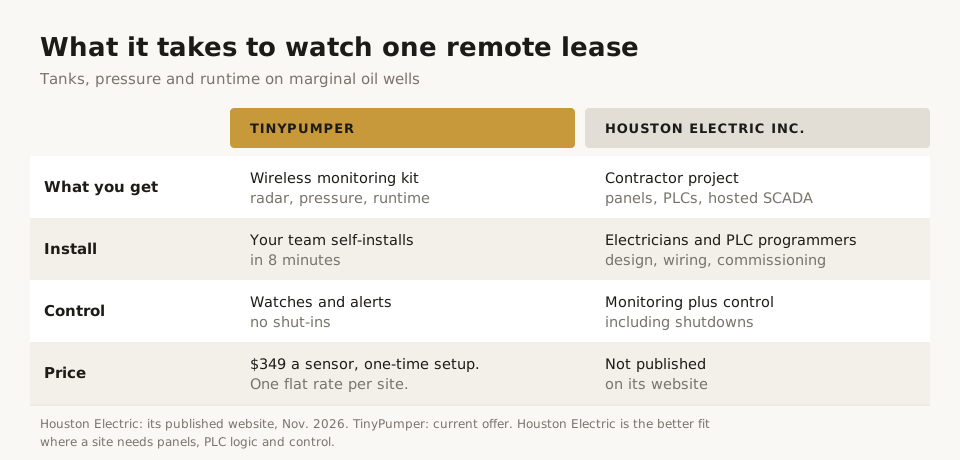
It depends on whether you need control or visibility. If you need panels built, PLC logic, automated shutdowns or a legacy SCADA system rewired, Houston Electric of Garber, Oklahoma, is built for that project work. If you need to see tanks, pressures and compressor runtime on marginal wells without a project, TinyPumper fits better: your team self-installs it in 8 minutes, at $349 a sensor, one-time setup, plus one flat monthly rate per site, as of November 2026. For daily production records, add GreaseBook, TinyPumper’s sister product.
What Is Houston Electric Inc. in Garber, Oklahoma?
Houston Electric Inc. is an oilfield and industrial electrical contractor that also designs, builds and supports automation. Its website lists panel fabrication and installation, PLC programming, SCADA integration for existing equipment, commissioning, troubleshooting of legacy systems, and a hosted SCADA service that lets customers monitor and control equipment from anywhere, around the clock.
Oil and gas is a big line for it, but not the only one. Its own SCADA page names utilities and manufacturing alongside oil and gas. That matters when you search the name: most results are for something else entirely.
It sells project work and ongoing support, not a boxed monitoring kit. Its website does not publish pricing.
What Does Houston Electric Do Well?
- Real electrical and controls work. Licensed electricians, PLC programmers and SCADA engineers on one crew, from design and wiring through commissioning. An app company cannot pull wire or fix a panel.
- Control, not just alarms. Its SCADA work covers trends, alarms, commands and shutdowns. If a site needs to act on its own, that takes a PLC and somebody who programs it.
- Legacy SCADA rescue. It markets upgrades and integration for older systems, which is a hard job most vendors walk away from.
- Open platforms. It says it builds on open-platform PLCs with no vendor lock-in.
- Local crews. For Oklahoma producers, a contractor that can drive out and troubleshoot has real value.
Where Does a Houston Electric SCADA Project Overshoot on Marginal Wells?
A controls project is built to run equipment. Most stripper wells don’t need that. They need somebody to know when the water tank is climbing, the casing pressure is creeping, or the compressor quit at midnight.
For that job, a project brings costs the well never pays back:
- Design, wiring and commissioning before the first reading shows up.
- Panels and PLCs that somebody has to maintain, update and troubleshoot for years.
- A separate screen. A SCADA dashboard shows what the equipment is doing. It does not keep your gauges, run tickets or production record, and nothing in Houston Electric’s published scope says it does.
This is the honest admission on our side too: TinyPumper watches, it doesn’t control. It will not shut in a well or adjust a pump. For most marginal wells, watching is about 99% of what you’d pay SCADA for, at roughly 95% less cost. For a wider look at the field, see our guide to oilfield monitoring alternatives.
How Does TinyPumper Compare With Houston Electric?
| Houston Electric Inc. | TinyPumper | |
|---|---|---|
| What it is | Electrical contractor and automation integrator in Garber, Oklahoma | Wireless site monitor your own team installs |
| What it watches | Pressure, temperature, flow and more through PLCs or RTUs, per its website | Tank levels by radar; wellhead, flowline and injection pressure; engine and compressor runtime |
| Control | Monitoring plus control, including shutdowns, per its website | Watches and alerts only; no shut-ins |
| Install | Its electricians, PLC programmers and SCADA engineers handle design, wiring and commissioning | Your team self-installs in 8 minutes; no electrician, trenching or third parties |
| Power at the site | Not stated beyond its power distribution work | Solar gateway; wireless sensors |
| Remote access | Hosted SCADA from any location, per its website | Readings on your phone; 100% continental US coverage over satellite |
| Production records | Not advertised | Feeds GreaseBook for gauges, run tickets and production history |
| Pricing | Not published on its site | $349 a sensor, one-time setup, then one flat rate a month per site, unlimited sensors |
| If it breaks | Service and troubleshooting by its crews | Lifetime hardware replacement |
| Trial | Ask the company | 60-day money-back; we pay return shipping |
| Industries | Oil and gas, utilities and manufacturing | Oil and gas |
Where the Houston Electric column says “not published” or “ask the company,” its public website does not say. Get those answers in writing before you sign.
TinyPumper is GreaseBook’s sister product. It gives 100% continental US coverage because we use satellite. Each gateway connects up to 8 sensors. Every order carries a 60-day money-back guarantee and lifetime replacement on all equipment.
The Amateur vs. the Pro
Picture a producer in central Oklahoma with a mix of stripper wells and one busy saltwater disposal site, deciding how to get eyes on all of it.
| The amateur… | The pro… |
|---|---|
| Hires a controls contractor to build a full SCADA panel on a well making a few barrels a day | Saves panel projects like Houston Electric’s for the sites that truly need control, and puts a self-installed monitor on the rest |
| Waits weeks on an electrician’s schedule to start watching a lease | Has readings the same day his team installs the sensors in 8 minutes |
| Finds out the compressor quit when the pumper rolls in | Gets an alert when the runtime counter goes quiet |
| Asks only what the panel costs | Asks what it costs, who maintains it, and what adding the next site costs |
| Treats a SCADA screen as the production record | Keeps production in GreaseBook so the office sees yesterday’s gauges without calling the pumper |
What to Avoid
- Don’t buy control you won’t use. A PLC that can shut in a well is worth it on a high-volume facility. On a stripper well it is a maintenance bill.
- Don’t sign without a price. Houston Electric publishes none, so ask for an itemized quote: design, panels, commissioning, hosting and support.
- Don’t ask who maintains it after the fact. Every panel and PLC is somebody’s job for years. Get that name before the build.
- Don’t confuse a monitoring screen with your books. SCADA shows pressure. It won’t stop wells slipping out of sight in a spreadsheet, and it won’t help when you cannot prove the visit or when the pumper keys it in at home on the laptop. GreaseBook covers that side, with geofencing that confirms the pumper was on the lease.
- Don’t mix up the names. Houston Electric Inc. in Garber is not CenterPoint, not Huston Electric in Indiana, and not Sam Houston Electric Cooperative.
When Is TinyPumper the Better Fit Than Houston Electric?
- Wells slip and you want to know which ones before the run ticket comes in light.
- You need tanks, pressures and runtime on the same lease, not a controls project.
- You want alerts the moment a reading crosses your line. Sensors report every hour and check thresholds every 5 minutes, so an alarm goes out right away.
- You’d rather pay one flat rate per site than price each new site as a job.
- Your leases sit in dead zones. Satellite covers 100% of the continental US.
Producers running TinyPumper report cutting lease runs by 30 to 50 percent and catching failures days sooner. To see how other tank and site monitors stack up, read our Tank Sentinel comparison or the full rundown of alternatives to oilfield monitoring systems.
TinyPumper watches tanks, pressures and compressor runtime on one gateway. $349 a sensor, one-time setup, then one flat rate a month per site. 60-day money-back.
See TinyPumperWhen Is Houston Electric the Better Fit?
Call Houston Electric when the job is electrical or control work: a new facility that needs power distribution, a site that must shut itself down on a high-pressure alarm, PLC logic that runs pumps or valves, or an inherited SCADA system that needs rewiring and commissioning. Those are projects, and a contractor with electricians and PLC programmers on staff is the right hire. TinyPumper does not do that work and we won’t pretend it does.
Who This Houston Electric Comparison Is Not For
This page is not for producers who need automated control, new electrical builds, or a legacy SCADA system brought back to life. It is also not for anyone shopping Houston power plans or a local electrician. If you are a producer who needs to see what happened on your wells overnight without starting a project, start with our oilfield monitoring alternatives guide.
Frequently Asked Questions About Houston Electric
What is Houston Electric Inc.?
Houston Electric Inc. is an electrical contractor and automation integrator based in Garber, Oklahoma. Its website lists oilfield electrical work, panel fabrication, PLC programming, SCADA integration, commissioning and a hosted SCADA service for remote monitoring and control from any location. It also serves utilities and manufacturing. It sells project work and support rather than a packaged monitoring kit, and its pricing is not published on its website.
Who owns Huston Electric?
Huston Electric, spelled without the o, is an Indiana electrical contractor and a different company from Houston Electric Inc. of Garber, Oklahoma. We have not verified who owns it, so check its own website for that. This page covers the Oklahoma oilfield contractor, which builds control panels, PLC automation and hosted SCADA for producers. If you were looking for an Indiana electrician, this comparison is not about them.
Who is the electricity provider in Houston?
In the Houston area, CenterPoint Energy Houston Electric owns the poles and wires and delivers the power, while you pick a retail electricity provider to buy from, because the Houston area is a deregulated market. The state’s Power to Choose site lists plans. None of that is Houston Electric Inc., the Oklahoma oilfield automation contractor this page compares with TinyPumper.
Who are the top 5 electrical contractors in the USA?
We don’t publish a ranking of national electrical contractors, and a list here without a source would be guesswork. Trade press such as Engineering News-Record publishes yearly specialty contractor rankings. For oilfield work, the better question is who knows wellsite panels and SCADA in your area. Houston Electric Inc. covers that in Oklahoma; TinyPumper covers monitoring your own team installs.
What is Sam Houston Electric?
Sam Houston Electric Cooperative is a member-owned electric cooperative that supplies power in parts of East Texas. It is a power utility, not an oilfield automation contractor, and it has no tie to Houston Electric Inc. of Garber, Oklahoma. If your lease buys power from a co-op, that co-op sets your rates. TinyPumper’s gateway runs on solar, so it needs no power line at the site.
Can TinyPumper shut in a well or control equipment?
No. TinyPumper watches; it does not control. It reads tank levels by radar, wellhead, flowline and injection pressure, and engine or compressor runtime, then alerts you when a reading crosses your line. If you need automated shutdowns or PLC logic, a controls contractor like Houston Electric is the right call. For most marginal wells, watching delivers about 99% of what you’d pay SCADA for.
Does TinyPumper need power or an electrician at the site?
No. The gateway is solar powered, the sensors talk to it over Bluetooth, and nothing gets wired to the tank or the wellhead. Your team self-installs it in 8 minutes with no electrician, trenching or third parties. Readings reach your phone over satellite, which covers 100% of the continental US, and every sensor carries lifetime hardware replacement.