Published 2026-11-16 · Updated 2026-11-16
Short answer: Acoustic Wells is the old name of Amplified Industries, an oilfield IoT company built around rod-pump monitoring and control. If you need pump cards, pump-off control and remote changes to your rod-pump controllers, Amplified is a serious tool, and this page says so. If what you need is to watch tanks, pressures and engine or compressor runtime on leases with no power, TinyPumper is the simpler alternative: radar on top of the tank, a solar gateway, satellite coverage, and your team self-installs it in 8 minutes.
It’s 1 a.m. on a lease forty minutes from town. The compressor quits. Nobody is on location until the pumper rolls up in the morning, and every hour in between is gas you don’t sell. That is the moment most producers start shopping for remote monitoring, and it is worth knowing which kind of tool answers it.
Is Acoustic Wells or TinyPumper the Better Fit for My Lease?
It depends on the job. If rod-pump control is the problem (pump cards, pump-off control, remote speed changes on LUFKIN or Weatherford controllers), Amplified Industries, the company formerly called Acoustic Wells, is the better fit. If you need to watch tanks, pressures and runtime with no power on site, TinyPumper fits: $349 a sensor, one-time setup, plus one flat monthly rate per site, as of November 2026. If you need full plant control, look at SCADA instead.
What Is Acoustic Wells?
Acoustic Wells is the former name of Amplified Industries, an oilfield monitoring and automation company that started at MIT. The first idea was simple: put a microphone-style sensor on the wellhead, listen to the pump, and process the sound on site. The company emerged under the Amplified Industries name in August 2023 (Business Wire, August 29, 2023), and MIT confirmed the rename (MIT News, March 2024).
Today the product is much more than a microphone. It is a rod-pump monitoring and control platform with load, position, pressure and electrical sensors, a gateway, pump-off control, tank monitors, a phone app and its own production ledger. When someone searches “acoustic wells oilfield monitoring,” this is the system they are looking at.
Do not mix it up with acoustic fluid-level shots, where a pump man fires an echo device down the casing to find the fluid level. That is a different tool with a similar name.
Can You Still Buy Acoustic Wells?
If you searched “acoustic wells for sale,” here is the straight answer: not under that name. The product is sold by Amplified Industries through its own website and sales team. Its rod-pump page lists under $1,000 for deployment and equipment (Amplified rod-pump page, October 2026). Tank monitor prices, monthly fees, contract length and connectivity charges are not published, so you will need a quote.
And if you searched “acoustic wells iot,” yes, it is an industrial IoT platform: sensors and existing controllers feed a gateway, the gateway sends data to Amplified’s cloud, and commands can travel back down to the controller.
What Does Acoustic Wells Do Well?
We are not going to knock Amplified for being good at what it was built to do. On rod pumps, it goes deep:
- Pump cards on every stroke. It reads load and position, builds surface and downhole cards, and calculates pump fillage.
- Downhole faults by name. Gas interference, worn barrels, paraffin, rod parts and holes in tubing are all on its published list.
- Control, not just alarms. Pump-off control, remote runtime and speed setpoints, and safety shutdowns.
- Works with controllers you already have. Wired Modbus hookups to LUFKIN, ChampionX and Weatherford controllers and several VFD brands.
- More than one way to count barrels. Pump-card estimates, meters, tank levels and well-test allocation shown side by side.
- Long-life tank devices. The company says its battery tank monitors run 10+ years before a battery swap (Amplified tank page, October 2026).
If your engineers want to tune rod pumps from the office, that is real value.
Where Does Acoustic Wells Overshoot on a Remote Lease?
A full rod-pump package is four or five sensors per well (MIT Alumni profile, June 2024), plus a gateway, register mapping, channel setup and alarm setpoints. That depth pays off on rod pumps you want tuned. On a lease where the questions are “is the tank filling, is the casing pressure climbing, is the compressor running,” it is more system than the job needs.
A few other things to weigh:
- Monthly cost is unknown until you ask. No per-well, per-device or per-site monthly fee is published.
- Coverage is not spelled out. The current site does not publish a coverage map or a satellite option.
- Little public feedback. G2 listed zero reviews for Amplified Industries (G2, October 2026). That is not proof of problems, but it means you should ask for references.
- Sound has limits. In a 2021 conference talk, Acoustic Wells itself named two hard spots: telling wells apart when several share a flowline, and weak signal at low pressure (ALRDC presentation, 2021). The newer multi-sensor kit leans less on sound, but ask how it handles your wells.
How Does TinyPumper Compare With Acoustic Wells?
| Acoustic Wells (Amplified Industries) | TinyPumper | |
|---|---|---|
| Built for | Rod-pump monitoring, pump cards and pump-off control, plus tanks and facilities | Watching tanks, pressures and engine or compressor runtime on remote leases |
| Controls equipment | Yes: pump-off control, speed and runtime setpoints, shutdowns | No: it watches and alerts, it does not control |
| Tank sensor | Radar on top, or a pressure sensor submerged in the fluid | Radar on top of the tank, no fluid contact |
| Install | Self-installable, per Amplified; controller hookups need register mapping and setpoints | Your team self-installs in 8 minutes, no electrician |
| Power | Battery tank devices (10+ years, Amplified tank page, October 2026); solar option on gas-powered rod wells | Solar gateway |
| Coverage | Not published on the current site; an older brochure names a Cat-M1 gateway (brochure copy, indexed December 2025) | 100% continental US coverage over satellite |
| Up-front price | Under $1,000 deployment and equipment for rod pumps (Amplified rod-pump page, October 2026); tank pricing by quote | $349 a sensor, one-time setup |
| Monthly | Not published | One flat rate a month per site, unlimited sensors |
| If it breaks | No replacement promise published | Lifetime hardware replacement |
| Trial | No refund guarantee published | 60-day money-back, we pay return shipping |
| Production data | Its own production ledger and dashboard | Readings flow into the GreaseBook dashboard |
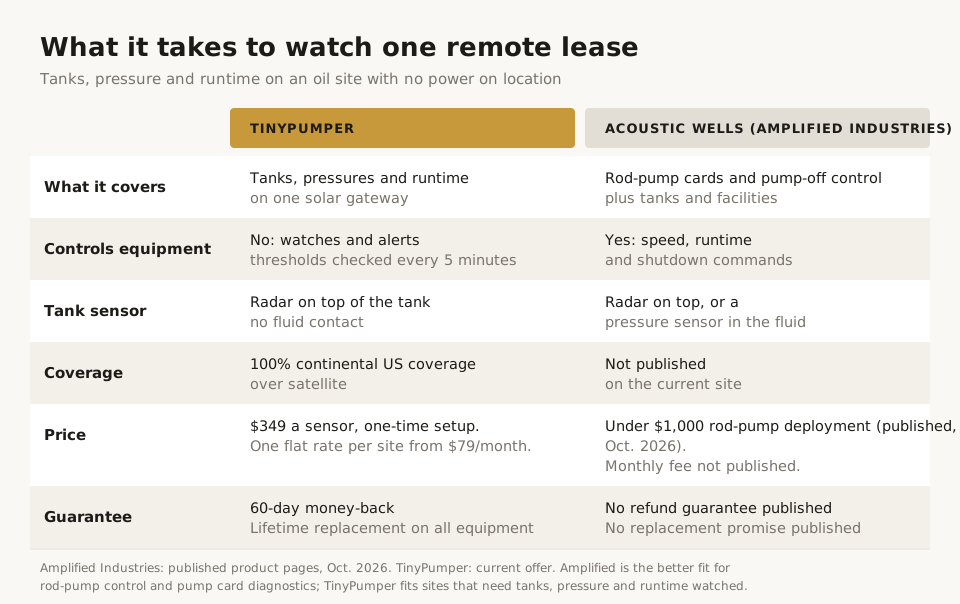
Where the Amplified column says “not published,” that is because its public site does not say. Get those answers in writing before you compare totals.
Here are the TinyPumper facts in one place. TinyPumper is a solar, self-installed monitor for tank levels, pressures and engine or compressor runtime. It gives 100% continental US coverage, because we use satellite. It connects up to 8 sensors per gateway. Every order carries the 60-day money-back guarantee, and there is lifetime replacement on all equipment. TinyPumper is GreaseBook’s sister product, and its readings flow straight into the GreaseBook dashboard.
The Amateur vs. the Pro
Shopping Acoustic Wells against a site monitor goes wrong in predictable ways:
| The amateur… | The pro… |
|---|---|
| Buys rod-pump control for a lease where the real worry is tank levels and compressor runtime | Matches the tool to the job: Amplified for pump cards, a site monitor for tanks, pressure and runtime |
| Takes the under $1,000 rod-pump figure (Amplified rod-pump page, October 2026) as the full cost | Asks Amplified for the monthly fee, billing unit and contract term in writing |
| Assumes the data will get out of a dead zone | Asks exactly how readings leave the lease; TinyPumper uses satellite for 100% continental US coverage |
| Reads zero public reviews as zero problems | Asks for reference calls with producers running similar wells |
| Wires a new control system onto every site | Puts control where the pump earns it and a light monitor everywhere else |
The best operators don’t buy the most capable system. They buy the one that answers the question they actually lose sleep over.
What to Avoid
- Don’t pay for control you won’t use. If nobody is going to tune pump-off settings on a given well, Amplified’s control layer is cost without payoff there.
- Don’t compare one price to a whole bill. Amplified’s published rod-pump number covers deployment and equipment only; monthly fees come by quote.
- Don’t put a sensor in the fluid if you can help it. Submerged sensors in produced water can foul and freeze. Amplified offers radar as well, so ask for it; TinyPumper’s radar never touches the fluid.
- Don’t skip the “what if it fails” question. Get every vendor’s replacement terms in writing. TinyPumper’s is lifetime hardware replacement.
- Don’t stop at one competitor. See how tank-focused gauges stack up in our Tank Sentinel alternative and TankScan alternative pages.
When Is TinyPumper the Better Fit Than Acoustic Wells?
- You want to know when a tank is filling, a casing pressure is climbing, or a compressor has stopped, on leases with no power.
- You want alerts fast. TinyPumper’s sensors report every hour and check your thresholds every 5 minutes, so the alarm goes out right away.
- You want one price per site, not per point, so a busy tank battery does not multiply the bill.
- You have dead zones. Satellite gives 100% continental US coverage.
- You would rather your own team put it on in 8 minutes than schedule a commissioning job.
Producers running TinyPumper report cutting lease runs by 30-50% and catching failures days sooner. For the full field of options, see our guide to oilfield monitoring alternatives.
TinyPumper watches all three on one solar gateway. $349 a sensor, one-time setup, then one flat rate a month per site. 60-day money-back.
See TinyPumperWhen Is Acoustic Wells the Better Fit?
Be honest about the job. Amplified Industries is the better choice when:
- Rod-pump tuning is the main problem and you want pump cards and fillage on every stroke.
- You need closed-loop control: pump-off control, remote speed changes and automatic shutdowns.
- You already run LUFKIN, ChampionX or Weatherford controllers and want remote access without swapping them.
- Your engineers want a production ledger that compares pump-card, meter, tank and well-test numbers.
TinyPumper watches; it does not control. No pump-off control, no speed changes, no shut-ins. If that is what you need, it is the wrong tool.
Where Does GreaseBook Fit Alongside TinyPumper?
Sensors cover the sites you put them on. On the rest, wells slip between visits and nobody off the lease sees what the pumper saw. TinyPumper readings land in GreaseBook, its sister product, and every well with a TinyPumper sensor gets free Greasebook. On the wells without sensors, GreaseBook lets every department see yesterday’s gauges without calling the pumper. It also fixes two old headaches: you cannot prove the visit on paper, and the pumper who keys it in at home on the laptop isn’t looking at the well. GreaseBook’s geofencing confirms the visit, and the app works from the phone he already carries.
Who This Page Is Not For
This page is not for producers whose main need is rod-pump control or pump card diagnostics; Acoustic Wells, now Amplified Industries, is built for that. It is also not for producers who need full SCADA control of instrumented facilities. If you are comparing tank and site monitors, start with the full list of monitoring options.
Frequently Asked Questions About Acoustic Wells
What is Acoustic Wells?
Acoustic Wells was an MIT-born startup that put a microphone-style sensor on the wellhead to listen to the pump. The company now sells as Amplified Industries (MIT News, March 2024). Today it is a rod-pump monitoring and control platform with load, position, pressure and electrical sensors, a gateway, pump-off control, tank monitors and its own production ledger.
Is Acoustic Wells for sale?
Not under that name. The product is sold by Amplified Industries through its website and sales team. Its rod-pump page lists under $1,000 for deployment and equipment (Amplified site, October 2026), but tank monitor prices, monthly fees and contract terms are not published, so you need a quote. Ask for the monthly fee and billing unit in writing before you compare it with anything.
Is Acoustic Wells an IoT system?
Yes. Acoustic Wells, now Amplified Industries, is an industrial IoT platform for oilfields. Sensors and existing pump controllers feed a gateway, the gateway sends data to Amplified’s cloud, and operators see pump cards, alarms and production on a web dashboard or phone app. It can also send commands back, such as speed changes or a shutdown, which makes it automation, not only monitoring.
What is the best Acoustic Wells alternative for oilfield monitoring?
It depends on the job. For rod-pump control, stay with Amplified or a pump-off controller vendor. For watching tanks, pressures and engine or compressor runtime on remote leases, TinyPumper is the simpler alternative. It uses radar on top of the tank, a solar gateway and satellite for 100% continental US coverage. Your team self-installs it in 8 minutes, and it comes with a 60-day money-back guarantee.
Does TinyPumper control the pump the way Amplified does?
No. TinyPumper watches; it does not control. It will not run pump-off control, change speed or shut a well in. It reports tanks, pressures and runtime every hour and checks your alarm thresholds every 5 minutes, so you hear about a problem right away. If closed-loop pump control is the job, Amplified or a pump-off controller is the better fit.
How is TinyPumper priced?
TinyPumper is $349 a sensor, one-time setup. Then one flat rate a month per site, with unlimited sensors at that site. You rent the gear rather than owning it, the $349 covers setup and a one-on-one build-out with an engineer by phone, and every piece of equipment gets lifetime replacement. Adding another tank or pressure sensor on the same site does not add to the monthly bill.