Published 2026-11-16 · Updated 2026-11-16
Short answer: Tank to Cloud usually means Tank Cloud from APG, now sold as Level and Flow. It puts tank levels on a web portal, and it works best where a tank farm already has power, a router and an internet link. If your leases have none of that, or you also need pressure and compressor runtime, TinyPumper fits better. It runs on solar and satellite, watches tanks, pressures and runtime on one gateway, and your team self-installs it in 8 minutes.
It is Saturday night. The portal says your far water tank is half full, and it is. What it cannot tell you is that the compressor quit at 9 p.m. and casing pressure has been climbing since. That is how wells slip: the tank looks fine until it doesn’t.
Is Tank to Cloud or TinyPumper the Better Fit for My Lease?
It depends on the site. If you run a tank farm with power, a router and an internet link already in place, Tank Cloud’s Modbus network lets one master sensor report for up to 10 others over one connection (APG Tank Cloud demo, 2026), and that can be a good fit. If your leases have no power and no internet, and you need pressure and compressor runtime too, TinyPumper fits better: solar, satellite, $349 setup per sensor, then one flat monthly rate per site, as of November 2026. If you need full control, look at SCADA.
What Is Tank to Cloud (APG Tank Cloud, Now Level and Flow)?
Tank to Cloud is a common way of writing Tank Cloud, a remote tank monitoring system built by Automation Products Group (APG) in Logan, Utah. APG has since renamed it Level and Flow. Level sensors and modules send readings to APG’s web portal, where you view levels, set alarms and export logged data to a spreadsheet.
It is not an oilfield product by design. APG sells it to any industry with tanks to watch. That matters, because the hardware and the install assume things a remote lease often does not have.
What Does APG’s Level and Flow Do Well?
- A free baseline view. The portal and the last 30 readings are free once you own the sensors (APG Level and Flow page, 2026).
- One internet link for many tanks. On a tank farm, one master sensor polls up to 10 others over Modbus and reports them all (APG Tank Cloud demo, 2026). One connection, many tanks.
- Takes existing signals. The RST-5003 module publishes any 4-20 mA signal to the portal, listed at $368 (USA BlueBook listing, July 2026).
- Remote setup. Sensors can be programmed from the portal.
- Hazardous-area options. APG’s catalog lists sensors rated for classified locations (APG catalog, 2019).
If you have a powered tank farm with internet and the tank level is the whole job, that is a fair package.
Where Does a Tank Cloud Install Get Hard on a Remote Lease?
Per APG’s own demo, the master sensor is wired to a router, sensors are daisy-chained on a Modbus line, and you supply the internet link to that router (APG Tank Cloud demo, 2026). On a remote tank battery that means three questions before the first reading shows up:
- Where does the power come from for the router and the master sensor?
- Who wires the daisy chain and keeps it working through a winter?
- Who pays for and maintains the internet link at every site?
On one big tank farm, that work is spread across many tanks. On 15 small leases scattered across a county, each lease needs its own router and its own link. APG does not publish an install time.
What Does Tank Cloud Not Watch?
Tank Cloud tells you what is in the tank. The expensive surprises on a lease usually come from somewhere else:
- Pressure. Casing, tubing and flowline pressure show a well loading up or a line plugging before the tank does. On Tank Cloud, that means buying a separate 4-20 mA transmitter and wiring it to an RST module.
- Runtime. A compressor or pumping unit that quit at midnight costs barrels every hour until somebody notices.
- The pumper side. APG’s portal shows readings, not who visited the lease. You still can’t see yesterday’s gauges without calling the pumper, and you cannot prove the visit.
It is also one more dashboard. Your levels live on APG’s portal while your production lives somewhere else.
How Does TinyPumper Compare With APG’s Tank Cloud?
| APG Tank Cloud (Level and Flow) | TinyPumper | |
|---|---|---|
| What it watches | Tank levels, plus any 4-20 mA signal through an RST module | Tank levels, pressures (wellhead, flowline, injection) and engine or compressor runtime |
| Power at the site | Not stated on APG’s public pages; the router needs power | Solar gateway, nothing wired to the tank |
| How data leaves the lease | Master sensor wired to a router on your internet link (APG Tank Cloud demo, 2026) | Satellite, 100% continental US coverage |
| Install | Modbus daisy chain plus router; install time not published | Your team self-installs in 8 minutes |
| Alarms | Alarm messaging and data logging are a subscription (APG Level and Flow page, 2026) | Thresholds checked every 5 minutes, alert sent right away |
| Price | LOE-3136 level sensor $1,188 sale, $1,425.60 list (RSP Supply reseller listing, July 2026); subscription price not published | $349 a sensor, one-time setup, then one flat rate a month per site, unlimited sensors |
| If it breaks | Ask the vendor | Lifetime hardware replacement |
| Trial | Ask the vendor | 60-day money-back, we pay return shipping |
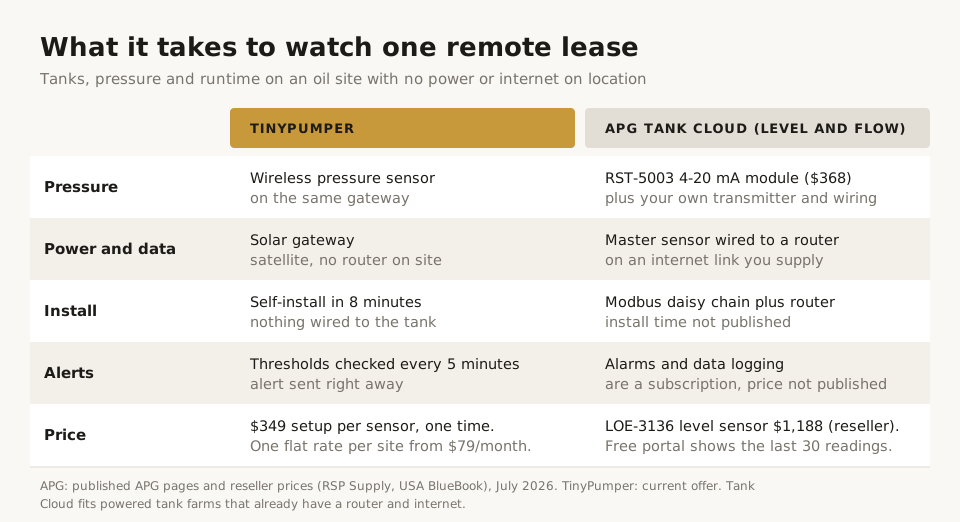
Where the Tank Cloud column says “not published” or “ask the vendor,” APG’s public pages do not say. Ask them before you buy. For the rest of the field, see our guide to oilfield monitoring alternatives.
The Amateur vs. the Pro
| The amateur… | The pro… |
|---|---|
| Buys a Tank Cloud sensor because the tank is the loudest problem | Lists every point on the lease (tank, casing pressure, compressor) before picking anything |
| Prices the $1,188 sensor (RSP Supply, July 2026) and forgets the router, wiring and internet link | Prices the whole site, including how the data leaves the lease |
| Assumes alarms come free | Asks which features are subscription and gets the number in writing |
| Lives with a pumper who keeps the gauge book and keys it in at home on the laptop | Puts sensors on the tanks and sees the trend every hour |
The best producers price the whole site, not the sensor.
What to Avoid
- Don’t buy a router-based monitor for a lease with no power. Tank Cloud’s master sensor reports through a router (APG Tank Cloud demo, 2026). No power, no router, no readings.
- Don’t count the free 30 readings as monitoring. The alarm that wakes you at 2 a.m. is the part APG sells as a subscription.
- Don’t add a dashboard nobody opens. If levels live on one portal and production lives on another, wells slip between them.
- Don’t skip the failure question. Ask every vendor what happens the day a sensor dies, and get the answer in writing.
When Is Tank Cloud the Better Fit?
If you run a tank farm with power and internet already on site, and you only need levels, Tank Cloud’s one-link-for-many-tanks design can be the simpler buy. It also fits if you have 4-20 mA instruments in place and want them on a web page. If you need full control of instrumented facilities, neither product is the answer; look at full SCADA.
TinyPumper at a Glance
TinyPumper is GreaseBook’s sister product. It gives 100% continental US coverage because we use satellite. Each gateway connects up to 8 sensors. The radar tank sensor mounts on top of the tank and never touches the fluid. Sensors report every hour and check your thresholds every 5 minutes. TinyPumper is $349 a sensor, one-time setup, then one flat rate a month per site, unlimited sensors. Every order carries a 60-day money-back guarantee, and all equipment has lifetime replacement. Every well with a TinyPumper sensor gets free Greasebook.
Producers running TinyPumper report cutting lease runs by 30 to 50 percent and catching failures days sooner. Compare other tank-only gauges on our Tank Sentinel alternative and TankScan alternative pages.
TinyPumper runs on solar and satellite and watches tanks, pressures and runtime on one gateway. $349 a sensor, one-time setup, then one flat rate a month per site. 60-day money-back.
See TinyPumperWho This Page Is Not For
This page is not for a producer whose powered, internet-connected tank farm only needs levels; Tank Cloud may suit that site fine. It is not for producers who need full SCADA control either. To weigh every option side by side, compare every monitoring option we cover.
Frequently Asked Questions
What is Tank to Cloud?
Tank to Cloud usually refers to Tank Cloud, a remote tank monitoring system from Automation Products Group (APG) in Logan, Utah, now sold as Level and Flow. Its sensors send readings to APG’s web portal, where the last 30 readings are free and alarms and data logging are a paid subscription (APG Level and Flow page, 2026). It serves many industries, not just oil and gas.
What is the best Tank to Cloud alternative for oil and gas?
If you only need tank levels at a site that already has power and internet, Tank Cloud may be enough. If your leases have neither, and you also need casing or flowline pressure and compressor runtime, a whole-site monitor fits better. TinyPumper watches tanks, pressures and runtime on one solar gateway over satellite, and your team self-installs it in 8 minutes.
Why do searches for Tank to Cloud show cloudy fish tank results?
Google mixes in aquarium pages because the words tank and cloud also describe cloudy fish tank water. Those pages answer how to clear a cloudy aquarium and how long a new tank stays cloudy, and an aquarium store is the right place for that question. This page is about oilfield tank level monitoring: knowing what is in your crude and water tanks from your phone.
Does TinyPumper need a router or power at the tank?
No. The gateway is solar powered and the radar tank sensor talks to it over Bluetooth, so nothing is wired to the tank and no router sits on site. Readings leave the lease over satellite, which gives 100% continental US coverage. Tank Cloud, by APG’s own description, wires its master sensor to a router and needs an internet link you supply (APG Tank Cloud demo, 2026).
How is TinyPumper priced compared with Tank Cloud?
TinyPumper is $349 a sensor, one-time setup, then one flat rate a month per site, with unlimited sensors at that site. The gear is rented, and lifetime replacement covers it. APG lists alarms and data logging as a subscription but does not publish the price, and its LOE-3136 sensor was listed at $1,188 on a reseller site (RSP Supply, July 2026).
Does TinyPumper watch pressure and compressor runtime?
Yes. Pressure sensors read wellhead, flowline and injection pressure, and a built-in shake counter on the gateway tells you whether an engine or compressor is running. Sensors report every hour and check your thresholds every 5 minutes, so an alarm goes out right away. Up to 8 sensors connect to each gateway, all for one flat monthly rate per site.