Published November 16, 2026 · Updated November 16, 2026
Short answer: Carthage Software, in oil and gas, is a legacy production reporting system. Today it mostly shows up as a data source other vendors build import tools for, not as a product being actively sold. If your wells still report through Carthage, the real question is not which old system to swap it for. It is how your pumpers get daily gauges, pressures and run tickets from the lease to your screen. GreaseBook does that on the phone the pumper already carries, works offline, proves the visit, and our petroleum engineers move your Carthage data for you.
Here is how it usually goes on a legacy system: the pumper writes it down, keys it in at home on the laptop, and the office sees it whenever that happens. Meanwhile wells slip a few barrels a week and nobody sees the trend until the purchaser statement shows up light.
Is Carthage Software or GreaseBook the Better Fit for Your Production Data?
It depends on where your data lives and what your pumpers carry. If Carthage still holds years of history and nobody in the field touches it, keep it as a record system until a move pays off. If pumpers still report on paper, Excel or a laptop and wells slip before anyone sees the trend, GreaseBook fits: a phone app with offline mode and visit proof, used by 600+ production companies as of November 2026. If you need accounting, keep an oil and gas accounting platform; GreaseBook feeds it.
What Is Carthage Software in Oil and Gas?
Carthage Software, in the oil and gas sense, is an older upstream production reporting system. The clearest current reference to it is on the PakEnergy Production page (2026), which lists import tools for Carthage data alongside FieldDIRECT and CODE. That tells you how the market treats it: as an existing system operators move data out of.
Searches for “carthage software” also pull up two unrelated things: Mago, a PHP toolchain written in Rust by a company called Carthage Software, and Carthage, a package manager for iOS apps. Neither one tracks a barrel of oil. This page is about the oil and gas system.
We could not find a current Carthage product site, a mobile app listing, published pricing or customer reviews. Where we say “not published” below, that is why. Ask your Carthage contact directly.
What Does Carthage Do Well?
We will give it its due:
- It had a real installed base. PakEnergy (formerly WolfePak) built import tools for Carthage data. Vendors only build those for systems with enough users to matter.
- It holds your history. If you ran it for years, it has your production record in one place, which beats a drawer of gauge sheets.
- It is a known quantity for your office. Whoever has run it for a decade knows where everything lives.
None of that is nothing. It just stops at the office door.
Where Does a Legacy System Like Carthage Leave Gaps?
The gaps are in the field, not the database:
- Wells slip and nobody catches the trend. If gauges reach the system days late, a well sliding from 9 to 6 barrels a day just looks like noise.
- You cannot prove the visit. With no geofencing, a gauge entry tells you a number, not that anybody stood at the tank.
- Everyone else has to call. Your engineer, your partner and your office all want yesterday’s gauges without calling the pumper. A system nobody can open from a phone forces the call.
- State reports start from scratch. Someone still rebuilds the Texas RRC PR form, or your state’s version, from whatever got keyed in.
Paper and Excel have the same problems. Excel is paper with a power cord: the pumper still writes it or texts it, and someone still types it in twice. A legacy system just moves the retyping to a different screen.
How Does GreaseBook Compare With Carthage?
| Carthage Software | GreaseBook | |
|---|---|---|
| Who it is for | Not published | Independent producers, from a handful of wells to over 2,000 |
| Pumper mobile app | Not published; no app listing found | iOS and Android, 8-minute pumper learning curve |
| Offline mode | Not published | Works offline, syncs when back in cell range |
| Proof of visit | Not published | Geofencing confirms the pumper was on the lease |
| Getting your data | PakEnergy lists import tools for Carthage data (PakEnergy Production page, 2026) | Our petroleum engineers do the move from one login |
| Well tests and allocation | Not published | Well testing and allocation engine |
| State reports | Not published | Prepared for any producing state, ready for you to submit |
| Accounting | Not published | Feeds every major oil and gas accounting platform |
| Pricing | Not published | Per well or per pumper, per month; office users free |
| Guarantee | Not published | 200% money-back guarantee |
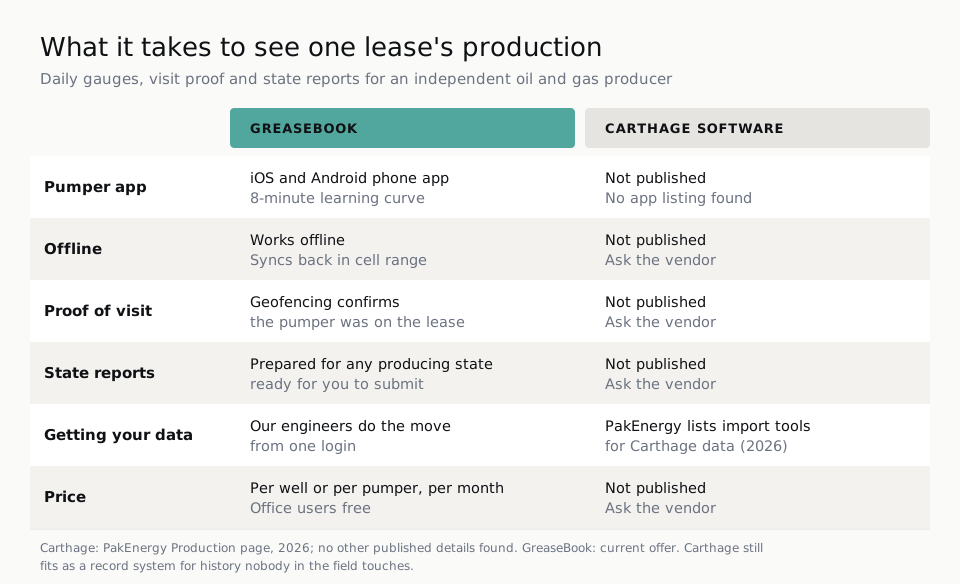
For the bigger picture on keeping production data clean from lease to office, see our guide to oil and gas production data management software.
What Does a Move Off Carthage Look Like?
Most operators’ real objection to leaving Carthage is not the upside. It is the lift. Here is what the lift actually is:
- Your job is one login. Hand us access to Carthage or an export. Our petroleum engineers do the rest.
- Wells first, history second. We build your wells and surface equipment first, so pumpers can start entering data. After pumpers give feedback on their routes and your supervisor signs off, we scrub, clean and backfill your historical records.
- No new gear. Pumpers use the smartphones in their pockets. No laptops to buy, nothing for the office to manage.
- Fast. Most operators are fully rolled out within a week. Pumpers learn it in 8 minutes. Office users are 99% proficient in about 20.
- Stuck in a contract? If you are locked into any legacy vendor, our contract buyout program buys out the months you have left, in exchange for a minimum one-year term plus those months.
Hand us one login. Our engineers build it out, your pumpers are up in 8 minutes, and the 200% money-back guarantee covers the rest.
See if GreaseBook fitsThe Amateur vs. the Pro: Moving Off Carthage
| The amateur… | The pro… |
|---|---|
| Keeps Carthage for history and adds a group text for daily gauges | Puts daily gauges on the pumper’s phone and keeps Carthage until the history is backfilled |
| Lets the pumper write it down and keys it in at home on the laptop | Has the pumper enter it standing at the well, offline if there’s no signal |
| Picks a replacement on price alone | Runs it on real wells under a money-back guarantee |
| Expects new field software to do the accounting too | Keeps the accounting platform and feeds it clean production data |
The best operators don’t rip out a system because it’s old. They move because the field data is late and they cannot prove the visit.
What to Avoid When You Leave Carthage
- Don’t move history before the field is live. Get pumpers entering today’s numbers first. Old Carthage records can be backfilled once routes are signed off.
- Don’t trade one office-bound system for another. If the new tool needs a laptop, your pumper will still key it in at home, days late.
- Don’t confuse a production app with accounting. Partner billing and distributions belong in an oil and gas accounting platform. GreaseBook integrates with every major one: PakEnergy, OGsys, Bolo, SSI, P2, PHDwin and the rest you’d expect. Run something we didn’t name? Tell us on the quiz and we’ll confirm.
- Don’t sign without a way out. Ask any vendor what happens if it doesn’t work in your field. Ours: we pay you double.
When Is Carthage Still the Right Call?
If Carthage is a quiet archive that nobody in the field touches, and your daily data already reaches the office the same day, leave it alone. We are not the cheapest option out there, and there is no prize for moving a system that isn’t causing pain. The move earns its keep when wells slip unnoticed, when you cannot prove the visit, or when every department has to call the pumper to know what happened yesterday.
What GreaseBook Is, in Numbers
GreaseBook is production software for independent oil and gas producers. As of November 2026, 600+ production companies trust it with their data and 10,000+ pumpers use it in the field. It has tracked 220 million+ barrels across 22 oil-producing states over 15 years in the oil patch. Pumpers learn it in 8 minutes, and operator trials succeed 98% of the time. Operators average a 6% pump-to-net improvement in 6 weeks. It comes with a 200% money-back guarantee. TinyPumper, GreaseBook’s sister product, monitors tanks, pressures and runtime between pumper visits.
Who This Page Is Not For
This page is not for producers who want one system to handle accounting work like partner billing and distributions; pair a production app with an oil and gas accounting platform instead. It is also not for operators whose Carthage install is only a read-only archive and whose field data already arrives the same day.
Frequently Asked Questions
What is Carthage Software?
Carthage Software, in oil and gas, is a legacy production reporting system. Today it shows up mostly as a data source other vendors import from; the PakEnergy Production page (2026) lists import tools for it. We could not find a current product site, a mobile app listing or published pricing, so ask your Carthage contact directly about support and what comes next for the product.
Is Carthage Software the same as the Mago PHP toolchain or the iOS Carthage tool?
No. Searches for Carthage Software also return Mago, a PHP toolchain written in Rust, and Carthage, a package manager for iOS apps. Neither one tracks oil and gas production. This page covers the oil and gas system operators know as Carthage, the one other production platforms still build import tools for when operators move their history.
What is the best Carthage Software alternative?
It depends on the job. If pumpers need to log gauges on a phone, work offline and prove the visit, a production app like GreaseBook fits. If you need partner billing and distributions, pair it with an oil and gas accounting platform. GreaseBook prepares state production reports for any producing state, ready for you to review and submit.
How do I move my Carthage data to GreaseBook?
You hand over a login or an export, and our petroleum engineers do the work. They build your wells and surface equipment first so pumpers can start entering data. After pumpers give route feedback and your supervisor signs off, the team scrubs, cleans and backfills your history. Most operators are fully rolled out within a week.
How is GreaseBook priced?
GreaseBook is priced per well or per pumper, per month, and office users are always free. The price depends on how many wells you run, how many pumpers cover your routes and what you need to track. Take the 30-second quiz to see if you fit, then get your exact price on a short call. The 200% money-back guarantee backs it.
Does GreaseBook submit state production reports for me?
No, GreaseBook prepares them. It builds state production reports from your pumpers’ data, such as the Texas RRC PR form, ready for you to review and submit. It covers any oil and gas producing state, and if a state’s form isn’t built yet, we build it at no cost to you. The submission and signature stay with you.