Short answer: In oil and gas, FieldVision usually means FieldVisor. That is the field data capture and production reporting platform Fielding Systems built and Quorum bought in 2015 (Quorum press release, March 2015). It suits E&P teams that want a broad operations platform inside Quorum’s world. If you are an independent producer who wants pumpers on the phone they already carry, proof of every visit, and production on your screen the same day, GreaseBook is the pumper-first alternative.
It’s 7 a.m. and three people in your office want the same answer: what did the wells on Lease 14 do? Your clerk is calling the pumper for yesterday’s gauges. Your engineer is waiting on a spreadsheet. And you cannot prove the visit he says he made Tuesday. That is the job this page is about.
Is FieldVisor or GreaseBook the Better Fit for My Leases?
It depends on how big your back office is and what you already run. If your company already runs Quorum’s suite and wants downtime analytics and custom forms inside it, FieldVisor may be the better fit. If you are an independent producer who needs pumpers on the phone they already carry and production on your screen the same day, GreaseBook fits. As of November 2026, 600+ production companies and 10,000+ pumpers use it, with an 8-minute learning curve and a 200% money-back guarantee. If you only need tanks watched between visits, look at TinyPumper.
What Is FieldVision in Oil and Gas?
FieldVision, in the oilfield, is the name many producers remember for FieldVisor. FieldVisor is a cloud platform from Fielding Systems for field data capture, downtime tracking and production reporting at E&P companies. Fielding Systems also built ScadaVisor for remote SCADA monitoring. Quorum completed its purchase of Fielding Systems on March 25, 2015 (Quorum press release, March 2015).
Search “FieldVision” and you will also find a construction AI app, a visual training app and camera monitors. None of those are oilfield software. If a colleague told you to look at FieldVision for pumper data, FieldVisor is almost certainly what they meant. Ask Quorum whether it is still sold under that name today.
What Does FieldVisor Do Well?
FieldVisor has real strengths, and we won’t pretend otherwise.
- Broad scope. It covers field capture, operations management and production reporting in one place (Fielding Systems press release, September 2014).
- Works offline. Its native app captures field data without signal (Fielding Systems press release, September 2014).
- Deep downtime tracking. It reports downtime by code and classification, adjusts allocations for downtime, and estimates deferred production (Fielding Systems press release, September 2014).
- Photos on custom forms. Pictures sync with form entries and tie to the well site. Pumpers use these forms for SPCC inspections and flare logs (Fielding Systems press release, December 2014).
- Enterprise backing. Quorum has owned it since 2015 (Quorum press release, March 2015).
Where Does FieldVisor Stop for an Independent Producer?
FieldVisor was built for E&P teams with several departments looking at the same data. A lean independent shop has a different day. Here is what Quorum’s public pages do not answer, so ask before you sign:
- Price. No public pricing for FieldVisor.
- Learning time. No published figure for how long a pumper takes to learn it.
- Setup time. No published implementation timeline.
- Tiers. An early release described an advanced level that adds work orders, invoicing and inventory (Oil & Gas Online release, June 2012). Ask which level you need, and what the next one costs.
- Proof of visit. Public material does not say whether it confirms the pumper was on the lease.
- State reports. Public material does not say whether FieldVisor prepares state production reports.
None of that makes FieldVisor a bad product. It means a small office should expect more setup and more to manage, unless Quorum shows you otherwise in a field trial.
How Does GreaseBook Compare?
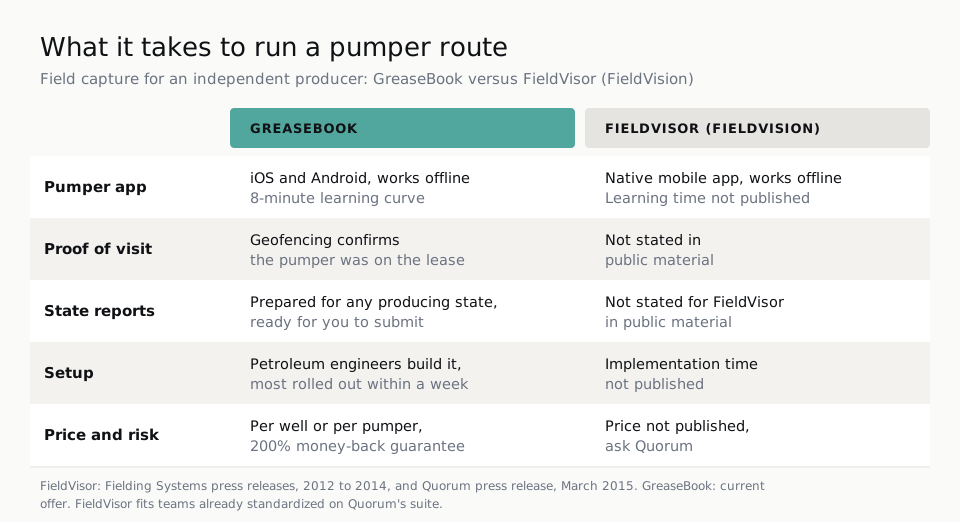
| FieldVisor (FieldVision) | GreaseBook | |
|---|---|---|
| Built for | Multi-department E&P production teams (Fielding Systems press release, September 2014) | Independent producers, a handful of wells to over 2,000 |
| Pumper app | Native mobile and tablet apps (Fielding Systems releases, 2012 to 2014) | iOS and Android, on the phone the pumper already carries |
| Offline | Yes (Fielding Systems press release, September 2014) | Yes, syncs on its own back in cell range |
| Pumper learning curve | Not published | 8 minutes. If he can text, he can use GreaseBook |
| Proof of visit | Not stated in public material | Geofencing confirms the pumper was on the lease |
| Downtime and allocation | Downtime by code, allocations adjusted for downtime (Fielding Systems press release, September 2014) | Downtime tracker and allocations |
| State reports | Not stated for FieldVisor in public material | Prepared for any oil and gas producing state, ready for you to submit |
| Setup | Not published | Our petroleum engineers build it. Most operators roll out within a week |
| Price | Not published. Ask Quorum | Per well or per pumper, per month. Office users always free. Exact price on a call |
| Guarantee | Not published | 200% money-back guarantee |
Where a FieldVisor cell says “not published” or “not stated,” that is because Quorum’s public pages do not say. Get those answers in writing.
What Is GreaseBook?
GreaseBook is oil production software that gets production data from your pumper’s phone to your screen. No paper, no Excel, and no chasing anyone down. As of November 2026, 600+ production companies trust GreaseBook with their data and 10,000+ pumpers use it in the field. It has tracked 220 million+ barrels across 22 oil-producing states over 15 years in the oil patch. Pumpers learn it in 8 minutes, and our petroleum engineers build the company for you. GreaseBook carries a 200% money-back guarantee: run it a full 6 weeks, and if you don’t see results, we pay you double what you paid. GreaseBook’s sister product, TinyPumper, watches tanks, pressures and runtime between pumper visits.
When Is GreaseBook the Better Fit?
Most producers who look at FieldVisor are not short on dashboards. Their problem is the pumper. Wells slip and nobody catches the trend. You cannot prove the visit. Every department wants yesterday’s gauges without calling the pumper. GreaseBook is built for that oversight:
- Proof of every visit. Geofencing confirms the pumper stepped onto the lease.
- One screen for every department. Gauges, pressures, comments, run ticket photos and well tests land where the owner, engineer and office all see them.
- Feedback in the field. The pumper sees each well’s history and comments on his phone while he stands in front of it. That beats keying it in at home on the laptop after the fact.
- State reports. GreaseBook prepares state production reports for any oil and gas producing state, ready for you to review and submit. If your state’s form isn’t built yet, we build it at no cost.
- It plays well with what you have. GreaseBook works alongside your SCADA. It feeds clean production data to the accounting system you already run. It does not do accounting itself.
If you’re coming off paper and Excel, the old way, or off legacy production software, the switch takes little of your time. You hand us a login to your current system. Our engineers build out your wells and surface equipment first. Your pumpers run their routes and give feedback, and your supervisor signs off. Then we scrub, clean and backfill your history. If your current contract has months left, our buyout program covers them, in exchange for a minimum one-year term plus the months we bought out.
For the full picture on keeping well data in one place, see our guide to oil and gas production data management software.
Take the short quiz to see if GreaseBook fits. If it does, grab a few minutes with a real production engineer and walk out with your exact price. 200% money-back guarantee.
See if GreaseBook FitsWhen Is FieldVisor the Better Fit?
If your company already standardizes on Quorum’s applications, keeping field capture inside that suite can be the simpler call. The same goes if you have the staff to configure and run a broad, multi-department operations platform. FieldVisor’s downtime coding and custom forms are real strengths for that kind of team (Fielding Systems press releases, 2014).
The Amateur vs. the Pro
The best operators judge field software at the wellhead, not in the demo. Here is how that plays out when FieldVisor and GreaseBook are both on the table.
| The amateur… | The pro… |
|---|---|
| Picks FieldVisor or any tool because a big name like Quorum owns it | Runs a field trial on his toughest route with his oldest pumper |
| Judges the office dashboard in the demo | Judges what the pumper does at the wellhead at 6 a.m. |
| Assumes “has a mobile app” means pumpers will use it | Asks how long it takes a pumper to learn it, and gets a number |
| Stays on a tool his pumpers fight because the contract has months left | Asks the new vendor to buy out the remaining months |
| Trusts that the pumper made the route | Gets proof of each visit from geofencing |
That last row matters. GreaseBook’s operator trials succeed 98% of the time, and proof of visit is a big part of why.
What to Avoid
- Don’t assume every FieldVision result is the oilfield product. Construction apps and visual training apps share the name. FieldVisor from Fielding Systems, now Quorum, is the one built for oil and gas.
- Don’t buy a level you won’t use. FieldVisor once offered an advanced level with work orders, invoicing and inventory (Oil & Gas Online release, June 2012). Ask what you need on day one and what the next tier adds.
- Don’t sign before a field trial. Any vendor, FieldVisor or GreaseBook, should let your pumpers prove it on a real route.
- Don’t swap one system for another without proof of visit. New software that still can’t show whether the pumper was on the lease leaves your biggest blind spot open.
- Don’t let a remaining contract decide for you. A buyout program turns leftover months into a reason to move, not a reason to stay.
Who This Page Is Not For
This page is not for producers who already run Quorum’s suite and want field capture inside it. It is also not for teams shopping for an accounting system. GreaseBook handles the production side and feeds your accounting software. It does not replace it.
Frequently Asked Questions
What is FieldVision in oil and gas?
In the oilfield, FieldVision is usually how people remember FieldVisor, a cloud platform from Fielding Systems for field data capture, downtime tracking and production reporting. Quorum bought Fielding Systems on March 25, 2015 (Quorum press release, March 2015). Other products share the FieldVision name, including a construction app and a visual training app, so make sure you are looking at the oil and gas product.
Who owns FieldVisor now?
Quorum Software owns it. Quorum completed its purchase of Fielding Systems, the company that built FieldVisor and ScadaVisor, on March 25, 2015 (Quorum press release, March 2015). Quorum’s current pages describe production operations tools that pull data from SCADA, field capture apps and measurement systems. Ask Quorum directly whether FieldVisor is still sold under that name and how it is packaged today.
What is the best FieldVision alternative for an independent producer?
If your pumpers carry smartphones and you want production on your screen the same day without a big rollout, GreaseBook is built for that job. Pumpers learn it in 8 minutes, it works offline, geofencing confirms each visit, and our petroleum engineers build your company for you. If your company already runs Quorum’s wider suite, staying inside it may be the better fit.
Does GreaseBook work offline like FieldVisor?
Yes. Fielding Systems has described FieldVisor’s native app as working offline (Fielding Systems press release, September 2014), and GreaseBook does the same. Your pumper logs gauges, pressures, run tickets and photos with no signal, and the app syncs on its own when he drives back into cell range. Nothing waits for him to get home to a laptop.
How hard is it to switch from FieldVisor to GreaseBook?
Your job is to hand over a login to your current system. Our petroleum engineers build out your wells and surface equipment first. Your pumpers run their routes and give feedback, your supervisor signs off, and then we scrub and backfill your history. Most operators are fully rolled out within a week. If a contract still has months left, our buyout program covers them for a minimum one-year term plus those months.
Does GreaseBook submit state production reports for me?
No. GreaseBook prepares them, and you submit them. It builds state production reports from your pumpers’ data for any oil and gas producing state, ready for you to review and submit. If your state’s form is not already built, we build it at no cost, because if you need it, somebody else probably will too.