Short answer: Peloton ProdView is oil and gas production data software from Peloton Computer Enterprises: allocations, surveillance and regulatory reports, with ProdView Go as the mobile capture layer. If you already run Peloton software and need that library, keep it. If the real problem is getting clean numbers off the lease every day, GreaseBook is the better Peloton ProdView alternative for that job. Pumpers learn it in about 8 minutes. If he can text, he can use GreaseBook.
It’s the tenth of the month. A partner wants last month’s volumes. I just want to see yesterday’s gauges without calling three guys. The pumper keys it in at home on the laptop, not standing at the well, and the office finds out a well has been slipping only when the trend is already ugly. That is a capture problem, not an allocation-engine problem.
Is Peloton ProdView or GreaseBook the Better Fit for My Operation?
It depends on where it hurts. If you already live in Peloton oil and gas software, need date-effective allocation and 50+ regulatory formats across 20+ jurisdictions (Peloton ProdView page, July 2026), ProdView may be your better pick. If the problem is pumper accountability and same-day gauges, GreaseBook does that job: an 8-minute learning curve, offline entry and geofenced visits, with 600+ production companies on it as of November 2026. Many producers split the work: field capture in GreaseBook, Peloton where the suite already runs.
What Is Peloton ProdView?
ProdView is Peloton’s production data lifecycle product. ProdView Peloton, peloton prodview, and prodview go are the same line: the office system plus the pumper app. Peloton WellView and Peloton Well View are the sister well-file product, not this page.
Peloton Computer Enterprises is the Calgary oil and gas vendor, founded in 1992, with 600+ oil and gas clients worldwide (Peloton About Us). It is not the exercise-bike company. Searches for peloton energy and peloton oil usually mean this vendor when they sit next to ProdView or WellView.
Peloton describes ProdView Go as an offline-capable companion for pumpers, field operators and measurement techs (Peloton ProdView FAQ, July 2026). iOS and Android listings exist.
What Does ProdView Do Best, and What Does GreaseBook Do Best?
We are not trying to replace Peloton’s report library. Here is the honest split.
| What Peloton ProdView does best | What GreaseBook does best |
|---|---|
| Multi-tier, date-effective allocation and flow-network checks | Getting the pumper to enter gauges, run tickets and comments at the well |
| A large regulatory report library (Peloton claims 50+ formats) | State production reports prepared for any oil and gas producing state, ready for you to submit |
| WellView and SiteView in the same Peloton platform | Proof of the visit: geo-fencing confirms he stood on the lease |
| Role-based admin across production accounting and ops | Offline entry that syncs when he is back in range |
| SCADA and IoT ingestion into the production record | Turnkey setup by our petroleum engineers |
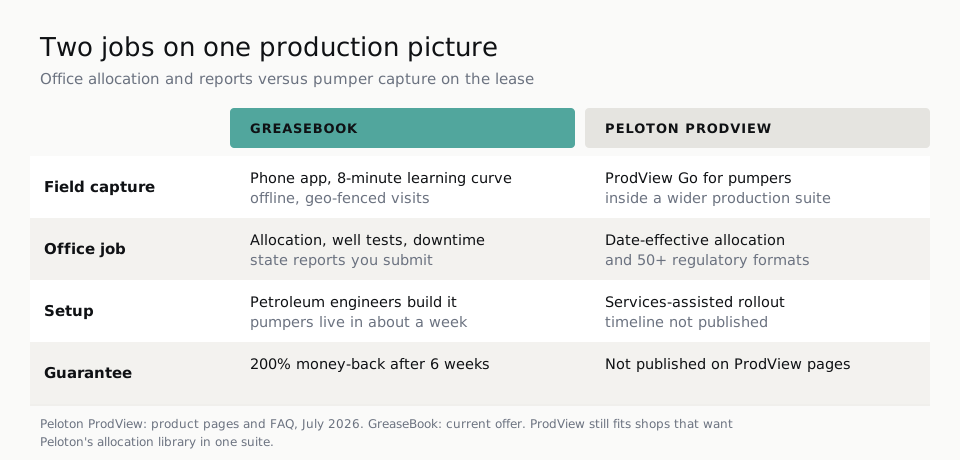
On the production side specifically, a tool built only for pumpers tends to beat a module built to serve a whole suite. That is a footnote, not the thesis. Use both if you already own Peloton.
How Does GreaseBook Handle the Field Side?
- The phone he already has. iOS and Android. Average learning curve is about 8 minutes.
- Offline first. GreaseBook keeps working in a dead spot and syncs later.
- Proof he was there. Geo-fencing confirms the visit. Wells slip when nobody can prove the route got run.
- Allocation inputs that are actually complete. Well tests, downtime and shut-in state get recorded on the well. See our guide to managing production data from the field.
- State production reports prepared for any oil and gas producing state, ready for you to review and submit. If your state’s form isn’t built yet, we build it at no cost.
Our petroleum engineers build it for you. Pumpers learn it in about 8 minutes. 200% money-back guarantee.
See if GreaseBook fitsThe Amateur vs. the Pro
| The Amateur | The Pro |
|---|---|
| Signs a ProdView statement of work because the demo showed a flow network, then finds pumpers still typing at the kitchen table | Asks whether ProdView Go is what contract pumpers will actually open at the well, then pilots GreaseBook on one route |
| Mixes Peloton oil and gas software with the bike company | Names Peloton Computer Enterprises, ProdView, ProdView Go and WellView as one oilfield vendor |
| Treats unpublished pricing as “it will be fine” | Gets Peloton’s services hours in writing, then compares GreaseBook’s 200% money-back after 6 weeks |
What to Avoid
- Assuming ProdView Go ratings tell the whole story. Read current App Store and Play notes yourself; they change. Ask two pumpers who use it on Android.
- Skipping geo-fence. If you cannot verify the pumper visited, a well can slip and nobody sees it.
- Ripping out Peloton to “go mobile.” Keep the suite if allocation is working. Add GreaseBook for capture.
What GreaseBook Facts Should You Know?
As of November 2026, 600+ production companies trust GreaseBook with their data. 10,000+ pumpers use it in the field. GreaseBook has 15 years in the oil patch, has tracked 220 million+ barrels, and serves operators in 22 oil-producing states. The average pumper learning curve is 8 minutes. GreaseBook has a 98% operator trial success rate and a 200% money-back guarantee: run it a full 6 weeks, and if you don’t see results, we pay you double what you paid us. TinyPumper is GreaseBook’s sister product; it monitors tanks, pressures and runtime between pumper visits.
What Is GreaseBook Not?
GreaseBook is a production app. It does not do Peloton LandView, and it does not replace WellView as a corporate well file. It feeds clean production data to the accounting system you already run, including PakEnergy (formerly WolfePak), OGsys, Bolo, SSI, P2, PHDwin and the rest of the majors you’d expect.
Who This Page Is Not For
This page is not for producers whose pumpers already live in ProdView Go, and it is not for teams shopping Peloton WellView as a drilling well file. For the production-data picture, start with oil and gas production data management software.
Frequently Asked Questions
What is Peloton ProdView?
Peloton ProdView is production data management software from Peloton Computer Enterprises. It covers allocations, surveillance, reconciliation and regulatory reporting, with ProdView Go as the mobile field layer. Peloton About Us (checked July 2026) says the company has served oil and gas since 1992 and names 600+ clients worldwide. It is not the exercise bike.
What is the best Peloton ProdView alternative?
If you need Peloton’s allocation library and already run WellView, staying on ProdView is reasonable. If you need pumper visits confirmed, offline entry, well tests and state production reports prepared for any producing state, GreaseBook covers that on the phone your pumper already carries. Our petroleum engineers do the setup, the average pumper learns it in 8 minutes, and a 200% money-back guarantee backs it.
Is ProdView Go offline?
Peloton’s FAQ says ProdView Go is an offline-capable companion for pumpers, field operators and measurement technicians (Peloton ProdView FAQ, July 2026). Confirm the current iOS and Android builds with your Peloton admin, including how a missed sync is corrected. GreaseBook also works with no signal and syncs on its own when the pumper is back in range.
Is Peloton software the same as the bike company?
No. Peloton Computer Enterprises is oil and gas software: ProdView, WellView, SiteView and LandView. The bike company is a different business. If you searched peloton energy, peloton oil, or peloton oil and gas software next to ProdView, you want the Calgary vendor, not a spin class.
Does GreaseBook replace Peloton WellView?
No. WellView is a corporate well file for planning, drilling, completions and workovers. GreaseBook is daily production capture. Teams often run both: WellView for the wellbore record, GreaseBook for gauges, tickets and pumper visits. See our WellView page if that is the product you meant.
How do I switch field capture from ProdView Go to GreaseBook?
Hand our team a login to your current system. Petroleum engineers build your wells and surface equipment first, so pumpers can start entering data. After pumpers check their routes and a supervisor signs off, we clean up and backfill history. Most operators are fully rolled out within a week. Ask about contract buyout if you are stuck in a term.