Short answer: TankLogix is a Permian oilfield automation company. It designs, builds, installs and supports tank monitoring, SCADA and instrument packages. If you want a crew to engineer and wire a controls system for your facilities, TankLogix fits that job. If you want tank levels, pressures and compressor runtime on your phone without a controls project, TinyPumper is the simpler alternative. Your team self-installs it in 8 minutes. It costs $349 a sensor, one time, then one flat rate a month per site.
It’s 5:40 Friday. The pumper is headed home, and you want to know what Lease 14 is doing before you leave the yard. You don’t need to open a valve from your desk. You just need to see the tanks, the pressure and whether the compressor is still running. That difference, seeing versus controlling, decides this whole comparison.
Is TankLogix or TinyPumper the Better Fit for My Leases?
It depends on whether you need control or visibility. If you need a crew to build, wire and run automation, such as remote shut-ins, PLC work or hosted SCADA on facilities, TankLogix is the better pick. If you need to see tank levels, pressures and compressor runtime from your phone, TinyPumper does that without a controls project. As of October 2026, TinyPumper costs $349 a sensor, one time, plus one flat rate a month per site, and your team self-installs it in 8 minutes. TankLogix does not publish its prices (TankLogix website, July 2026).
What Is TankLogix?
TankLogix is an oilfield automation, SCADA and measurement company. Its site says it “designs, builds, installs, and supports the controls and automation systems that keep oil and gas production running.” Its tank monitoring system tracks liquid inventory in oil and water tanks and sends readings to the TankLogix Portal, a web app with alarms, trends and report downloads. It also runs hosted SCADA on Inductive Automation’s Ignition platform and sells instruments out of its Texas and New Mexico offices.
Put simply, TankLogix is an integrator. You buy a system it engineers and installs, not a box off the shelf.
What Does TankLogix Do Well?
We’ll be straight about it. TankLogix has real strengths:
- It builds like an automation shop. Design, build, install and support all come from one company, which helps on complex facilities.
- It reads almost any instrument. It lists pressure transducers, magnetostrictive floats, guided radar and capacitive sensors, and it talks to Modbus serial devices (TankLogix website, 2026). That matters on older sites full of mixed gear.
- It measures oil and water in the same tank. TankLogix says its interface reading is accurate to within .1 inch (TankLogix website, July 2026).
- It runs off-grid. A solar system powers the control unit, or you can hardwire it.
- It carries enterprise credentials. It lists SOC 2 security practices and integrator status with Endress+Hauser and Inductive Automation.
- It keeps parts close. Its Odessa and Carlsbad offices stock instruments for same-day pickup.
- It handles disposal paperwork. The Portal includes disposal workflows, invoicing support and a P-18 report.
- It stands behind the equipment. TankLogix covers its equipment for 2 years (TankLogix website, July 2026).
How Does a TankLogix Install Work?
From what TankLogix publishes, a site comes together in layers:
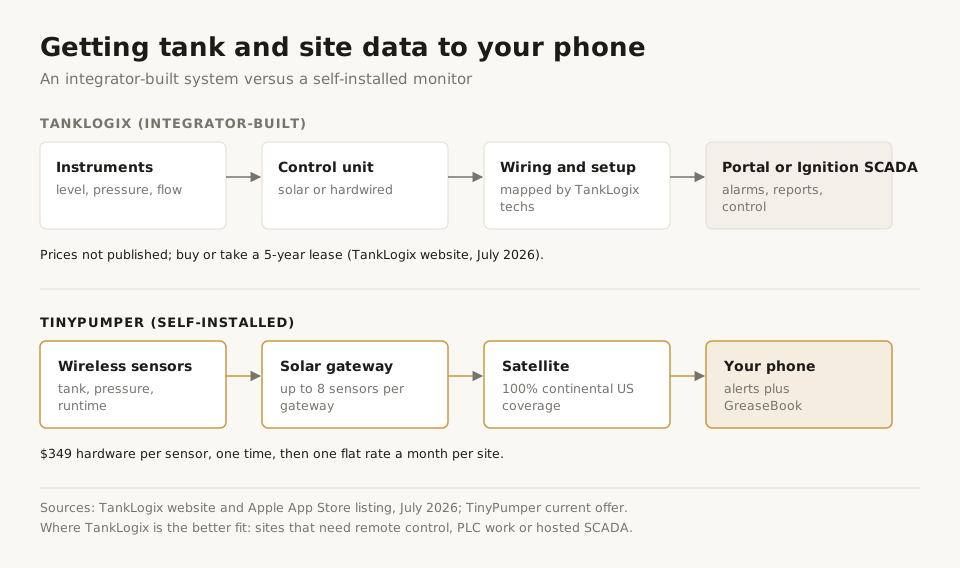
- Instruments. Level, pressure or flow devices get picked and mounted for each tank or line.
- Control unit. A box on location collects the readings, on solar or hardwired power.
- Wiring and setup. Instruments get wired to the control unit, and each one gets mapped and scaled.
- Communications. The control unit sends data off the lease. Satellite is one of its listed options.
- Software. Readings land in the TankLogix Portal or in hosted Ignition SCADA, where alarms and reports get built.
TankLogix does not publish an install time. Because it designs and installs the system itself, plan on its technicians doing the field work and setup, not your pumper.
Where Does TankLogix Stop for an Independent Producer?
Two places, and neither is a knock on the engineering.
The project. Every choice above (sensor type, wiring, power sizing, alarm setup) is a decision someone has to make and pay for. On a big facility, that is money well spent. On 10 or 20 conventional leases, the install labor can outweigh the hardware, and you can’t size it ahead of time because prices aren’t public.
The production side. TankLogix’s site centers on monitoring, alarms, SCADA and disposal reporting. It does not show a pumper app for daily gauges, run tickets, production allocation or state production reports. So you may end up with TankLogix for the tanks and a second system for your production numbers, with two screens to check.
How Does TinyPumper Compare?
| TankLogix | TinyPumper | |
|---|---|---|
| What it is | Automation integrator: tank monitoring, SCADA, instruments, controls | Whole-site monitor: tank levels, pressures (wellhead, flowline, injection), engine and compressor runtime |
| Can it control the well? | Yes, as part of a controls and SCADA build | No. It watches, it doesn’t control. No shut-ins, no pump adjustments |
| How the tank is measured | Your choice of several sensor types (TankLogix website, 2026) | Radar on top of the tank, no fluid contact |
| Oil and water in one tank | Two-liquid reading, accurate to .1 inch (TankLogix website, July 2026) | Tank level by radar |
| Install | Designed and installed by TankLogix; time not published (TankLogix website, July 2026) | Your team self-installs in 8 minutes, no electrician, no trenching |
| Power | Solar control unit or hardwired | Solar powered, nothing wired to the tank |
| Coverage | Satellite among its listed options | 100% continental US coverage, because we use satellite |
| Pricing | Not published; buy or take a 5-year lease (TankLogix website, July 2026) | $349 a sensor, one time, then one flat rate a month per site, unlimited sensors |
| If it breaks | Equipment covered for 2 years (TankLogix website, July 2026) | Lifetime hardware replacement |
| Trial | Not published | 60-day money-back, we pay return shipping |
| Production records | Not shown: no pumper gauges, run tickets or allocation | Data flows into GreaseBook; every well with a TinyPumper sensor gets free Greasebook |
When Is TinyPumper the Better Fit?
- You want to see, not steer. TinyPumper gives you roughly 99% of SCADA’s upside without the cost or the complexity.
- You don’t have a controls engineer. If you can change a lightbulb, you can install TinyPumper. The sensors screw in.
- You want to price it before you buy it. $349 a sensor, one time. Then one flat rate a month per site, so adding a tank or a pressure point at the same site does not raise the monthly bill.
- You want alarms fast. Sensors report every hour and check your thresholds every 5 minutes, so an alert goes out the moment something crosses the line.
- You want one screen for field and production data. TinyPumper readings land in GreaseBook next to the pumper’s gauges, run tickets and comments. Every well with a TinyPumper sensor gets free Greasebook.
Producers running TinyPumper report cutting lease runs by 30 to 50 percent and catching failures days sooner.
TinyPumper is GreaseBook’s sister product. It has 100% continental US coverage, because we use satellite. Each gateway connects up to 8 sensors per gateway. It is solar powered, IP67-rated and Class I Div 1 certified. Every order carries a 60-day money-back guarantee and lifetime replacement on all equipment.
For the full field of options, see our guide to oilfield monitoring alternatives, or read how it works across a lease in oil well monitoring systems.
TinyPumper self-installs in 8 minutes. $349 a sensor, one time, then one flat rate a month per site. 60-day money-back.
See TinyPumperWhen Is TankLogix the Better Fit?
Pick TankLogix when the job is automation, not just visibility:
- You need remote control: shut-ins, PLC logic, pump control.
- You want hosted SCADA on Ignition with custom screens. (If you’re weighing Ignition itself, see our Ignition SCADA alternative page.)
- You have brownfield sites full of Modbus instruments you want tied together.
- You run disposal wells and want disposal invoicing and P-18 reporting inside the monitoring portal. For level and flow watching alone, see saltwater disposal monitoring.
- Your IT or procurement team needs SOC 2 practices on paper.
If that’s you, TankLogix is a fair choice. For more on when full SCADA earns its keep, read oil and gas SCADA.
Looking for TankLogix Itself?
People search for the company in a lot of ways. Here are quick answers:
- TankLogix login: The TankLogix Portal login lives on tanklogix.com (www.tanklogix.com). We don’t run it, so contact TankLogix for account help.
- Tank Logix spelling: The company writes it as one word, TankLogix.
- TankLogix app and download: TankLogix Mobile is on the Apple App Store, listed free ($0, Apple App Store, July 2026).
- TankLogix alternative PDF: There is no PDF of this page. Use your browser’s print option and save it as one.
- TankLogix blog, careers and LinkedIn: Find these on the company’s own site and its LinkedIn page.
- TankLogix Midland: TankLogix lists locations in Odessa and Midland, Texas, Carlsbad, New Mexico, Hermleigh, Texas and Logan, Utah.
- TankLogix oil and gas automation: That’s its core business: controls, automation, SCADA and instruments for oil and gas sites.
- TankLogix Ignition: Its hosted SCADA runs on Inductive Automation’s Ignition platform, and it is an Inductive Automation Registered Integrator.
Who This Page Is Not For
This page is not for producers who need remote control of their facilities, and it is not for disposal operators who want invoicing and P-18 reporting built into the monitoring portal. TankLogix or a full SCADA build serves them better. If you’re comparing other tank monitors, see our Tank Sentinel alternative, TankScan alternative and oilfield tank monitoring pages, or go back to the full list of monitoring alternatives for producers.
Frequently Asked Questions
What is TankLogix?
TankLogix is an oilfield automation, SCADA and measurement company with offices in Texas, New Mexico and Utah. It designs, builds, installs and supports controls and automation for oil and gas sites. Its tank monitoring system reads oil and water levels, and readings flow to the TankLogix Portal or to hosted SCADA on Ignition. It works as an integrator, so a TankLogix crew engineers and installs the system for you.
What is the best TankLogix alternative?
It depends on the job. If you need remote control and hosted SCADA, look at other automation integrators or a full SCADA build. If you only need to see tanks, pressures and compressor runtime, TinyPumper is the simpler alternative. Your team self-installs it in 8 minutes, it costs $349 a sensor, one time, then one flat rate a month per site, and the data lands in GreaseBook next to your production numbers.
Does TankLogix publish its prices?
No. TankLogix does not publish hardware, install or monthly prices on its website (TankLogix website, July 2026). It says tank monitoring can be bought outright or leased, with a 5-year lease option (TankLogix website, July 2026). TinyPumper publishes its price: $349 a sensor, one time, then one flat rate a month per site with unlimited sensors, backed by a 60-day money-back guarantee.
Is TankLogix built on Ignition?
TankLogix offers hosted SCADA powered by Inductive Automation’s Ignition platform, and it lists itself as an Inductive Automation Registered Integrator. That gives you custom screens, alarms and control on instrumented sites. TinyPumper is not SCADA and does not control the well. It watches tanks, pressures and runtime and sends alerts to your phone, which covers what most conventional leases need.
Do I need a controls engineer to install TinyPumper?
No. Your team self-installs TinyPumper in 8 minutes with no electrician, no trenching and no third-party service call. The gateway is solar powered and connects up to 8 sensors per gateway. The radar tank sensor mounts on top of the tank, so nothing touches the fluid. If anything ever fails, lifetime hardware replacement sends you a new one.
Is there a TankLogix app?
Yes. TankLogix Mobile is on the Apple App Store, listed free ($0, Apple App Store, July 2026). Some reviewers there say the app struggles to load without strong internet after an update (Apple App Store reviews, July 2026). TinyPumper sends readings and alerts to your phone through GreaseBook, and every well with a TinyPumper sensor gets free Greasebook.