Short answer: Centeron is a wireless tank monitoring system from Schneider Electric, first developed by Robertshaw Industrial Products. It was built for fuel, propane and lubricant distributors who use tank levels to schedule truck deliveries. It reads tanks well. On an oil lease you also need wellhead pressure and to know whether the compressor is running. TinyPumper watches tanks, pressures and runtime on one gateway, for one flat rate per site, and your team installs it in 8 minutes.
A distributor and a producer look at the same tank and ask different questions. The distributor asks, “When do I send the truck?” You ask, “Did the well make oil last night, and is everything still running?” That difference is what this page is about.
Is Centeron or TinyPumper the Better Fit for My Lease?
It depends on your job. If you deliver fuel or propane and want tank levels feeding route and dispatch planning, Centeron fits that work. If you run oil wells and need tank levels, casing or flowline pressure and compressor runtime together, TinyPumper watches all three on one gateway. As of October 2026, TinyPumper costs $349 a sensor, one time, plus one flat monthly rate per site. If you need full control of instrumented facilities, neither one fits; look at oil and gas SCADA.
What Is Centeron?
Centeron is a wireless tank monitoring system. Sensors on the tank send levels to an online portal called WebView, which you check from a computer or the mobile app. Schneider Electric sells and supports it today, so you will see it called “Schneider Electric Centeron.” Robertshaw Industrial Products developed it.
Centeron’s own literature describes the goal plainly: help “any liquid distribution business” schedule and dispatch its truck fleet. It lists oil and gas production as one of several industries served, next to propane, heating oil, lubricants and chemicals.
Not the same as Centreon. Centreon (with the “re”) is IT network monitoring software for servers. If your search pulled up server tools, that is a different company. This page is about Centeron tank monitors.
What Does Centeron Do Well?
Credit where it is due:
- Hazardous-location rated. Its RF monitors carry UL 913 and CSA certification for Class I, Division 1, Group D locations (Centeron RF monitor product sheet, 2015).
- Several ways to read a tank. Radar, float, pressure and propane monitors, on tanks from 9 inches to over 50 feet deep (Centeron RF monitor product sheet, 2015).
- Long battery life. The RF monitors are rated for 5 years at a 10-minute send interval or 8 years at a 1-hour interval (Centeron RF monitor product sheet, 2015).
- Built for delivery planning. WebView pairs with OptiFill fill optimization and Dispatch Compass routing software.
If you route trucks to customer tanks for a living, that is a strong package.
Where Does Centeron Stop on an Oil Lease?
Centeron answers the distributor’s question: how much is in the tank? On a producing lease, the costly surprises usually come from somewhere else:
- Wellhead and flowline pressure. Pressure tells you a well is loading up or a line is plugging days before the tank shows it. Centeron’s pressure monitors are sold for tanks, not well surveillance.
- Runtime. A compressor or pumping unit that quit at midnight costs you every hour until somebody notices. Nothing in Centeron’s literature covers engine or compressor runtime.
- Injection and disposal. Water going down an injection well needs its own pressure watch.
Centeron’s add-on software is about trucks and routes, not production. So the question is not “which tank monitor?” It is “what else on this lease do I need to see?” For a wider look at your options, see our guide to oilfield monitoring alternatives.
How Does TinyPumper Compare?
| Centeron | TinyPumper | |
|---|---|---|
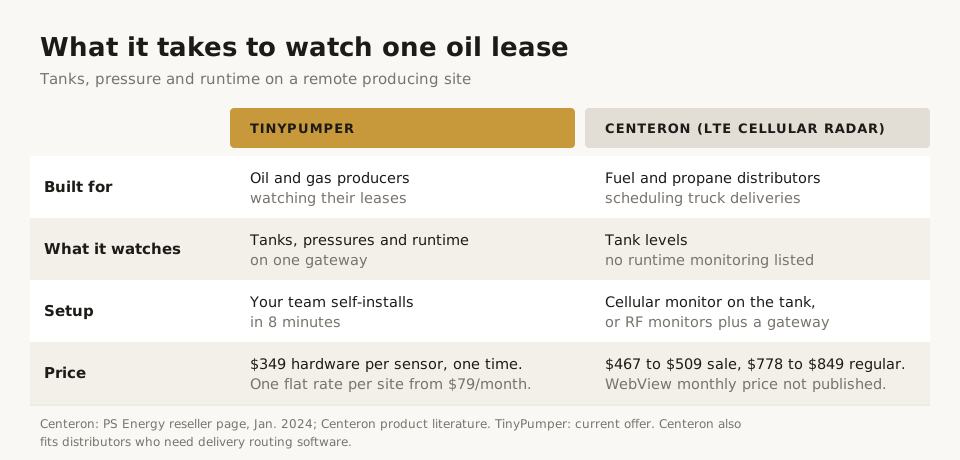
| Built for | Fuel, propane and lubricant delivery planning | Oil and gas producers watching their leases |
| What it watches | Tank levels; pressure monitors for tanks | Tank levels, pressures (wellhead, flowline, injection) and engine or compressor runtime |
| How the tank is measured | Radar, float, pressure or propane monitors | Radar on top of the tank, no fluid contact |
| Setup | Turnkey cellular monitor, or RF monitors plus a gateway that handles up to 40 monitors (Centeron LookBook, accessed October 2026) | Your team self-installs in 8 minutes |
| Coverage | Cellular monitors, or RF to a gateway with 1 mile line of sight, 500 feet obstructed (Centeron RF monitor product sheet, 2015) | 100% continental US coverage over satellite |
| Hardware price | $778 to $849 regular, $467 to $509 on sale, for LTE cellular radar monitors (PS Energy reseller page, January 2024) | $349 a sensor, one time |
| Monthly price | WebView pricing not published | One flat rate a month per site, unlimited sensors |
| If it breaks | Ask the vendor | Lifetime hardware replacement |
| Trial | Ask the vendor | 60-day money-back, we pay return shipping |
Where a Centeron cell says “not published” or “ask the vendor,” its public materials do not say. Ask Schneider Electric or your distributor directly.
When Is TinyPumper the Better Fit?
- You produce oil and need more than the tank: pressures and runtime on the same lease.
- You want alerts the moment something crosses a line. TinyPumper’s sensors report every hour and check thresholds every 5 minutes, so an alarm goes out right away.
- You want one price per site, so adding a second tank or a pressure sensor does not add a monthly charge.
- You have dead zones. Satellite gives 100% coverage across the continental US.
Producers running TinyPumper report cutting lease runs by 30 to 50 percent and catching failures days sooner. See how it fits across the whole lease in our oil well monitoring systems guide.
TinyPumper has 100% continental US coverage, because we use satellite. Each gateway handles up to 8 sensors. Every order carries a 60-day money-back guarantee. All equipment has lifetime replacement. TinyPumper is GreaseBook’s sister product.
TinyPumper watches all three on one gateway. $349 a sensor, one time, then one flat rate a month per site. 60-day money-back.
See TinyPumperWhen Is Centeron the Better Fit?
If you deliver fuel, propane or lubricants and your money is made by sending the truck at the right time, Centeron’s WebView, OptiFill and Dispatch Compass were built for exactly that. TinyPumper is not routing software. And if you need full control of instrumented facilities, neither product is the answer; look at oil and gas SCADA.
Centeron Setup, Login and Manuals
People searching for Centeron are often current users. Here are straight answers.
- Centeron WebView login. WebView is Centeron’s online portal, reached through centeron.net (people search it as “webview centeron net” or “www centeron net”). Your login comes from whoever set up your account, usually your distributor or Schneider Electric.
- WebView login password. We cannot reset it. Ask your account admin first, then Schneider Electric support. We have no access to Centeron accounts.
- Centeron setup. A cellular Centeron monitor goes on the tank and reports straight to WebView with no controller. Multi-tank sites use RF monitors that report to a gateway, and the gateway needs power or Ethernet with a clear line of sight to the tanks.
- Centeron tank monitor manual. Schneider Electric publishes install guides for its Centeron monitors on its document site. Your distributor can send the one for your model.
If your Centeron monitors are losing support, or you are weighing a replacement, a sister page on Tank Sentinel and our oilfield tank monitoring guide cover the rest of the field.
Two Questions to Ask Any Tank Monitor
- What else does it watch? If the answer is only the tank, you still need another system for pressure and runtime.
- What happens the day it fails? TinyPumper ships a new one under lifetime hardware replacement. Get every vendor’s answer in writing.
Who This Page Is Not For
This page is not for fuel or propane distributors who need delivery routing, and it is not for producers who need full SCADA control. If you are comparing every option at once, start with the full list of monitoring alternatives for producers.
Frequently Asked Questions
What is Centeron?
Centeron is a wireless tank monitoring system sold by Schneider Electric and first developed by Robertshaw Industrial Products. Monitors on each tank send levels to an online portal called WebView. It was built mainly for fuel, propane, lubricant and chemical distributors who schedule truck deliveries off tank levels. Oil and gas production is one of several industries it lists.
What is the best Centeron alternative for oil and gas?
For a producer, the best alternative watches more than the tank. TinyPumper covers tank levels, wellhead and flowline pressure, and engine or compressor runtime on one gateway, for one flat rate per site. Your team self-installs it in 8 minutes, and satellite gives 100% continental US coverage. For delivery routing, Centeron’s own software remains the better fit.
How do I log in to Centeron WebView?
WebView is Centeron’s online portal, reached through centeron.net. Your username and password come from whoever set up the account, usually your fuel distributor or Schneider Electric. If you forgot your password, ask your account admin first, then Schneider Electric support. TinyPumper has no access to Centeron accounts and cannot reset them.
Is Centeron the same as Centreon?
No. Centeron, spelled with “er,” is a wireless tank monitor for fuel and liquid tanks. Centreon, spelled with “re,” is software that monitors computer servers and IT networks. The names look alike, so search results mix them up. If you are watching oil tanks on a lease, you want Centeron or a tank monitoring alternative, not Centreon.
How is TinyPumper priced?
TinyPumper is $349 a sensor, one time. Then one flat rate a month per site, with unlimited sensors at that site. Adding another tank or a pressure sensor to the same site does not raise the monthly bill. Every order comes with a 60-day money-back guarantee, return shipping paid, and lifetime replacement on all equipment.