Short answer: Pumper’s Friend is a free iPhone app that lets a pumper record tank and gauge readings and send a pumper report to the office. For one person, it is a simple way off paper. GreaseBook is the alternative when the office needs the data along with the pumper. It runs on iPhone and Android and works offline. It confirms each visit by geofencing and turns gauges into allocation and state production reports for you to review and submit. Pumpers learn it in 8 minutes, and a 200% money-back guarantee backs it.
Your engineer wants last week’s gauges on the Smith lease. The office has an email from one pumper and a text from another. The third pumper’s gauge book is still riding in his truck. Wells slip a barrel here and a barrel there, and nobody sees the trend because nobody has all the numbers in one place.
Should I Use Pumper’s Friend or GreaseBook for My Pumpers?
It depends on who needs the numbers. If you are one pumper on an iPhone and want a free digital gauge sheet you email in, Pumper’s Friend does that. If your office needs every route in one place, pumpers on Android too, proof of each visit, allocation and state production reports ready to submit, GreaseBook fits better. If you need full SCADA control of instrumented facilities, neither one is the answer.
What Is Pumper’s Friend?
Pumper’s Friend is an iPhone app for oilfield pumpers that records tank and gauge readings and sends pumper reports back to the office. Its own site calls it iPhone software for the oil field and lists it as free. Third-party app roundups describe a visual screen. The pumper moves on-screen dials, rulers and levels to match the real gauge instead of typing numbers. A 2011 Rigzone roundup of oilfield apps covered it and pointed readers to Systems of Merritt, Inc.
It is a focused field tool, not a production reporting system. That is not a knock. It is what the product says it is.
Is Pumper’s Friend the Oilfield App or the Engine Radiator?
Most of what Google shows for this name has nothing to do with oilfield software. If you searched “pumper friend engine,” you are probably after the Pumper’s Friend radiators and engine coolers sold under the same name, and those are a different product from the iPhone app. A “pumper friend engine for sale” listing is the same story. So are most “pumper friend engines for sale” posts on hobby forums: old iron and cooling parts.
A “pumper friend for sale” search mostly turns up parts too, because the app itself is listed as free on its own site. That also answers “pumper friend price”: the oilfield app costs nothing to download, per its site. If your search was “pumper friend alternative chevy” or a “bigalsmachine pumper friend alternative,” you want a radiator or a machine-shop part, and we can’t help with that one. If you want a “pumper friend alternative for sale” as oilfield software, the rest of this page is for you.
What Does Pumper’s Friend Do Well?
- It gets one pumper off paper. Its site leads with cutting paper records and sending pumper reports digitally.
- The gauge screen is visual. Roundups describe matching on-screen dials and levels to the real gauge, which can cut typed-number mistakes.
- It costs nothing. Its site lists it as free, which matters to a small shop or a single contract pumper.
- It has been around. Rigzone covered it in 2011, long before most oilfield apps existed.
Where Does Pumper’s Friend Stop for a Producing Company?
A gauge app answers one question: what did this pumper read today? A producing company has more questions than that.
- iPhone only. Its site and the roundups list it for iPhone. Relief pumpers and contract pumpers carry whatever phone they own.
- Reports arrive by email. Its site lists an email report format. Somebody in the office still combines those emails into one picture, every week.
- Offline is not stated. Its site does not say whether it works with no signal, and plenty of routes have none.
- No proof of visit is stated. With a gauge report alone you cannot prove the visit happened.
- No allocation or state reports are stated. Gauges still have to become allocated production by well and state production reports somewhere else.
The goal is simple: every department should see yesterday’s gauges without calling the pumper. That takes one place for every route’s numbers. Our guide to production data management software covers what that looks like.
How Does GreaseBook Compare to Pumper’s Friend?
| Pumper’s Friend | GreaseBook | |
|---|---|---|
| Who it serves | The pumper, per its site | The producing company: pumpers, office, engineers and owner |
| Phones | iPhone, per its site and app roundups | iPhone and Android |
| Data entry | Visual dials and levels matched to the gauge, per third-party roundups | Gauges, pressures, comments, run tickets and photos, with checks that catch fat-fingered entries at the source |
| No cell signal | Not stated on its site | Works offline, syncs when back in range |
| Getting data to the office | Emailed pumper report, per its site | Live dashboard for the whole team |
| Proof of the visit | Not stated on its site | Geofencing confirms the pumper was on the lease |
| Allocation and state reports | Not stated on its site | Allocation by well and lease; state production reports for any producing state, prepared for you to submit |
| Accounting systems | Not stated on its site | Feeds clean production data to the accounting platform you already run |
| Price | Listed as free on its site | Per well or per pumper, monthly; office users free; exact price on a call |
| Guarantee | Not stated on its site | 200% money-back |
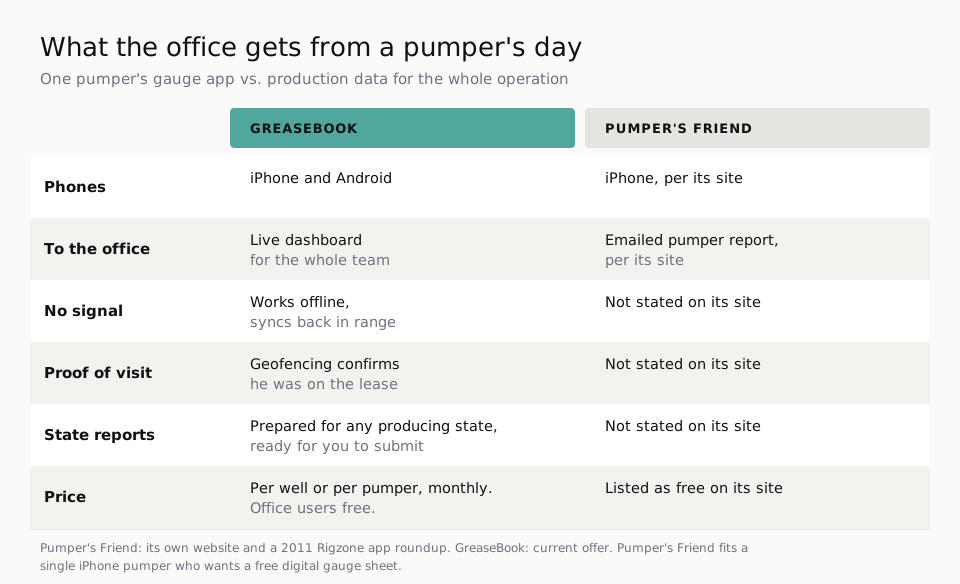
Where the Pumper’s Friend column says “not stated,” its public site does not say. Ask before you count on it.
The Amateur vs. the Pro: Moving Off Pumper’s Friend
| The amateur… | The pro… |
|---|---|
| Picks the free app because it costs nothing today | Counts the clerk hours spent combining emailed reports every week |
| Lets each pumper send gauges his own way | Puts every route in one app so the office sees yesterday’s gauges without calling |
| Treats a gauge report as proof the pumper went | Uses geofencing, because a report alone cannot prove the visit |
| Compares wells at month-end | Watches each well’s trend, so a well that slips shows up in days |
What to Avoid When You Leave Pumper’s Friend
- Don’t judge on sticker price alone. A free app that leaves someone retyping emailed reports into Excel still costs clerk hours. Excel never sends an invoice, and neither do the hours.
- Don’t pick a system where the pumper keys it in at home on the laptop. The best time to enter a gauge is standing in front of the tank. GreaseBook works offline, so a dead zone is no excuse.
- Don’t run half the routes on the old app. Two systems means two sets of numbers, and nobody trusts either one.
- Don’t let an iPhone-only app decide who you can hire. A relief pumper with an Android phone should log gauges the same day he starts.
When Is GreaseBook the Better Fit Than Pumper’s Friend?
- More than one pumper reports to your office, and you want every route on one screen.
- Your crew carries a mix of iPhones and Android phones.
- You need to verify visits, not take them on faith.
- Gauges have to become allocation, with well tests, downtime and shut-in state on the well, and state production reports you submit.
GreaseBook is trusted by 600+ production companies, with 10,000+ pumpers in the field. It has 15 years in the oil patch and 220 million+ barrels tracked across 22 oil-producing states. Pumpers learn it in 8 minutes, and our petroleum engineers build your company out for you. It carries a 200% money-back guarantee: if it doesn’t work, we pay you double. Operator trials run at a 98% success rate. TinyPumper is GreaseBook’s sister product, for 24/7 remote monitoring of tanks, pressures and runtime between pumper visits.
Here is the honest part. GreaseBook is not the cheapest option, because Pumper’s Friend is free. GreaseBook is priced per well or per pumper each month. The price depends on how many wells you run, how many pumpers cover your routes and what you need to track. Office users are always free. See how a producer keeps one place for every route’s production data before you decide.
Take the 30-second quiz to see if you're a fit. If you are, a production engineer walks you through your exact price. 200% money-back guarantee.
See GreaseBookWhen Is Pumper’s Friend the Better Fit?
If you are a single pumper on an iPhone and want a free digital gauge sheet, Pumper’s Friend may be all you need. The same holds if your office is happy reading emailed reports one at a time. If you need full SCADA control of instrumented facilities, neither app is the answer.
Who This Pumper’s Friend Comparison Is Not For
This page is not for a lone pumper who only wants a free iPhone gauge sheet. It is also not for producers who need full SCADA control. For how producers organize production data across every route, see how producers manage production data.
Pumper’s Friend Alternative FAQ
Is Pumper’s Friend free?
Its own website lists the oilfield app as free, which makes it an easy first step off paper for a single pumper. GreaseBook is not free. It is priced per well or per pumper each month, office users never pay, and you get your exact price on a call with a production engineer once a 30-second quiz shows you’re a fit. A 200% money-back guarantee backs it.
What is the best Pumper’s Friend alternative?
It depends on what the office needs. If one pumper just wants a digital gauge sheet, Pumper’s Friend may be enough. Some producers need every route in one dashboard, iPhone and Android, offline logging and geofenced proof of each visit. If you also need allocation and state production reports ready to submit, GreaseBook is the alternative built for that job. 600+ production companies trust it.
Does Pumper’s Friend work on Android?
Its site and the app roundups that mention it list it for iPhone, and we found no Android version. GreaseBook runs on iPhone and Android, so a crew with mixed phones can work in one app. That includes contract pumpers on their own devices. They all log gauges, run tickets and photos, and everything lands in one dashboard.
Is the Pumper’s Friend radiator company the same as the oilfield app?
They share a name, and that is where most searches get mixed up. Most of Google’s results for the name are engine radiators, industrial coolers and car parts. The oilfield app is the iPhone pumper app that a 2011 Rigzone roundup tied to Systems of Merritt, Inc. If you want an engine part, this page is not it. If you want pumper software, read on.
Can GreaseBook bring in my old Pumper’s Friend reports?
Yes. Our petroleum engineers first build your wells, tanks and surface equipment so pumpers can start logging. After pumpers check their routes and your supervisor signs off, we scrub, clean and backfill the historical records, including old emailed reports and spreadsheets. Your only job is sending what you have. Most operators are fully rolled out within a week.
Does GreaseBook work without cell service?
Yes. The GreaseBook pumper app works offline. Your pumper logs gauges, pressures, run tickets and photos on the lease with no signal, and the app syncs on its own when he is back in range. The Pumper’s Friend site does not say whether that app works offline, so ask before you count on it out on a dead-zone route.