Short answer: IHS FieldDirect, now sold by S&P Global, is a field data capture system: pumpers key in daily production on a phone or tablet and it syncs to the office. It does that job and it is a safe enterprise pick. If your pumpers are fighting the app, your reports need someone with IT skills to build, or you want allocation and state production reports in the same place, GreaseBook is the better fit. Our petroleum engineers do the whole switch, and your pumpers learn it in about 8 minutes.
The well went down Thursday. The pumper wrote it in. Then the app threw an error, he gave up, and the reading sat on a laptop at his kitchen table until Monday. That is the gap this page is about.
Is IHS FieldDirect or GreaseBook the Better Fit for My Operation?
It depends on how your team works. If your engineers run S&P Global’s Harmony tools and you have IT staff building reports on FieldDirect’s web services, stay put. If your pumpers fight the app, your numbers land days late, or nobody in the office has time to build reports, GreaseBook fits better. As of October 2026, 600+ production companies and 10,000+ pumpers use it, pumpers learn it in about 8 minutes, and it carries a 200% money-back guarantee. If you only need tanks and pressures watched, look at TinyPumper instead.
What Is IHS FieldDirect?
IHS FieldDirect is daily production data collection software for upstream oil and gas. S&P Global describes it as a way to “digitally collect and send your daily production data from the field to the office.” Pumpers record production, pressures, volumes, meter readings, run tickets, downtime and failures, and the data syncs to a hosted database the office, engineers and partners can see.
It started under IHS and IHS Markit. S&P Global completed its merger with IHS Markit on February 28, 2022 (S&P Global press release, 2022), so FieldDirect is now an S&P Global Commodity Insights product. It also connects into S&P’s wider toolset, including Harmony Enterprise for engineering analysis.
Is FieldDirect the Same as IHS Field Direct?
Yes. People search for it a lot of ways: fielddirect, field direct, ihs field direct, ihs fielddirect and field direct software all mean the same S&P Global product. The login addresses people type, like www.fielddirect.com and https://ua.fielddirect.com, are how existing users reach their FieldDirect account; confirm the right address with your S&P Global rep.
One warning: searches for fielddirect.co and field direct.com can turn up an unrelated business that shares the name. This page is about the oil and gas product only.
Looking for an IHS FieldDirect alternative PDF? There is no separate download. This page is the comparison; print it to PDF from your browser and hand it to your partners.
What Does FieldDirect Do Well?
- Offline capture. Its Android listing says data capture “does not require an Internet connection” and sends later when signal returns.
- Broad field data. Production, pressures, meter readings, run tickets, downtime and failures all go in.
- Enterprise track record. S&P says it has trained more than 8,000 pumpers (S&P Global FieldDirect case study, May 2022).
- Data access for engineers. Its FDDS web services feed Excel, Tibco Spotfire and Harmony, and partners connect it to Enertia, BOLO, ARIES and WellView.
- Mixed feeds. It accepts automated data alongside pumper entries.
If your team is built around S&P’s tools, that is real value. We are not going to pretend otherwise.
Where Does FieldDirect Stop for an Independent Producer?
The pumper app gets mixed marks. The iPhone app is rated 3.2 out of 5 from 56 ratings (Apple App Store, July 2026). One pumper wrote that after an update he hit an input error “almost every other well” while entering close to 120 wells a day (Apple App Store review, July 2026), and that “it really makes more sense to go back to PC data entry.” When the pumper routes around the app, the office is back to waiting.
Reports often need IT skills. FieldDirect’s data comes out through web services. Enerpact, a FieldDirect partner, says customers “often do not have the IT resources to build custom reports” and sells its product to fill that gap (Enerpact whitepaper, undated). A three-person back office does not have a report developer.
No price to plan around. S&P says it bills monthly “based on the number of wells” (S&P Global case study, May 2022), but publishes no prices.
Allocation and state reports are not in its published materials. FieldDirect is pitched as a capture and export system that feeds other tools. That means more systems to buy and keep in sync.
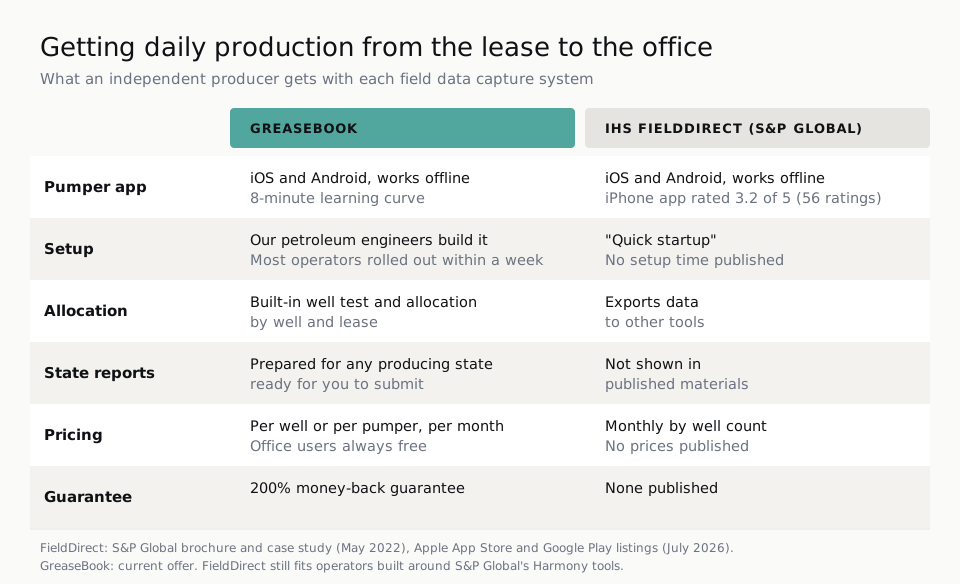
How Does GreaseBook Compare?
| IHS FieldDirect (S&P Global) | GreaseBook | |
|---|---|---|
| Pumper app | iOS and Android | iOS and Android, 8-minute learning curve |
| Offline | Yes | Yes, auto-syncs back in signal |
| Proof the pumper was there | Not shown in published materials | Geo-fencing confirms every lease visit |
| Setup | “Quick startup,” no time published | Our petroleum engineers build it; most operators roll out within a week |
| Allocation | Exports to other tools | Built-in well test and allocation by well and lease |
| State production reports | Not shown in published materials | Prepared for any oil and gas producing state, ready for you to submit |
| Accounting systems | Exports and partner connectors | Integrates with every major oil and gas accounting platform |
| Pricing | Monthly by well count, no prices published | Per well or per pumper, per month; office users always free |
| Guarantee | Not published | 200% money-back guarantee |
FieldDirect details come from S&P Global’s brochure and May 2022 case study, Enerpact’s whitepaper, and its Apple App Store and Google Play listings (checked July 2026). Where a cell says “not shown,” S&P’s public materials do not say; ask your rep.
Why Do Pumpers Stick With GreaseBook?
Because it runs on the phone they already carry, and if he can text, he can use GreaseBook. It works offline, so dead zones are no excuse. And the feedback lives in the field: your pumper sees the well’s history and past comments standing in front of the well, not at home on a laptop that night.
That matters more than any feature list. Paper gauge sheets and Excel leave the office retyping numbers and a week behind. A legacy system nobody wants to use does the same thing with a bigger invoice. The data only gets clean when the pumper actually enters it at the well.
For the office, GreaseBook is one screen: live production, alerts, downtime, allocated production by well, and state production reports prepared for any producing state, ready for you to submit. If your state’s form isn’t built yet, we build it at no cost. See how it all fits in our production data management software guide.
How Hard Is It to Switch From FieldDirect?
Your whole job is handing us a login to FieldDirect. Our petroleum engineers do the rest:
- We build out your wells and surface equipment so pumpers can start entering data.
- Pumpers give feedback on their routes and your supervisor signs off.
- Then we scrub, clean and backfill your historical production.
Most operators are fully rolled out within a week. Office users are 99% proficient in about 20 minutes. No laptops to buy, no new gear.
Stuck in a contract? Our contract buyout program buys out the months left on your old provider’s contract, in exchange for a minimum one-year term plus the bought-out months. The old contract is never a reason to stay stuck.
Take the 30-second quiz to see if you're a fit. If you are, grab 15 minutes with a production engineer and walk out with your exact price. 200% money-back guarantee.
See if GreaseBook fitsWhat Does GreaseBook Integrate With?
Keep your accounting software. GreaseBook feeds it clean production data from the field. It integrates with every major oil and gas accounting platform on the market: OGsys, PakEnergy (formerly WolfePak), Bolo, SSI, P2, PHDwin, and the rest of the majors you’d expect. Run something we didn’t name? If it’s a major platform, we already talk to it.
GreaseBook also integrates with SCADA, so operators running automation on their best wells see SCADA data and pumper data on the same screen.
When Is FieldDirect Still the Right Choice?
If your engineers run rate transient analysis in Harmony Enterprise, FieldDirect plugs straight into that, and switching the capture layer adds work. If you have in-house IT already building dashboards on its web services, you have paid down the hard part. In those shops, staying put is a reasonable call.
Who This Page Is Not For
This page is not for operators whose engineering runs on S&P Global’s Harmony tools, or for enterprise teams with IT staff already building reports on FieldDirect. It is for independent producers running anywhere from 2 to 2,000 wells who need clean production data without a report developer. If you are still on paper or Excel, start with our oil and gas production software guide, and if allocation is your sticking point, see production allocation software. For the bigger picture, see how producers manage production data.
GreaseBook at a Glance
GreaseBook is oil production software trusted by 600+ production companies. 10,000+ pumpers use it in the field across 22 oil-producing states. It has 15 years in the oil patch and has tracked 220 million+ barrels. Pumpers learn it in about 8 minutes. It carries a 200% money-back guarantee. TinyPumper is GreaseBook’s sister product for remote well monitoring, and every well with a TinyPumper sensor gets free Greasebook.
Frequently Asked Questions
What is IHS FieldDirect?
IHS FieldDirect is field data capture software for upstream oil and gas, now sold by S&P Global. Pumpers enter daily production, pressures, meter readings, run tickets and downtime on an iOS or Android app, even offline, and it syncs to a hosted database the office can see. It exports to engineering and accounting tools, including S&P’s own Harmony Enterprise.
Is FieldDirect still an IHS product?
FieldDirect started under IHS and IHS Markit. S&P Global completed its merger with IHS Markit in February 2022, so FieldDirect is now sold under S&P Global Commodity Insights. People still search for it as IHS FieldDirect, Field Direct or FieldDirect software, and all of those names point to the same oil and gas product.
What is the best IHS FieldDirect alternative?
For an independent producer with a lean back office, GreaseBook is the strongest alternative. Pumpers learn it in about 8 minutes, it works offline, and it adds allocation and state production reports prepared for any producing state. Our petroleum engineers handle the switch, most operators are rolled out within a week, and it carries a 200% money-back guarantee.
How much does FieldDirect cost compared with GreaseBook?
S&P Global says FieldDirect bills monthly based on your number of wells, but it publishes no prices. GreaseBook is priced per well or per pumper, per month, and office users are always free. Every operation is different, so take the 30-second quiz to see if you fit, then get your exact price on a 15-minute call.
How do I switch from FieldDirect to GreaseBook?
You hand us a login to FieldDirect. Our petroleum engineers build your wells and surface equipment first, your pumpers give route feedback, and your supervisor signs off. Then we clean and backfill your historical production. Most operators are fully rolled out within a week, and our contract buyout program covers months left on your old contract.