Published November 2, 2026 · Updated November 2, 2026
Short answer: Sensorfield is a solar-powered remote monitoring system that sends sensor readings straight to the cloud. It works across many industries, oil and gas included. If you run wells, the reading alone is only half the job. You also need it beside your pumper’s gauges and run tickets. TinyPumper watches tanks, pressures and runtime on one gateway, and the data lands in GreaseBook, so the sensor’s numbers and your pumper’s numbers sit in one place.
The compressor trips at 2 a.m. The sensor sees it. Then somebody still has to match that reading against the gauge sheet, the run ticket and the month’s production. That last step is where a general-purpose monitor leaves a producer on his own.
Is Sensorfield or TinyPumper the Better Fit for My Lease?
It depends on what you need on the lease. If you want raw sensor data from many industries, or you already run a production system and just need readings sent to it by API, Sensorfield fits. If you run oil and gas wells and want tank levels, pressures and runtime alongside your pumper’s numbers in one place, TinyPumper fits. As of November 2026, TinyPumper is $349 a sensor, one-time setup, then one flat rate a month per site, with free GreaseBook on every monitored well. If you need full control, look at oil and gas SCADA.
What Is Sensorfield?
Sensorfield (also searched as “sensor field”) is an industrial remote monitoring system: sealed, solar-charged transmitters plus sensors that send readings to a cloud dashboard. Its own site says it “modernizes how field data is collected, shared, and understood” and connects “equipment directly to the cloud.” The company is based in Houston and was founded in 2011 (GlobeNewswire press release, April 2017).
Oil and gas was its first market. Today it sells to many industries. Its own case studies feature utilities and transformers next to oilfield work. So when you search “Sensorfield alternative,” you are really asking whether a cross-industry monitor fits an oil and gas lease as well as a tool built only for one.
What Does Sensorfield Do Well?
- Fast to set up. Sensorfield says its sensors self-install “in a couple of minutes” and you “see data almost immediately.”
- No power to run. Transmitters charge from built-in solar, and an external power option is there if you want it.
- Takes your existing instruments. A 4-20 mA adapter and an RS-485 Modbus cable run up to 250 ft (Sensorfield website, viewed July 2026), so loop-powered sensors and Modbus devices can report through it.
- Wide pressure and level range. Pressure up to 8,000 psi, and a radar level sensor rated 3 mm accurate at up to 50 ft (Sensorfield website, viewed July 2026).
- Sends data anywhere. An open API and MQTT let your own system pull the readings.
If your crew is comfortable wiring Modbus and you already have a place for the data to land, that is a capable kit.
Where Does a General-Purpose Monitor Stop for a Producer?
Sensorfield’s public pages talk about dashboards, alarms and sending data to your cloud. They don’t describe daily gauges, run tickets or production records. For a producer, that leaves three gaps:
- Two systems. The sensor data lives in one dashboard. Your pumper’s numbers live somewhere else. Somebody reconciles them by hand, or pays to wire the API.
- No ready oilfield kit. You can monitor almost anything, but you pick and fit the sensors yourself. Casing, tubing, flowline and injection pressure, plus compressor runtime, are not packaged as one upstream bundle on its site.
- Unclear price. Sensorfield’s site says “no monthly fees,” while a reseller listing describes the cost of the sensor plus a monthly service fee (Darcy Partners listing, viewed July 2026). No dollar figures are published. Get the full number in writing before you buy.
The question to ask is not “which sensor?” but “where does this reading end up, and who has to move it?”
How Does TinyPumper Compare?
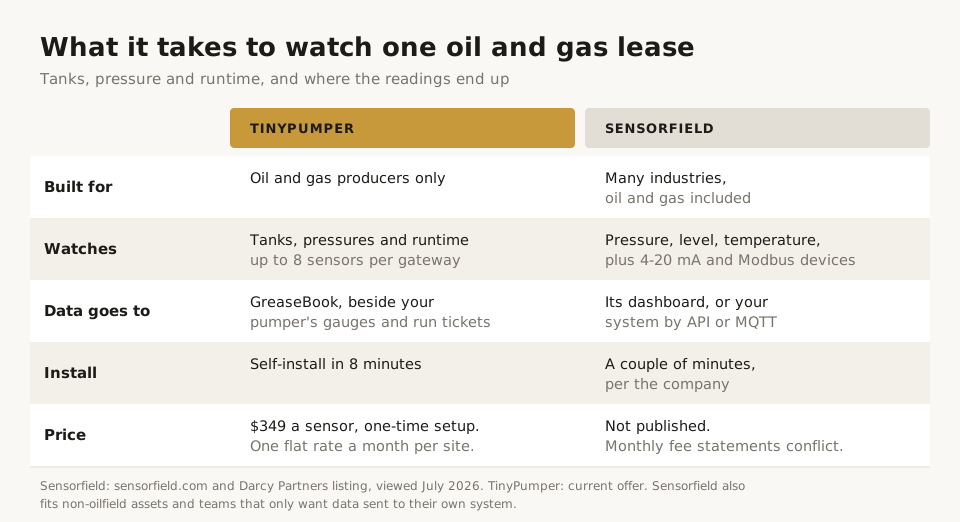
| Sensorfield | TinyPumper | |
|---|---|---|
| Who it is built for | Many industries, oil and gas included | Oil and gas producers only |
| What it watches | Pressure, level, temperature, vibration, acoustic, plus 4-20 mA and Modbus devices | Tank levels, pressures (wellhead, flowline, injection) and engine or compressor runtime |
| Where the data goes | Its dashboard, or your system by API or MQTT | Straight into GreaseBook, beside your pumper’s gauges and run tickets |
| Tank measurement | Radar level sensor | Radar on top of the tank, no fluid contact |
| Install | “A couple of minutes,” per the company | Your team self-installs in 8 minutes |
| Coverage | Transmitters reach the cloud over a cellular modem, per the company | 100% continental US coverage, because we use satellite |
| Pricing | Not published; public statements conflict on a monthly fee | $349 a sensor, one-time setup, then one flat rate a month per site, unlimited sensors |
| If it breaks | Ask the vendor | Lifetime replacement on all equipment |
| Trial | Ask the vendor | 60-day money-back, we pay return shipping |
Where a Sensorfield cell says “ask the vendor” or “not published,” its public site does not say. Ask them directly.
When Is TinyPumper the Better Fit?
- You run oil and gas wells and want the sensor’s numbers and your pumper’s numbers in one screen. Every well with a TinyPumper sensor gets free Greasebook.
- You want the lease covered without picking parts: tanks, pressures and runtime on one gateway, up to 8 sensors per gateway.
- You want alerts right away. Sensors report every hour and check your thresholds every 5 minutes, so an alarm goes out the moment a line is crossed.
- You want one price per site, not per point, so a busy tank battery does not multiply the bill.
- You have dead zones. Satellite gives 100% continental US coverage.
Producers running TinyPumper report cutting lease runs by 30 to 50 percent and catching failures days sooner. See how it fits the whole lease in our oil well monitoring systems guide and our oilfield tank monitoring guide.
TinyPumper watches tanks, pressures and runtime and feeds GreaseBook. $349 a sensor, one-time setup, then one flat rate a month per site. 60-day money-back.
See TinyPumperWhen Is Sensorfield the Better Fit?
- You monitor assets outside oil and gas, like transformers or plant equipment, and want one platform for all of them.
- You already run a system of record and only want sensor data delivered to it by API or MQTT.
- You have a lot of existing 4-20 mA or Modbus instruments and a crew to wire them.
And if you need to control the well (shut-ins, pump changes), neither one is the answer. TinyPumper watches; it doesn’t control. Look at oil and gas SCADA.
Sensorfield App, Dashboard and Login
Sensorfield readings show up in its cloud dashboard. Sign in through sensorfield.com; for a lost password or account access, contact Sensorfield directly, because we can’t reach their accounts. Its public pages don’t say whether a native Android app exists, so ask them if your crew is on Android phones.
TinyPumper readings land in GreaseBook. The GreaseBook app runs on iOS and Android, so you can check a tank from your kid’s soccer game.
What Do Sensorfield Reviews and Reddit Say?
There is not much public to go on. Its Birdeye listing showed a five-star rating on 2 reviews (Birdeye, viewed July 2026), with no review text shown. We did not find Reddit threads with real user complaints or praise. Thin reviews are not bad news, but they mean you should ask Sensorfield for two producers to call before you buy. Ask any vendor for the same, us included.
TinyPumper in Plain Facts
TinyPumper has 100% continental US coverage, because we use satellite. It takes up to 8 sensors per gateway. It comes with a 60-day money-back guarantee. Lifetime replacement covers all equipment, every sensor included. TinyPumper is GreaseBook’s sister product, and its data flows straight into the GreaseBook dashboard.
Who This Page Is Not For
This page is not for buyers monitoring non-oilfield assets, teams that only need raw sensor data sent to a system they already run, or producers who need full SCADA control. For the rest of the field, see oilfield monitoring alternatives, the Tank Sentinel alternative and the TankScan alternative.
Frequently Asked Questions
What is Sensorfield?
Sensorfield is a remote monitoring system made by a Houston company of the same name. Solar-charged transmitters connect to pressure, level, temperature and other sensors and send readings to a cloud dashboard. It started in oil and gas and now sells to many industries. It can also pass data to your own system through an open API or MQTT.
What is the best Sensorfield alternative for oil and gas?
For a producer, the best alternative is one that puts sensor readings beside the pumper’s gauges and run tickets. TinyPumper watches tanks, pressures and engine or compressor runtime on one gateway, and the data flows straight into GreaseBook. Your team self-installs it in 8 minutes, and every well with a TinyPumper sensor gets free Greasebook.
Does Sensorfield charge a monthly fee?
Its own site says there are no monthly fees. A reseller listing describes the cost of the sensor plus a monthly service fee (Darcy Partners listing, viewed July 2026). Sensorfield does not publish dollar prices, so ask for a written quote that covers hardware, any service fee and any integration work before you buy.
Is there a Sensorfield app for Android?
Sensorfield’s public pages describe a cloud dashboard but don’t say whether a native Android app exists, so ask the company before your crew relies on one. If you go with TinyPumper, readings land in GreaseBook, and the GreaseBook app runs on both iOS and Android phones, with an office dashboard for owners and engineers.
How do I log in to Sensorfield?
Sensorfield users sign in to its dashboard through sensorfield.com. We are not affiliated with Sensorfield and can’t reset passwords or open accounts, so contact the company directly for login help. If you are weighing a switch, TinyPumper readings appear in the GreaseBook dashboard on the web and in the GreaseBook phone app.
What do Sensorfield reviews say?
Public reviews are thin. Its Birdeye listing showed a five-star rating on 2 reviews (Birdeye, viewed July 2026), with no review text visible, and we found no Reddit threads from real users. Ask Sensorfield for two producer references to call. TinyPumper backs itself with a 60-day money-back guarantee, return shipping paid.