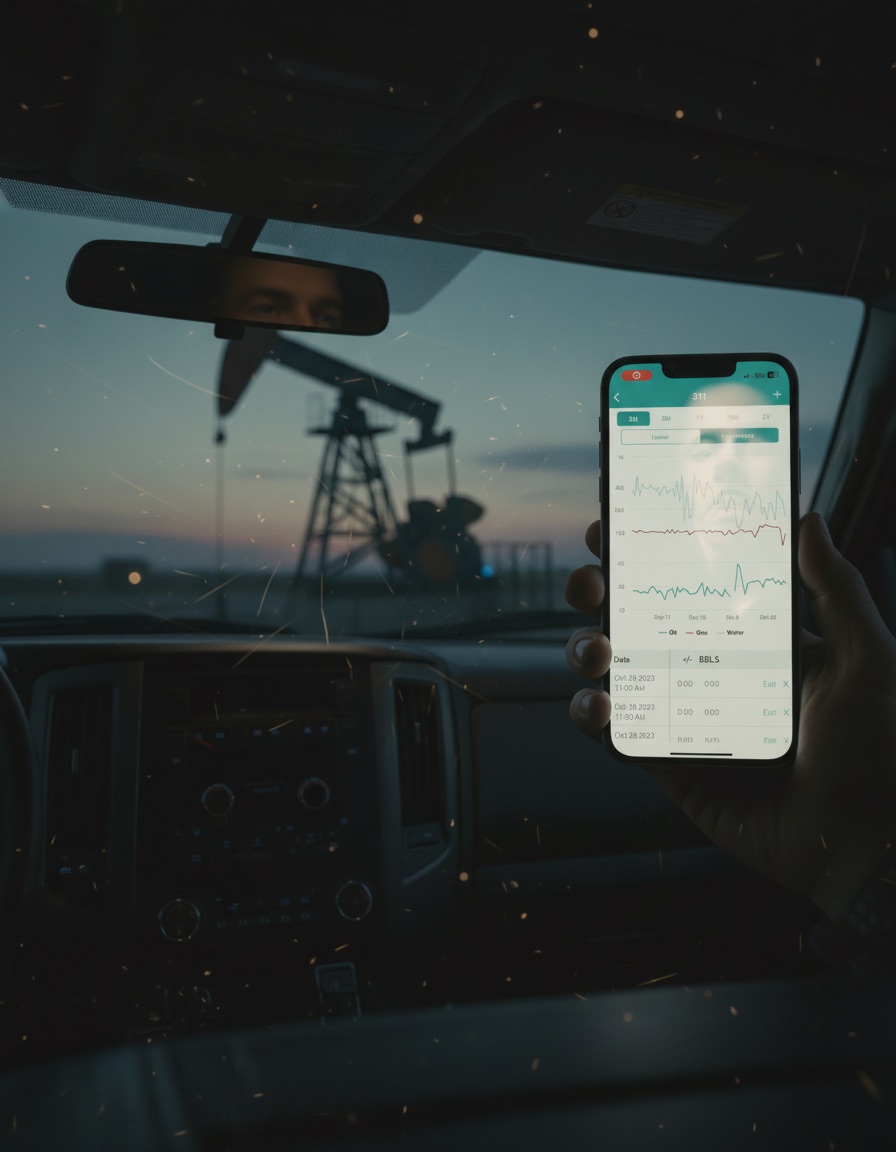
When a well goes down, your pumper doesn’t wait for any report. He calls it in from the lease, right then, and somebody’s rolling within the hour. Every operator reading this has that system, and it works. This essay isn’t about that well.
It’s about the well that didn’t go down this morning. The one that just started making a little less.
The pump’s a hair weaker than it was last month. The gauge sits a half-inch lower than it ought to. Nothing’s broken, nothing’s leaking, and there is absolutely nothing to call in, because from where your pumper stands, today looks like yesterday. He does exactly what a good hand does: writes the number in his book and moves to the next lease. The book rides around in his truck. Sometime this week the sheet makes it to the office. Sometime after that, somebody keys it into the spreadsheet, between the phones ringing and the mail. And sometime around month-end, that well’s slow slide finally surfaces as one quiet number in a column of numbers, where you may or may not notice it, depending on how the averages fall.
The paper trail is what’s supposed to catch the smoke, and it delivers it three weeks late.
And here’s the thing about those fires: almost every one of them smoldered first. The breakdown that got called in this morning had been smoking for weeks in numbers nobody could see: the pump getting weaker, the fluid coming up short, the little slide that never crossed anybody’s call-it-in threshold. The call was made the moment it burst into flame. Everything before that moment was catchable, and cheaper, and invisible. That’s the real bill the lag runs up. Not that you hear about failures late, but that you meet every failure at its most expensive stage.
Most operators I talk to are running two to three weeks behind their own field. They know it, too. Say it to them and they nod, the way you nod about the weather. It’s just how the patch has always worked: the wells live in the present, the office lives in the past, and everybody drives back and forth between the two.
I want to talk you out of treating that as weather. Because after years of watching hundreds of independent operations from the inside, I’ve come to a conclusion that sounds too simple: most producers don’t have a production problem. They have a lag problem. The wells are fine. The people are fine. It’s the when that’s bleeding them.
The month-end fire report
Think about what a production report actually is.
Every number on it is true. Every number on it is also finished. The well that started sliding on the 9th already gave up two weeks of barrels. The water cut that started creeping already climbed. The lease that quietly made less than the same stretch last month already made it. None of these ever earned a phone call, because none of them was ever an event; they were slopes, and slopes are invisible from ground level. You’re not reading intelligence. You’re reading the fire marshal’s report: what burned, when it burned, and not one thing you can still do about any of it.
A production report is a map of last month’s fires: accurate to the barrel, and too late to put a single one of them out.
And here’s the part that makes the lag so expensive: it doesn’t feel like ignorance. Stale data doesn’t look stale. It looks like data. You have numbers, columns, trends, a binder that thumps when it hits the desk. The operator with no reports at all knows he’s blind. The operator with month-old reports feels informed, and feels it right up until the run ticket comes up light.
Being informed too late is worse than being uninformed, because it comes with confidence.
How the lag got built in
Nobody chose this. The lag is just what the tools deliver.
The old way hauls information at the speed of a pickup: handwriting in the book, the book in the truck, the sheet to the office, the clerk to the spreadsheet. Four hops, each one adding days, each one adding a chance for the number to smear or vanish. The spreadsheet doesn’t fix it, either; it’s where the lag gets organized. The data still arrives by truck. Excel just gives the delay a grid to live in.
And the industry’s software upgrade kept the lag on purpose, without meaning to. Legacy production systems, overpriced and overbuilt, put the database on an office laptop and left the field exactly where it was: writing on paper, hauling it in, waiting for a clerk to key it. Or, just as often, the pumper keys it in himself at the kitchen table that night, fifty wells after the fact, trying to remember what the morning looked like. Nobody stays organized against that. Different price tag, same speed. The lag survived every generation of tools because every generation of tools lived in the office, and the news lives at the wellhead.
The lag isn’t a habit you can coach away. It’s the transportation time of the system you’re running. To kill it, the number has to stop commuting.
What the same-day operation looks like
Now picture the version where the number never rides in a truck.
The pumper gauges the tank like he always has. But the read goes in right there, standing at the well, on the phone in his shirt pocket, with his notes attached. It gets sanity-checked against that well’s own history on the spot, so a fat-fingered entry gets caught while he can still look at the gauge instead of at month-end. And it lands on your screen the same day, every well, every lease.
And then the system does the one thing paper and spreadsheets never could: it draws the slope. On a gauge sheet, a trend is forty numbers scattered across forty pages, and no human reads it. On the screen, it’s a line, and the line gets highlighted the moment it starts bending.
The pumper sees it first, standing right in front of the well, which is the best place on earth to catch a trend: the man looking at the slope is also looking at the wellhead, and he can check it, fix it, or call it in right then, while it’s still a slope. Ideally nobody else ever has to get involved. And when a trend does need more eyes, it’s on the office’s screen the same day, so the call becomes “I see the slide on that well, what are you seeing?” three weeks earlier than that call has ever been made.
Then tomorrow morning happens differently for you, too. Seven o’clock, coffee still hot, and yesterday is already in front of you. Which wells slipped, with the pumper’s note about why. Which tank is filling fast. Which lease put up a number that doesn’t fit its own line. You catch the well slipping the day it slips, not two weeks later when the deviation finally outmuscles the averages.
The unit of value here is deferred production, and the arithmetic is blunt. A slipping well doesn’t charge you for the slip. It charges you for every day nobody saw the slope. Catch it on day one and you lost a day of the difference. Catch it at month-end and you donated the month. Same well, same slide, same fix once you see it. The only variable was the lag.
And everybody in this business already knows the price schedule: catch it while it’s smoke and it’s a part and an afternoon. Let it turn into the fire and it’s a rig, a workover, and the deferred production on top. Same root cause, wildly different invoice, and the only thing that picks which one you pay is when somebody saw it coming.
That’s why I say most operations don’t have a production problem. Wells slip everywhere, for everybody, forever, and the loud failures already get phone calls. The difference between a tight operation and a leaking one is almost never the event. It’s the gap between the slope and the seeing.
Closing the gap
That gap is the entire reason GreaseBook exists. It’s the industry’s simplest production app: pumpers enter their reads on their phones at the well, and producers see their whole operation, with context, the same day. No paper riding in trucks, no re-keying, no waiting on month-end to learn what Tuesday did.
It’s been doing exactly that for 15 years, for 600+ producing companies and 10,000+ pumpers, across 220 million barrels and counting. The learning curve on the pumper side is about 8 minutes, and the setup is turnkey: our petroleum engineers build your company out for you. The operators running it aren’t smarter than their neighbors. They’re just working this morning’s field instead of last month’s.
You can keep reading last month’s fire maps. Or you can start catching smoke.
If the lag sounds like your operation, take a look at GreaseBook and take the quiz while you’re there. It runs about twenty seconds, which, for the record, is the longest delay we’re comfortable with.