
Rigzone once ran an essay of mine that the legacy software companies would love to make disappear.
The argument was simple. The industry had fallen head over heels for Big Data: massive downhole and geological datasets, cross-basin correlations, black-box models that promised to find barrels nobody else could see. My case was that everyone was staring down the wrong end of the well. The data that runs an oil company day to day, what every tank, well, and meter did yesterday, was a broken mess of paper and spreadsheets, and fixing it was worth more than any model. Forget big. Fix small.
Then it came true.
The majors sank tens of millions into data warehouses, black-box algorithms, and command centers with more screens than a frac van. Ask around: how many of the people actually running field operations trust those systems today? The consultants got paid. The “implementation phases” stretched into years. The revolution became a line item nobody brings up at the ops meeting.
And now every pitch deck in the patch has AI on it.
Hold that thought. This time the story has a twist.
The party you were supposed to feel bad about missing
If you run an independent operation, you probably remember feeling left behind. No nine-figure technology budget. No fleet of Silicon Valley consultants. No command center.
In hindsight, that was the best thing that ever happened to you.
While the big boys were pouring money into complexity, you stayed lean. They took the bait. You didn’t. Nobody ever pumped a well from a conference room, and you never had the budget to pretend otherwise.
Why Big Data went bust
Big Data came with a “measure it all” attitude. Matt Turck, a venture capitalist who tracked that industry for years, spelled out what buying in actually requires: an organization that can capture data, store data, clean data, query data, analyze data, and visualize data. All of it, seamlessly. The whole company, not just the IT guy.
If that doesn’t sound easy, it’s because it isn’t.
Here’s what happened instead. Companies piled up billions of data points: seismic traces, petrophysical logs, decades of well files, cross-basin production histories. The importance of any single point got lost. Coincidences got promoted to cause and effect. Teams chased “trends” that turned out to be an artifact in the data or a typo in a forty-year-old well file. Expensive wild goose chases, dressed up in charts.
And because the data set was big instead of small, it got crunched by somebody else’s proprietary model. That lends a veneer of objectivity. It also means nobody can question the output. The model says the acreage is worth twice what your engineer thinks. Why? The model doesn’t say.
A retired geologist recently told me about his years at one of the larger independents. When the Big Data wave hit, the company stood up a whole new team with a new office layout: exploration and development in weekly scrum meetings, post-it notes on the walls, new hires brought in to speed up prospect generation. They bought tools to automate seismic and petrographic interpretation and to model predrill resource distributions. The best thing to come out of it, by his telling, was a model that used in-house subsurface maps to value acreage for purchase. The values came back inflated. The team was eventually disbanded.
That story repeats at company after company, and the moral is always the same.
The wrong end of the well
Here’s the part that made them maddest: while the industry aimed its smartest tools two miles down the hole, the questions that decide money every single day went begging at the surface. What did every well make yesterday? Which one is down right now? Did the load get hauled, and does the run ticket match the tank? Your pumper missing one down well will cost you more than any dataset you’ll ever buy.
And how was that surface data traveling, all through the Big Data decade? Paper gauge sheets. Spreadsheets nobody trusted. Legacy production software parked on an office laptop, waiting for a clerk to feed it. The most instrumented industry on earth was steering its day-to-day operation on numbers that arrived two weeks late, when they arrived at all.
That was the real argument. The highest-ROI dataset in the company wasn’t two miles down. It was riding around the lease in a pumper’s shirt pocket, and it was broken. Because every dashboard ever sold to this industry sits downstream of the same ten seconds: the moment right after the pumper gauges the tank, while the number is still fresh in his mind. Entered there, on the spot, it’s data. Saved for a kitchen table that night, after a fifty-well route, it’s a memory doing an impression of data. And everything built on top of a memory is fiction with good graphics.
And numbers without context aren’t much better than no numbers at all. You can poll a tank every thirty seconds and still not know why the level dropped at midnight. Was it a sale? A spill? Did somebody pull bottoms? The sensor can’t tell you. The pumper can.
The run ticket, the downtime note, the “treater’s acting up again”: that context is what turns a reading into information. He’s also the one who notices a vac truck driver skimming, or a gauge sheet that got pencil-whipped (numbers written from the truck, not the tank). Obvious to a human. Invisible to any algorithm. Strip that out and you don’t have data. You have noise at scale.
Now, about AI
Here’s where I’m supposed to tell you AI is Big Data all over again. Another buzzword, another bust on the way.
I won’t, because it isn’t. Big Data was a marketing term. AI is a tool, and it’s a real one. It’s already reading logs, catching failure patterns, and answering in seconds what used to cost an engineer a weekend. Anyone telling you it’s all hype is going to be wrong in a way they don’t recover from.
But AI has two hard limits in the oil patch, and nobody selling it mentions either one.
First, AI can only reason over what got captured. It can’t know the treater was acting up if nobody wrote it down. And feed it swamp data and it doesn’t get confused. It gets confident.
Second, AI has no hands. It can’t gauge a tank, thaw a valve, or swap a polish rod. Every insight it ever produces has to be carried out by a human being standing on location. In this industry, that human has a name: your pumper.
So the machine’s eyes and the machine’s hands turn out to be the same person the Big Data crowd spent a decade trying to engineer around. That’s the twist. AI doesn’t replace the pumper. AI makes the pumper the most important data source and the most important actor in your company.
Where AI actually belongs
There’s an order of operations, and it doesn’t start with a subscription.
First, get the workflow between your field and your office straight. One way to capture reads. One place they land. Same day.
Second, make capture so simple it actually happens: every well, every day, by the person standing there, with their notes attached. And before anyone objects that a man can fat-finger a phone as easily as a gauge sheet: this is exactly where the phone earns its keep. It sanity-checks every read against that well’s own history the moment it’s entered, and anything that doesn’t make sense gets flagged while the pumper is still standing at the tank. Paper accepts anything. A spreadsheet accepts anything. The phone asks questions. Quality control happens at the source, or it doesn’t happen at all.
Third, once the lifeblood of your operation lives in one clean, centralized place, wire in the rest: equipment, runtimes, pressures, whatever else talks. That’s the layer where AI earns its keep, cross-referencing all of it and surfacing context no one person could hold in their head.
Fourth, close the loop. AI’s suggestion rides back out to the field, and the pumper puts it to work.
AI belongs on top of the stack. Not instead of it.
And one more thing the pitch decks won’t tell you: AI can’t backfill your history. A gauge sheet that didn’t get captured today is gone for good. The operators who’ll get the most out of AI five years from now are the ones stacking clean field data now. Every day your operation runs on paper, scattered spreadsheets, or a legacy production system nobody trusts is a day the smartest tool ever built will never be able to use.
What the winners are doing
The operators who came out of the last hype cycle ahead didn’t build command centers. They did something almost embarrassingly simple: they fixed capture.
Not Big Data. And not the other so-called upgrade either: the legacy production suite, overpriced and overbuilt, living on an office laptop, waiting for a clerk to feed it. The right data. Yesterday’s tank levels, run tickets, downtime, and well tests, entered once, in the field, on the phone the pumper already carries, and visible to everyone who needs them by morning coffee.
Picture it: seven in the morning, coffee still hot, and yesterday is already on your phone. Every lease, every tank, every note, before the office lights come on.
And the same ten seconds work in reverse. A well acting up is best handled by the man already standing in front of it, and when he has that well’s whole history and production in his pocket, that’s exactly what happens: pressure trending down, last month’s fix right there in the notes, problem reported and handled on the spot. Not two days later, after a supervisor calls to ask whether anybody noticed.
Do that, and anomalies stop hiding. You don’t need a proprietary model to spot a well that’s off trend when the numbers are current, complete, and carry the pumper’s notes. A sharp operator reading clean small data will out-diagnose a black box reading a swamp, every time. And it works the same whether you run five wells or five thousand.
It was workflow. The field knew things the office found out too late, or never. Software only works in this industry when it starts with the human element. Skip that, and you’re funding the next round of case studies in what not to do.
Smart oil runs on small data
That argument is the entire reason GreaseBook exists. It isn’t artificial intelligence and it isn’t a command center. It’s the industry’s simplest production app: pumpers gauge their tanks and enter reads on their phones, and producers see their whole operation, with context, the same day. Rollouts stick about 98% of the time. Not because the software is clever, but because there’s almost nothing to learn. Our onboarding record is an 85-year-old pumper who refuses to retire, start to finish in about eight minutes.
The era of smart oil won’t belong to the biggest budget. It’ll belong to whoever holds the truest picture of what their wells actually did yesterday. When the AI wave gets cheap enough for the independent (and it will), that picture is the price of admission.
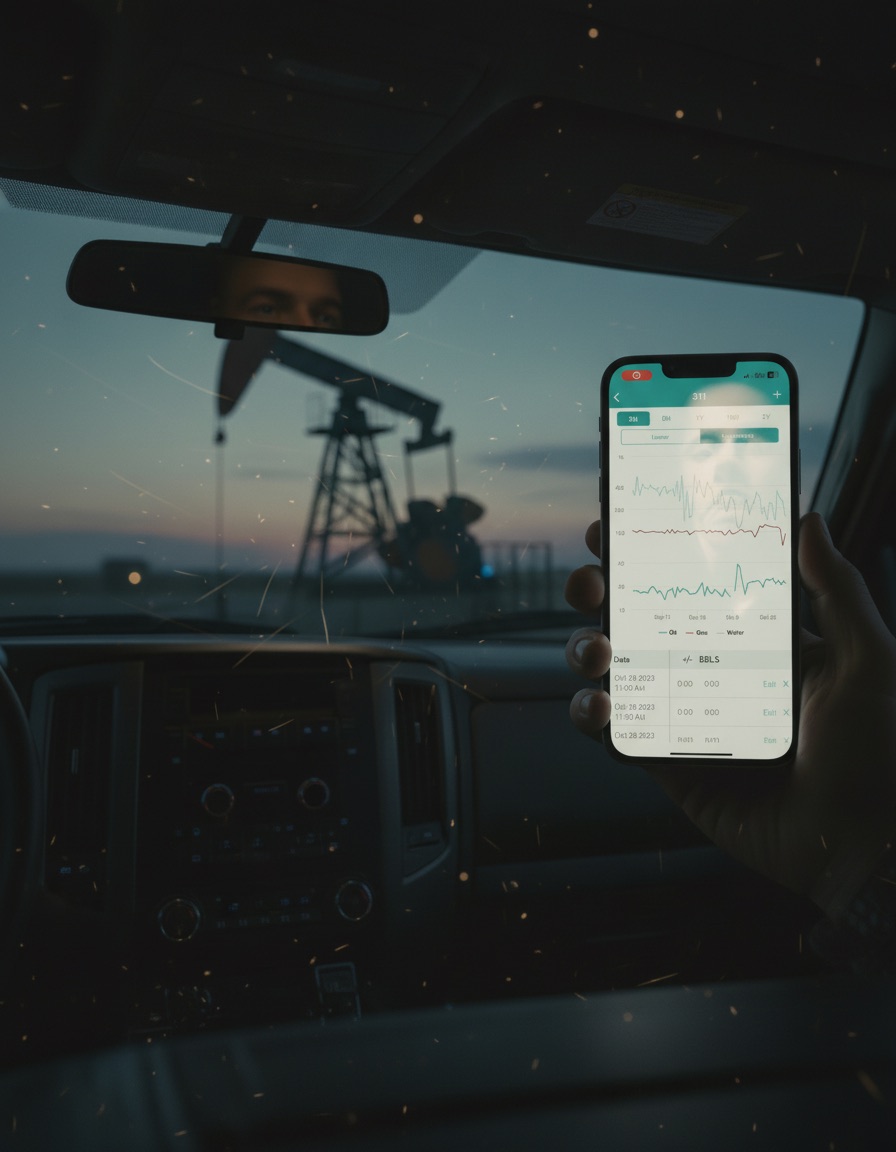
You can keep running on the swamp while the tools get smarter. Or you can get the first ten seconds right, starting tomorrow morning.
If you’re curious what that looks like, take a look at GreaseBook and take the quiz while you’re there. It runs about twenty seconds. Shorter than a safety meeting, and nobody makes you sign anything.
An earlier version of this essay was published on Rigzone. Rigzone name and logo are the property of Rigzone.com, Inc.; used here to identify the original place of publication.